Error Clustering Analysis Across a Class Set of FRQs
Teachers can uncover why students struggle by sorting errors instead of just tallying scores.
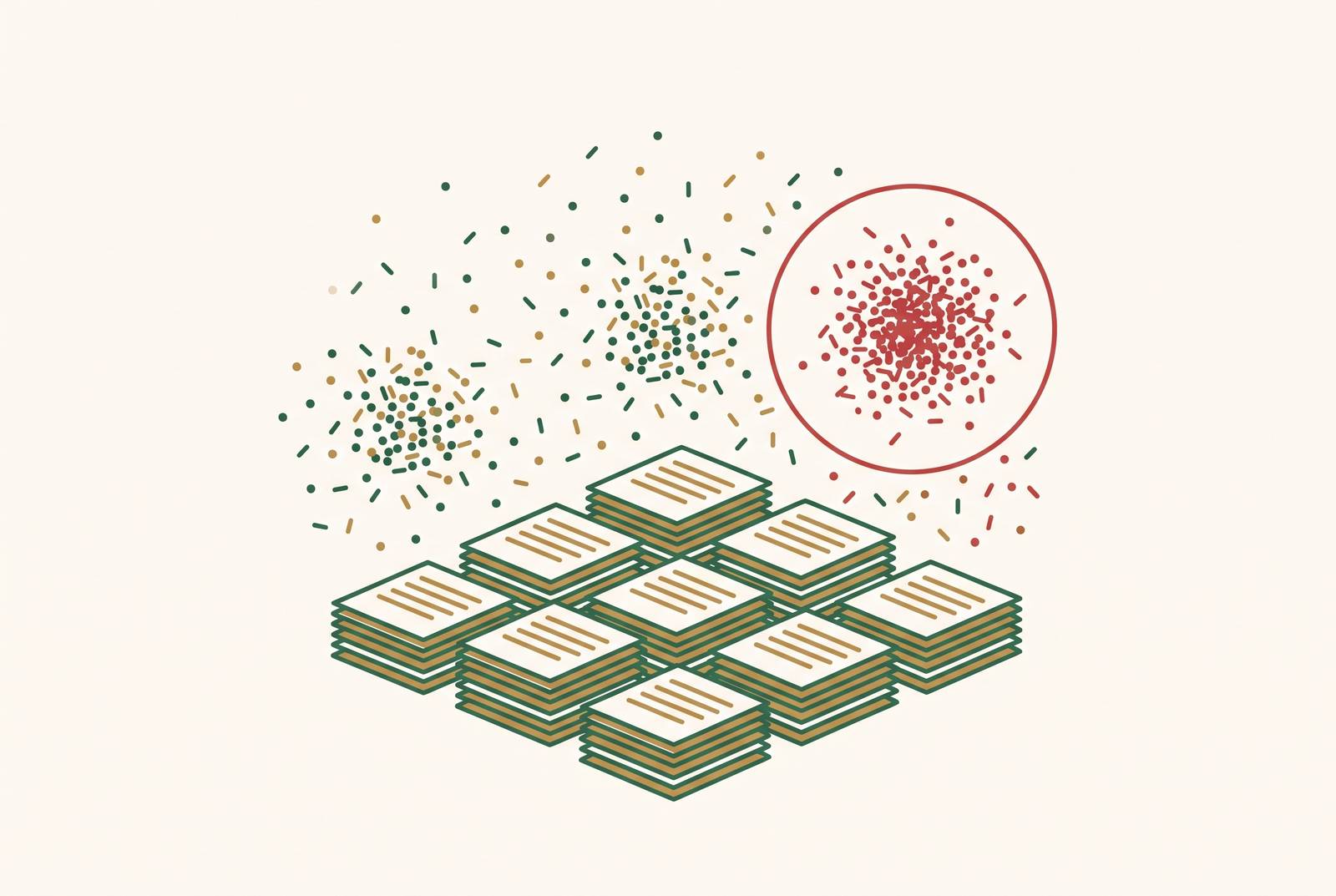
A stack of 30 graded FRQs holds two different stories. One is the score list: who got a 6, who got a 2. The other is buried underneath, and most teachers never dig for it. That second story is about why the scores landed where they did, and whether ten students who struggled struggled for the same reason or ten different ones. Error clustering analysis is the method for pulling that second story out into the open.
Score distributions are useful, but they're a summary, not a diagnosis. A low class average tells a teacher the class had a rough time. It does not say whether that roughness came from a shared misconception, a shaky procedure, or students simply answering the wrong question. Without that distinction, a teacher is stuck making one of two expensive guesses: reteach the whole unit when only one idea was broken, or move on when a wrong idea is still sitting active in most of the room.
FRQs are actually the best kind of assessment for catching this, because they're open-ended and multi-step. A multiple-choice question hides the reasoning. An FRQ leaves a paper trail of exactly how understanding fell apart, step by step, if someone reads it that way. The shift this requires is small but real: stop asking "how did each student do," and start asking "where does this class's understanding break down, and what do those breakdowns have in common?"
What error clustering analysis actually is, and what it is not
Error clustering means grouping responses by the way they failed, not by the score they earned. The unit being analyzed isn't the student. It's the error. A cluster is a pile of responses that broke down in the same place, for the same reason.
That's a different question than rubric scoring asks. Rubric scoring asks, "did this response earn the point?" Error clustering asks, "why didn't it, and who else in the room made that exact same move?"
At the research level, this idea has a computational version. Lan et al. at Rice University (L@S, 2015) built frameworks that convert open responses into features, cluster those features, and use the cluster to assign both a score and feedback. Their method surfaces the actual structure of correct, partially correct, and incorrect solutions, not just a pass/fail line.
None of that requires software to matter in a classroom, though. A teacher sorting a physical stack of papers into piles by error type, instead of by grade, is doing the same thing by hand.
One distinction has to survive the sorting, or the whole exercise turns mushy: error type versus error depth. Type is what went wrong (conceptual, procedural, misreading the prompt). Depth is how deep the misunderstanding runs. A cluster analysis mixes these up if it isn't careful, and that's worth guarding against from the start.
And to be clear about the limits: clustering doesn't replace individual feedback. It's a class-level diagnostic. It tells a teacher where to aim the next lesson, not what to write in the margin of any one paper.
A working taxonomy of FRQ error types drawn from AP Chief Reader data
The largest public record of class-level FRQ error analysis comes from the AP Chief Reader Reports, published annually. The 2024 cycle covered a range of subjects including Biology, Calculus AB/BC, Precalculus, Environmental Science, Chemistry, English Language, and others. Read across them, and five clusters show up again and again.
Task-verb errors: the student knows the content but answers the wrong cognitive demand: describes when the prompt asked for a justification, identifies when it asked for an explanation. AP Biology's 2024 report flagged this directly. It's worth sitting with that for a second, because it means many of these aren't content gaps at all. They're execution errors dressed up as content errors.
Conceptual misunderstanding: the student is working from an incorrect or incomplete model. AP Psychology saw students conflate random selection with random assignment, two ideas that sound alike but do very different jobs in an experiment. AP Comparative Government saw students classify voting as a civil liberty rather than a civil right. AP Chemistry saw students struggle with titration concepts, as reflected in the low mean score on Question 1.
Prompt-drift errors: the student answers a real question, just not the one that was asked. AP Environmental Science 2024 documented this clearly: two short paragraphs buried in the prompt were essential to answering certain stems, and a large share of students skipped right past them.
Evidence and reasoning incompleteness: the student names the right concept but never explains the mechanism behind it. AP Environmental Science 2024 again gives the clean example: responses that said "forest A is a control" and stopped there, earning zero points, because naming the term isn't the same as explaining what it does.
Procedural or computational errors: the method is right, the execution isn't. AP Calculus AB 2024 flagged students making variable-substitution errors, plugging in incorrect values where the problem called for specific ones. AP Computer Science A 2024 flagged students removing elements while iterating forward through an ArrayList, which causes index drift, a bug with a name and a fix.
These five types are not equally fixable, and that's the whole point of building the taxonomy in the first place. Task-verb and prompt-drift errors often clear up fast with targeted practice. Conceptual misunderstanding takes longer, because the model in the student's head has to be rebuilt, not just corrected at the margins.
The real value of having this taxonomy going in is that a teacher can code responses while grading, instead of rereading the whole stack afterward looking for patterns.
How to read a class set for clusters: the sorting process step by step
Step 1: Annotate while grading, not after. Mark each response with a short code as it's scored: T for task-verb, C for conceptual, D for drift, R for reasoning incomplete, P for procedural. Don't wait to reread everything later.
Step 2: Sort by question part, not by student. FRQ sub-parts are semi-independent. A student can be squarely in the conceptual cluster on part (a) and squarely in the task-verb cluster on part (c). Mixing those together by student blurs the signal.
Step 3: Tally cluster frequency per sub-part. A tally sheet, sub-part down one side, error type across the top, shows immediately which clusters are one-off flukes and which are class-wide.
Step 4 involves inspecting the cluster's contents. Pull two or three responses from the biggest cluster and actually read them side by side. Are they making the identical mistake, or did two different errors just get filed under the same label by accident?
Step 5: Separate prevalence from severity. A cluster shared by 70% of the class points to a curriculum gap. But a cluster held by only 15% of the class might reflect something more serious, like a reversed cause-and-effect relationship, and that deserves just as much attention even though fewer hands are raised.
What comes out the other end is a cluster map: a one-page summary of which errors showed up on which sub-parts, and how many students landed in each. That's the document that should drive whatever happens next.
AP Chemistry 2024 offers a good anchor for why this matters. The mean score on Question 1, covering titrations and calorimetry, was 4.43 out of 10. That number alone says almost nothing. Its meaning only shows up once someone knows whether the gap lives in procedure, in the underlying buffer chemistry concept, or in students misreading what the question asked.
What the clusters look like in practice across different AP subjects
The pattern shows up differently depending on the subject, which is exactly what makes it worth checking against the taxonomy each time.
AP English Language (2024): the synthesis FRQ rewarded essays built around a conceptual line of reasoning. A recurring error cluster produced responses that were formulaic rather than rhetorical, prioritizing structure over argument. This is a reasoning-completeness error.
In AP Precalculus (2024 and 2025), both years' Chief Reader Reports flagged the exact same pattern around the task verbs "explain," "give a reason," "provide a rationale," "justify." Students could do the math. They couldn't put the reasoning into words. That this showed up two years running, not once, is itself a signal worth returning to later.
AP Psychology (2023) included a no-contradiction rule in its scoring guideline: if a response gave a correct answer alongside multiple incorrect answers tied to the same concept, it earned no point. That's a subtle but important cluster, because it catches students who understand part of an idea but can't discriminate the right piece from the wrong one.
In AP Computer Science A (2024), a notable cluster of students removed elements while iterating forward through an ArrayList, which causes index drift. This is about as clean as a procedural cluster gets: one cause, one fix (iterate backward, or adjust the index counter manually).
In AP Calculus AB/BC (2024), students were strong at the calculator work, finding definite integrals and derivatives at a point. But a distinct cluster formed the moment the question asked what those values actually meant in context. Chief Reader Julie Clark of Hollins University pointed to this directly: understanding how derivatives and integrals build meaning in context is its own skill, separate from computing them.
Across every one of these subjects, the reasoning-incompleteness cluster shows up the most, and it's also the easiest to act on. It doesn't require rebuilding content knowledge. It requires teaching what a complete explanation actually looks like on the page.
Why some error clusters persist year over year and what that means for instruction
AP Precalculus makes the clearest case for why persistence matters. A task-verb cluster around justification and explanation got flagged in both the 2024 and 2025 Chief Reader Reports. Not a similar issue. The same one, essentially restated.
That raises a fair question: what does it mean when an error shows up two years in a row? At that point, it's stopped being an assessment finding and become a curriculum finding. The concept was taught. It just wasn't taught in a way that transfers to open-response reasoning under exam pressure.
The distinction changes how a teacher should respond. A cluster that shows up once might just mean an odd cohort, or a unit taught during a rough stretch of the semester. A cluster that keeps showing up points to something structural, baked into how the concept gets introduced, practiced, or checked for understanding all year long.
AP Biology's cluster around writing complete explanations, flagged in 2024, tells the same story. Students practice the content. They rarely practice the specific act of putting their reasoning into full sentences before the exam actually asks them to.
There's a practical payoff here too. When a teacher's own cluster map matches a pattern already named in a Chief Reader Report, that connects a classroom-level decision to a gap observed at a national scale, and the remediation advice attached to it (like using sample question banks, or having students revise an insufficient response) becomes something that's already been tested and written down, not something a teacher has to invent from scratch.
How the remediation response should match the cluster type
The error type should decide the intervention. The score shouldn't.
A class clustered around task-verb errors needs to see what a complete "justify" response actually looks like on the page. The AP Precalculus Chief Reader Report makes this same recommendation directly: hand students a response with insufficient reasoning and have them improve it.
A class clustered around reasoning incompleteness needs the full explanation chain modeled out loud. Show two responses that earned the same content credit, but only one earned the reasoning point, and ask students to find the difference.
A class clustered around conceptual misunderstanding needs the specific model rebuilt, not a review of the whole unit. A conceptual mix-up of that kind needs one focused lesson on the specific distinction. It doesn't need a full unit review.
A class clustered around procedural errors needs worked-example correction. A procedural iteration bug of that kind has a specific fix, and students who made that mistake get the most out of tracing through the error line by line, watching exactly where it goes wrong.
The cluster map from the sorting step is what makes this planning possible in the first place. It tells a teacher how many students need which kind of response, and whether that calls for a whole-class lesson or a small pull-out group.
One habit worth dropping is assigning more problems of the same type to fix a conceptual or task-verb cluster. That doesn't fix anything. It just reinforces the same wrong idea at higher volume. The cluster analysis is precisely what exposes that difference before the extra worksheets get handed out.
Where AI-assisted grading accelerates the clustering process without replacing teacher judgment
Sorting one class set of 30 responses by hand is doable. Sorting across five sections, multiple FRQs, or a whole department's worth of papers is not, not on a teacher's actual schedule. That's where AI grading tools earn a real place in the process.
The k-means approach assigns the same score and feedback across responses grouped in a cluster, where clusters represent groups performing similarly relative to the model answer. It's the same underlying logic as sorting a paper stack into piles, just done at a scale no single teacher could manage by hand.
The accuracy question is worth being specific about. A 2025 study in MDPI Applied Sciences compared LLaMA 3.2 and GPT-4o against human graders on 207 responses and found GPT-4o reached statistical equivalence with human grading across a range of question types. A 2025 FTC conference paper found large language models are particularly strong in STEM domains where the rubric is clear-cut. A randomized controlled trial across four undergraduate political science courses, involving 271 students, 26 tests, and 3,080 short-answer responses, found 88% of responses graded with AI assistance, showing this works at real classroom scale, not just in a lab.
Where AI and human graders disagree is worth knowing too. In one analysis, close to half of the disagreements came down to interpretive judgment calls, like whether a small notational slip should cost a point. Roughly a fifth (22.7%) were plain oversights on the AI's part. A smaller share involved students using a valid method the rubric simply hadn't anticipated. These are exactly the spots where a teacher's judgment still matters and can't be automated away.
There's a real limit here too, and it's worth naming plainly. On the MathCCS benchmark, built specifically to test error diagnosis and feedback, none of the leading models evaluated, including GPT-4o and Claude-3.5-Sonnet, broke 30% accuracy on classifying the error type, and their suggested fixes scored below 4 out of 10 on average. Scoring a response correctly and diagnosing why it went wrong are two different skills, and right now, the gap between them is wide. That gap is exactly why teacher review still matters in this workflow, not a nice-to-have on top of it.
The workflow that makes sense, then, is AI first, human final: let the tool sort and code responses into candidate clusters, then have the teacher check the most crowded clusters, settle the edge cases, and turn the resulting map into an actual lesson plan.
Passionfruit's AI-powered grading sits at exactly this layer. It runs unlimited practice problems with AI feedback built to track not just what a student got wrong, but where the thinking itself broke down, giving teachers a running cluster map in real time instead of waiting for one big FRQ at the end of a unit to reveal it all at once.
What a teacher does with the cluster map after the grading is done
The cluster map is, at bottom, a prioritization tool. It answers a concrete question, "where do the next two class days go?", with actual evidence instead of a gut call.
If a cluster shows up in the majority of responses on a given sub-part, that calls for a shared lesson before any graded papers go back to students. Handing back scored FRQs without fixing the shared misunderstanding first means students read feedback they don't yet have the conceptual footing to use.
If a cluster shows up in a smaller but still meaningful slice of the class, that's the basis for a pull-out group or a differentiated practice set. The students stuck in a conceptual cluster on one sub-part might be perfectly solid on procedure, and need a completely different kind of help than the students stuck in a reasoning-completeness cluster on the very same question.
Either way, the map is what turns a stack of graded papers into an actual plan, rather than a pile of scores everyone quietly moves on from.