Identifying the Difference Between a Content Gap and a Test-Taking Skills Gap
Knowing which gap is costing points changes what you actually need to fix.
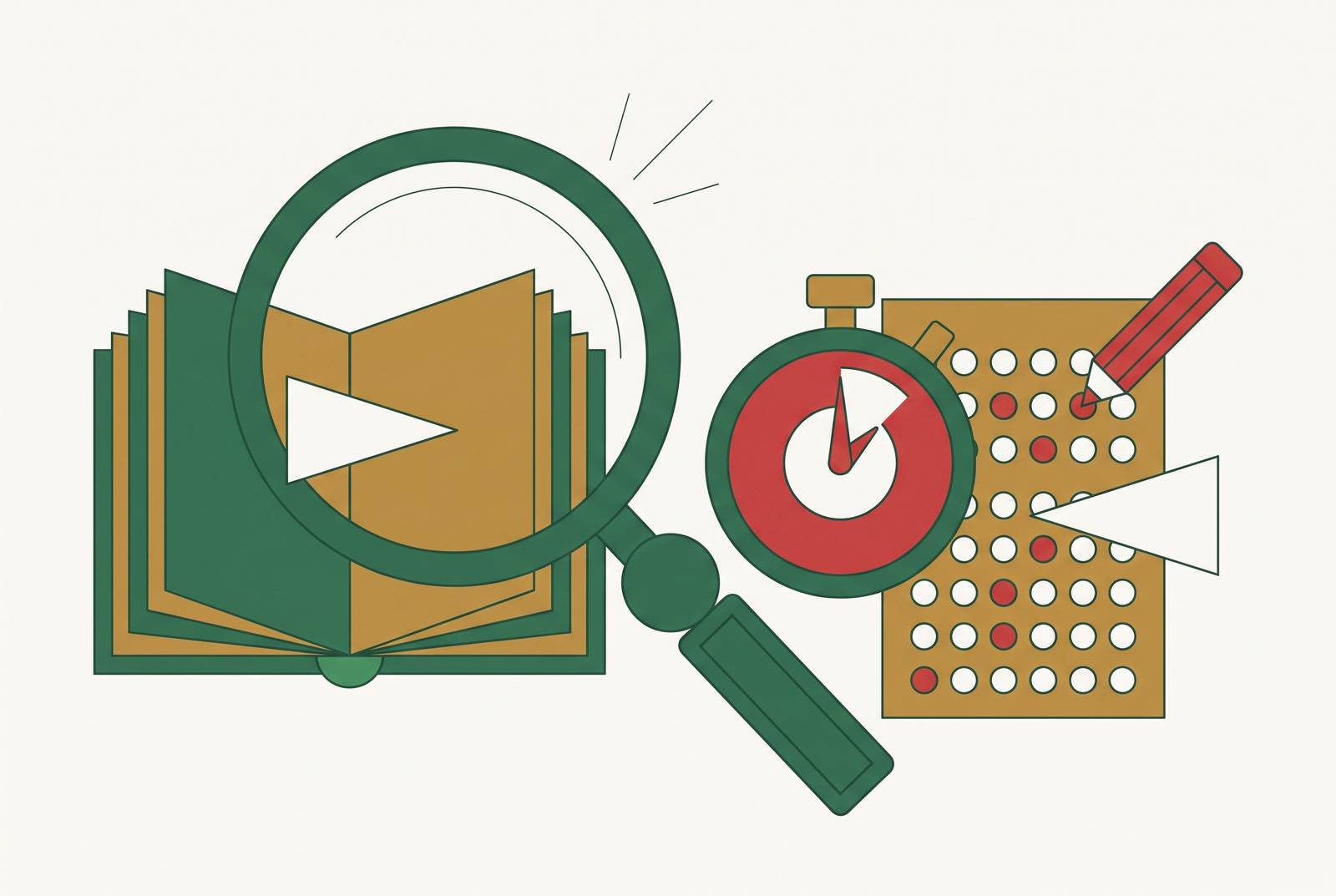
A student can put in real hours, finish every assignment, and still watch a score sit flat. The reason almost always traces back to one thing: the student fixed the wrong problem, because nobody correctly identified which gap was actually costing them points. A content gap and a skills gap are the two root causes behind most stalled scores. A content gap means the student doesn't know the material. A skills gap means the student knows the material but can't perform under the exam's specific demands. Mix those up, and the fix a student applies will miss the actual target.
A junior juggling AP Biology, AP Calculus BC, and AP US History at the same time makes the case. She poured most of her study hours into Biology, because it felt like the hardest class on her schedule. Her January diagnostics told a different story: a 4 in Bio, a 2 in APUSH, and a 3 in Calc BC. The subject that felt hardest wasn't where her biggest gap actually lived.
That mismatch is the whole argument in miniature. Subjective difficulty and objective gap type are two separate measurements, and confusing them sends limited study hours to the wrong place. A student can be working hard and still be working on the wrong thing, and the rest of this piece is about building a process that catches that mismatch before it costs a student months of misdirected effort.
What a content gap is
A content gap is a failure of knowledge acquisition. The student hasn't learned the concept, fact, or procedure the question is testing, full stop.
AP exams are where content gaps do the most damage, because AP exams test subject mastery rather than general reasoning. A student who never fully absorbed material from a September unit is carrying that hole forward, and by May it's compounded with every other unit built on top of it.
AP US History shows this clearly. The APUSH free-response section, which combines Short Answer Questions, the Document-Based Question, and the Long Essay Question, makes up roughly 60% of the total score, with the DBQ carrying a particularly heavy individual weight. A student who sits down to write a DBQ and simply can't recall the historical facts needed to build an argument has a content gap. No amount of essay-structure coaching fixes a missing fact.
Content gaps also behave in a specific, almost mechanical way over time. A student who starts AP prep in April has already lost a meaningful chunk of what got taught back in September and October. Memory fades on its own schedule, and an early content gap doesn't stay the same size. It widens on its own unless a student deliberately revisits that material before it's needed again.
The SAT and Test-Taking Skills Gaps
A skills gap looks different. The student has already learned the material. What fails is the application of it: pacing, strategy, or the executive function needed to perform under the exam's specific conditions.
This appears most on the SAT. Its central challenge isn't content at all, it's time management and pacing. The SAT's primary challenge is time management and pacing: a student probably knows enough content to score well, because knowing content and performing it under timed digital conditions are completely different skills. That distinction means a student can ace a review session and still underperform on test day for reasons that have nothing to do with knowledge.
The digital SAT's adaptive format makes this sharper. A student who has never trained under the pressure of Module 1 determining how hard Module 2 will be hasn't built the stamina or pacing instincts the format demands, even with solid content knowledge underneath. Strategy, timing, and the ability to read a tricky question correctly under pressure are core to SAT performance in a way they simply are not on AP exams, which lean much harder on content mastery.
It shouldn't. Skills gaps can look exactly like content gaps from the outside, and the next section addresses how to tell them apart.
The communication error, a third category most common on AP FRQs
A simple content-versus-skills split is useful but incomplete. A student who fails to explain enzyme inhibition correctly on an AP Biology free-response question could have a content gap, an application gap, a communication gap, or a timing gap, and each one needs a different fix.
AP Physics 1 makes the case most clearly. Students underperform there because the exam tests applied reasoning across four standardized free-response types: mathematical routines, translation between representations, experimental design and analysis, and qualitative-quantitative translation. These were redesigned in 2025 specifically to remove the old paragraph-response requirement. Generic content review doesn't touch any of that. A student can know every formula in the unit and still lose points because they never practiced translating between a graph and an equation under exam conditions.
AP US History runs the same pattern from a different angle. A student who has memorized every date and name but never practiced building an argument from documents will often think their problem is content, but their problem is actually the DBQ's required structure. The DBQ requires a specific structure, using evidence to support a claim in a particular way, and that structure has to be practiced on its own, separately from memorizing facts.
That might sound like more to keep track of, but it's actually a sharper lens, not a heavier one. Knowing the fuller taxonomy is what makes a diagnostic process actually useful instead of just a label applied after the fact.
How to tell which gap you have
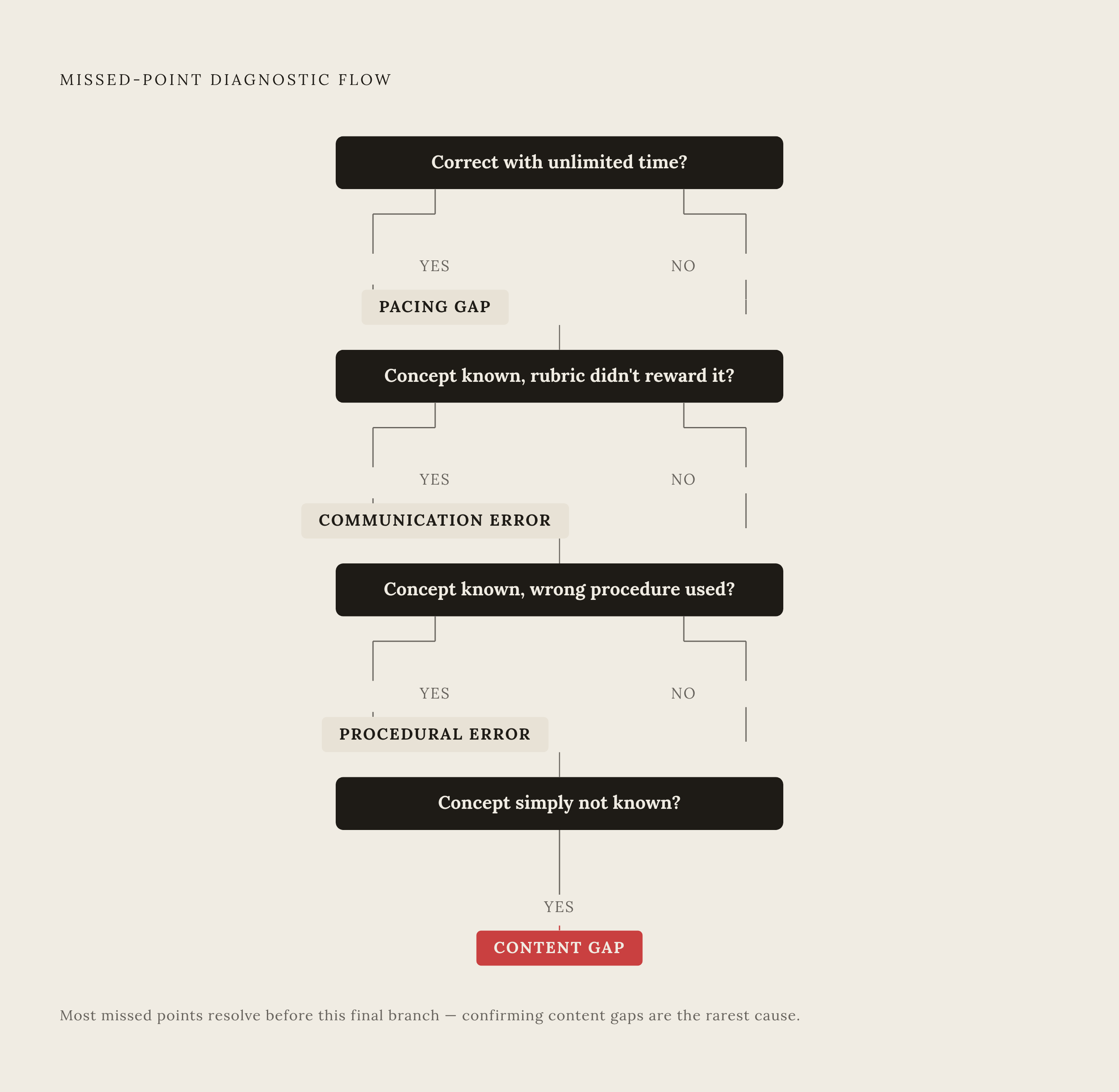
Figuring out which gap is actually in play takes more than glancing back at missed questions. It means logging error type consistently, across multiple practice sessions, so a pattern becomes visible instead of a one-off mistake.
For AP subjects like chemistry, a two-axis approach works well: track errors by unit and by practice skill at the same time, so a student can see not just which unit is weak but whether the weakness repeats across units, which points toward a skills problem rather than a content one. A diagnostic that starts with a full-length, timed practice exam gives a far more honest picture than a chapter review, because it reveals current performance under conditions that actually resemble the real test, and it identifies which specific areas need focused attention.
For SAT prep, a weekly error log that categorizes every mistake as careless error, content gap, timing issue, or misreading is the foundational tool. A student should sit with each mistake long enough to understand why it happened.
A short set of questions, asked after every missed point, does most of the diagnostic work. Ask first whether the question would have been answered correctly given unlimited time. If yes, the issue is pacing or executive function. Ask next whether the concept was understood but expressed in a way the rubric didn't reward, which marks a communication error. Ask whether the concept was understood but the wrong procedure got applied, which points to an application or procedural error. And ask, last, whether the underlying concept simply wasn't known, which is the one case that actually confirms a content gap.
The SAT offers one more diagnostic signal that's easy to miss: the gap between practice scores and real test scores. That gap usually comes from a mismatch between the practice materials used and what the actual exam demands. The material was never the problem. The format was.
Why 2026 AP changes make skills-gap diagnosis more urgent
Two structural changes to the AP program make all of this harder to ignore. First, additional AP FRQs are now restricted to AP Classroom and controlled by teachers, after most of the large public archives were removed as of summer 2025, though the three most recent years of FRQs are still available publicly. Students who used to comb through old FRQs to spot their own communication errors and rubric blind spots have lost a big piece of that self-diagnostic process, and now depend more heavily on teacher-guided review or dedicated diagnostic tools.
Second, AP Physics 1 cut its multiple-choice section down and replaced the old mixed FRQ format with the four standardized types mentioned earlier, dropping the standalone paragraph-response type even though written reasoning still lives inside the new formats. More time per question should shrink pure pacing problems. At the same time, the new FRQ types are built to expose skill gaps more precisely, so a student who used to blame the clock for lost points may discover the real issue was always the quality of their explanations.
For teachers, the archive restriction turns gap detection into a core classroom responsibility rather than something students could once handle largely on their own. Sorting out which students have a content gap and which have a communication gap now falls more squarely on the teacher, which raises the value of a structured diagnostic process rather than an informal one.
Applying the right remedy once the gap is correctly identified
None of this diagnostic work matters unless it changes what happens next. Getting the label right and then applying a generic study plan anyway just moves the same failure to the next practice test.
Content gaps on AP exams respond to backward planning, not cramming. An approach built around an AP audit worksheet, mapping every major unit since September, honestly rating retention on each one, and spreading review across the weeks that remain, works far better than compressing a year of material into April. The units a student has genuinely forgotten need several review passes spaced out over time; the ones still fresh need a single refresh. The schedule should follow the real retention map, not an equal slice of time for every unit.
Communication errors on AP free-response questions need a different remedy entirely. Rubric literacy, not more content, closes this gap. A student needs to practice writing answers that match the specific language and structure a rubric rewards. AP content functions as the raw material, but the score usually comes down to how that material gets used on the page, so explanation practice (not additional facts) is what actually moves the needle.
Skills gaps on the SAT need timed practice under conditions that resemble the real thing, section-by-section pacing drills, and deliberate practice at skipping and returning to hard questions strategically. Static PDF practice sets miss the adaptive jump between Module 1 and Module 2, the one thing that makes the digital SAT hard. Training for that specific jump is its own skill, separate from content knowledge, and it has to be practiced in a format that actually reproduces the pressure. Running content drills to fix a pacing problem, or running pacing drills to fix a missing concept, wastes the exact weeks a student doesn't have to spare.
AI diagnostic tools and teacher-facing analytics in gap detection
Spotting the right gap by hand, one practice test at a time, asks a lot of any student or teacher. It takes consistent logging, honest self-assessment, and enough pattern recognition across sessions to see what a single test can't show on its own.
Software built specifically to track error types across practice sessions can do that pattern-matching automatically, flagging whether a student's missed points cluster around a single unit (a content signal) or spread evenly across units while clustering around a single question type (a skills or communication signal). For teachers facing a shrinking supply of public FRQ archives, that kind of automated error-tagging matters even more, since the self-diagnostic tool students used to rely on independently is no longer there for them to use on their own.
None of that replaces the underlying diagnostic logic laid out above. A tool can tag an error as a pacing issue or a content miss, but the categories it's sorting into are the same five described earlier: content, application, communication, procedural, and time management. What changes is speed and scale. A process that used to take a student weeks of manual error-logging can now surface the same pattern after a handful of practice sessions, which matters most for students and teachers working against a fixed exam date with no room left to guess wrong twice.
Sources
- Spring 2026 Testing Timeline: SAT & AP Strategy Guide
- Upcoming March 14, 2026 SAT Exam
- Understanding SAT Trends: Analyzing Changes in Scores and Performance
- Detecting Knowledge Gaps from Conversational AI Interactions Using Curriculum Prerequisite Graphs
- Redefining personalized learning in the artificial intelligence era: an updated systematic review from 2019 to 2025 | Smart Learning Environments | Springer Nature Link
- AP Exam Score Grading System