Sequencing FRQs to Build Argumentative Complexity Over the Year
Teach thesis first, then evidence, then complexity—in that order.
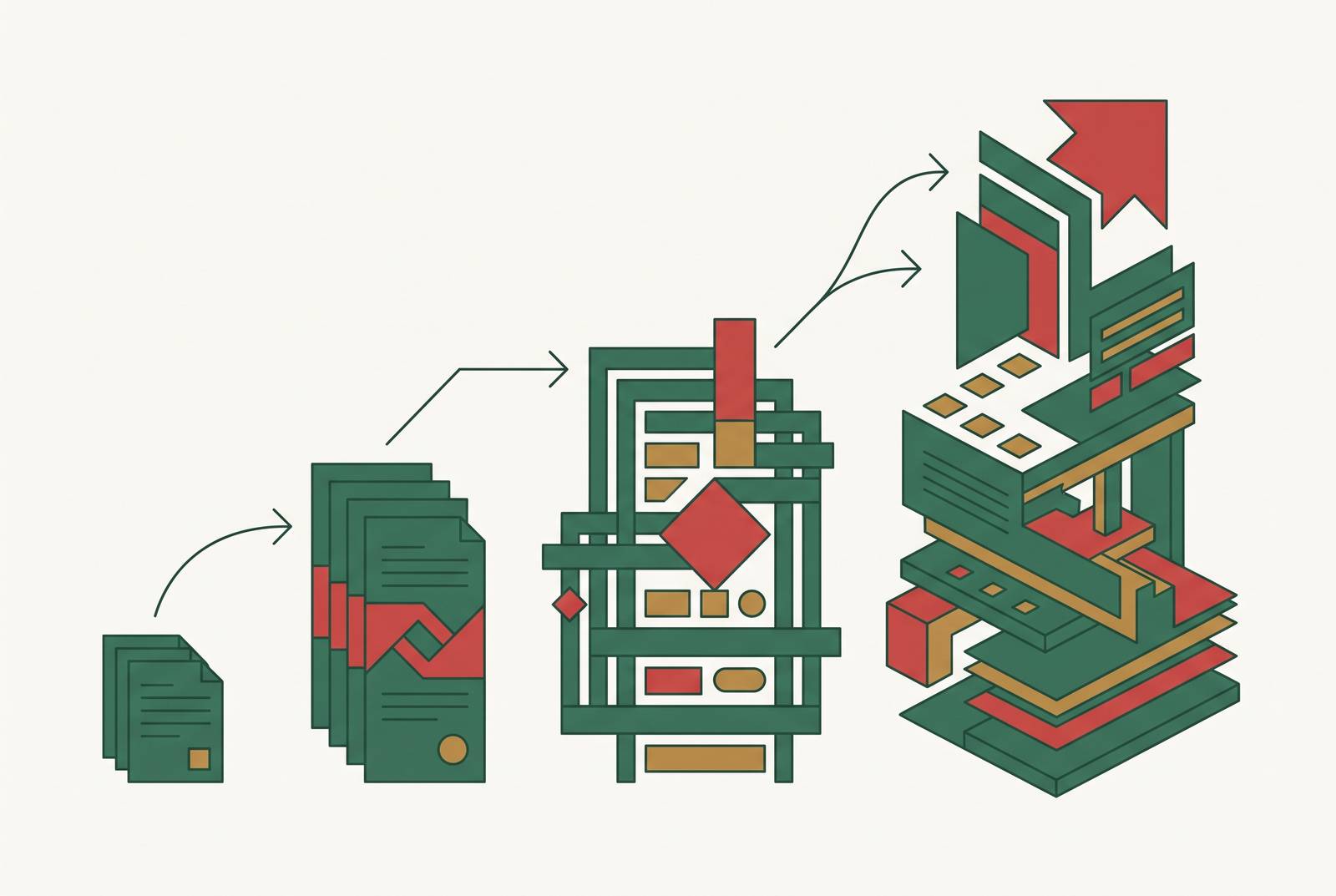
The AP FRQ rubric isn't a checklist. It's a blueprint. Teachers tend to teach toward it at the end of the year, when the exam looms. But the rubric's own architecture already tells you when to teach each layer of it.
Look at the three rows. Thesis comes first. Evidence and commentary sits in the middle. Sophistication caps the top. Each row depends on the one before it. You can't explain how evidence works if the claim is still shaky. You can't earn the complexity point if the evidence and commentary don't already hold together. The order of instruction should mirror the order of the rows. That's the whole argument.
AP English Language, AP English Literature, and AP World History all repeat the same structure. AP Lang's six-point rubric gives one point for thesis, up to four for evidence and commentary, and one for sophistication. The same three rows apply to all three essay types: synthesis, rhetorical analysis, and argument. AP Lit uses the same six-point scale, with the same three rows on each of its three essays. AP World History layers thesis, contextualization, evidence, sourcing, and complexity across the DBQ and LEQ formats. The SAQ drops the thesis, contextualization, and analysis-and-reasoning rows entirely.
The weight distribution isn't random. In AP Lang and AP Lit, evidence and commentary are worth four of the six points. Explanation is worth more than decorative language or a long introduction. AP World History splits its points differently, but the pattern holds: most students over-invest in finding examples and under-invest in commentary. They collect evidence and forget to say why it matters. Now think about what happens when you teach all three layers at once.
What students actually do when the layers are taught all at once
A typical fall-semester FRQ tells you everything. The thesis is safe but vague. The evidence is there but uncommented. And the sophistication paragraph sits at the end like a hat on a horse. It doesn't belong to anything.
That last part is the giveaway. Sophistication should emerge from the reasoning itself. Qualification, meaningful tension, contextual awareness, recognition of limitations. Those things create complexity. Adding an isolated counterpoint or a complicated sentence doesn't. Yet students tack on a paragraph at the end and call it complexity. It fails every time.
Why does this happen? Because the lower layers aren't automatic yet. Students default to cosmetic compliance with the upper layers when they haven't mastered the lower ones. They can't develop commentary and sophistication at the same time if thesis-writing still requires effort. Cognitive load is the problem. The lower skill has to be automatic before the next one can be practiced deliberately.
The same failure shows up one row down. Weak commentary summarizes. Strong commentary explains why. Students list examples without explaining how they prove the claim. They've done the finding. They haven't done the thinking. So the question becomes: what would happen if you taught the layers one at a time, in the order the rubric demands?
Phase one: making the thesis automatic before anything else
The thesis row earns exactly one point. It has a precise definition: a defensible claim that responds to the prompt. Not a restatement of the topic. Not a vague topic sentence. A claim.
What "defensible" means depends on the format. In AP Lit, it's an interpretive claim about how literary elements create meaning. You name a specific device, its effect, and the interpretive tension it opens. "The speaker is lonely" isn't a thesis. An argument about chosen solitude versus endured isolation is.
In AP Lang, the defensible claim has to address the task. But synthesis, rhetorical analysis, and argument each have a different evidence requirement and reasoning pattern. The task word matters. Identify, describe, explain, justify. Each demands a different sentence type. Misreading the task word is the most upstream thesis error there is.
In AP World History, a historically defensible argument has to directly answer the prompt. Restating the prompt doesn't earn credit. A vague topic sentence doesn't either.
Early fall is the time for high-volume, low-stakes thesis practice. Give students a prompt. Ask for the thesis sentence only. Evaluate it against row one of the rubric. No full essay required. Students write many theses quickly, see the pattern of what earns the point, and build automaticity without the overhead of evidence and commentary. By the end of the first marking period, writing a defensible thesis should feel fast and reliable. That's the bar to clear before moving on.
Phase two: building commentary as a separate, teachable move
Evidence and commentary is two skills, not one. The second half is where most points are won or lost. Students must explain how evidence advances the line of reasoning, not merely include it.
The commentary chain has a repeatable structure. In AP Lang rhetorical analysis: identify a specific rhetorical choice, describe the textual evidence, explain the choice's immediate function, connect that function to audience and purpose. In AP Lit: quote with specificity, name the device or syntactic choice, explain its effect on meaning, link the device to the work's broader stakes. In AP Gov concept application: name the concept, name the mechanism (not just the label), connect the mechanism to the broader constitutional or political principle.
The same move, three different domains. That's useful for teachers across departments. The pedagogy doesn't change. Only the content does.
The best practice format here is comparative annotation. Take a weak-scoring response and a strong-scoring response to the same prompt. Map exactly where the commentary chain breaks in the weak one. Have students revise the weak version rather than write from scratch. That makes the skill visible instead of abstract.
Precise verbs are a cheap, powerful lever. A writer concedes, contrasts, humanizes, reframes, intensifies. Those verbs communicate function. "Persuades" tells you nothing. A verb repertoire for commentary is low-cost and high-yield at this phase.
Evidence-type awareness belongs here too, for synthesis tasks. A statistic, an expert explanation, an image, a personal account. Each contributes a different form of evidence. Acknowledging those differences strengthens commentary and supports a more nuanced line of reasoning. This is the first time students think about evidence quality. That's a prerequisite for sophistication.
How format progression within a subject mirrors the rubric sequence
The rubric rows aren't the only sequence. The FRQ formats within a single course are also ordered by cognitive demand. Matching that order to the calendar is a second dimension of sequencing.
AP World History makes this clearest. The three formats are explicitly distinct, with different score weights. The SAQ, worth 20% of the exam score, asks for concise answers and accurate explanation with specific evidence. That's the lowest-demand format. The only skill required is precise identification and explanation. No thesis, no extended argument.
The DBQ, worth 25%, adds document-based argumentation, evidence use, sourcing, contextualization, and argumentation. Mid-demand. It builds on the SAQ's evidence requirement and layers document sourcing and contextualization on top.
The LEQ, worth 15%, requires thesis, evidence, reasoning, and complexity built entirely from the student's own knowledge. Highest demand. It uses the same skills as the SAQ and DBQ, but drops the document-sourcing sub-skill and adds the demand of supplying all evidence independently.
Treating these formats as the same task is a mistake. They're distinct cognitive modes. SAQ precision, then DBQ synthesis, then LEQ independent complexity. That's a natural scaffold, not an arbitrary order.
AP Lang works the same way. The synthesis essay provides sources, so it demands less independence. Rhetorical analysis requires passage-bound reasoning, a mid-level demand. The argument essay requires evidence from the student's own knowledge, reading, experience, or observation. Highest independence demand. Sequencing synthesis before argument within the year maps onto the same principle.
Sophistication last: why the complexity point cannot be front-loaded
Sophistication is the capstone because it requires an argument that already works. Complexity earned at Row C is complexity that emerges from an argument that has already earned Rows A and B reliably. What does sophistication actually require? In AP Lang, nuanced thinking, complex understanding, or especially effective prose. Qualification, meaningful tension, contextual awareness, recognition of limitations. Sustained throughout the essay, not tacked on. In AP Lit, complexity through tension, irony, historical context, or a broader thematic stake. A thesis that frames a tension opens Row C territory from the start. That's why thesis quality predicts sophistication eligibility. In AP World History, complexity means a nuanced argument showing qualification, multiple causes, continuities, or contradictions. Not an unrelated paragraph at the end.
So sophistication isn't a personality trait. It's not something naturally complex writers are born with. It's a predictable outcome of building the lower layers first. The sequence implication is direct: don't assign explicit sophistication practice until students reliably earn the upper range of evidence and commentary points. Otherwise sophistication practice produces only its cosmetic version, the tacked-on paragraph.
Late-year sophistication work should be revision-based. Take a student's own essay that already scored well on thesis and evidence. Ask where the argument could be qualified. Where a counter-cause could be integrated. Where a broader historical or thematic tension could be named. That makes sophistication feel like a deepening of existing reasoning, not an additional task.
How rubric-level feedback data makes the sequence visible and adjustable
The sequencing argument depends on knowing which rubric layer each student has mastered. That means feedback at the criterion level, not just a total score. A generic class average won't tell you which students consistently miss contextualization versus which miss complexity. Criterion-specific data is what makes the sequence adjustable rather than arbitrary. You need to see, across a class, exactly which row is the current bottleneck.
AI FRQ grading tools produce this data at scale. Several platforms score AP FRQs against published rubrics point by point. They return a per-criterion call. A teacher can see, across a class, exactly which row is the current bottleneck. That's the structural point, not a product pitch. The practical consequence is that teachers can group students by their specific deficit. Thesis. Evidence quantity. Commentary depth. Complexity. Assign targeted revision, not a full re-teaching of the whole rubric to everyone.
One tool, Passionfruit, is built around identifying rubric-level gaps. That's the right design philosophy. But the principle is broader: any tool that produces criterion-level data, AI grading or structured peer review, serves the sequencing logic.
Putting the sequence on a calendar: what to assign when
A rubric-driven sequence doesn't require a new curriculum. It requires assigning the right kind of FRQ practice at the right point in the year, using the rubric hierarchy as the decision rule for when to advance. Early fall is the thesis isolation phase. High-volume, low-stakes thesis-only prompts across all relevant FRQ formats. The advancement criterion: students reliably produce a defensible, format-appropriate claim without excessive revision time.
Mid-fall through mid-year is the evidence and commentary phase. Full FRQ responses with feedback targeted at the evidence and commentary row. The advancement criterion: students consistently explain how evidence advances their claim, not merely cite it. Format complexity can increase within this phase. SAQ to DBQ in AP World. Synthesis to rhetorical analysis in AP Lang.
Late year is the sophistication phase. Revision-based complexity work on essays that already score well on the lower rows. The task isn't to write a new essay. It's to deepen an existing argument through qualification, counter-cause integration, or thematic broadening.
The advancement criteria are the critical design decision. If you move students to the next phase before the current one is reliable, you get the cosmetic sophistication that fails to earn Row C. The calendar should be driven by rubric evidence, not by semester dates alone.
Pacing context matters by exam. AP World History timing targets include shorter windows for SAQs and the LEQ, and roughly 60 minutes for the DBQ. Time management under exam conditions is itself a late-year skill. Add it only after argument quality is stable.
The rubric already contains the answer to "when do I move on?" When a student earns the current row's points reliably, they're ready for the next row's practice. That's the sequencing logic made fully explicit.