AP Exam Prep Calendars for Semester-Block and Traditional Schedules
Two calendars fix the retention gap between block and traditional AP schedules.
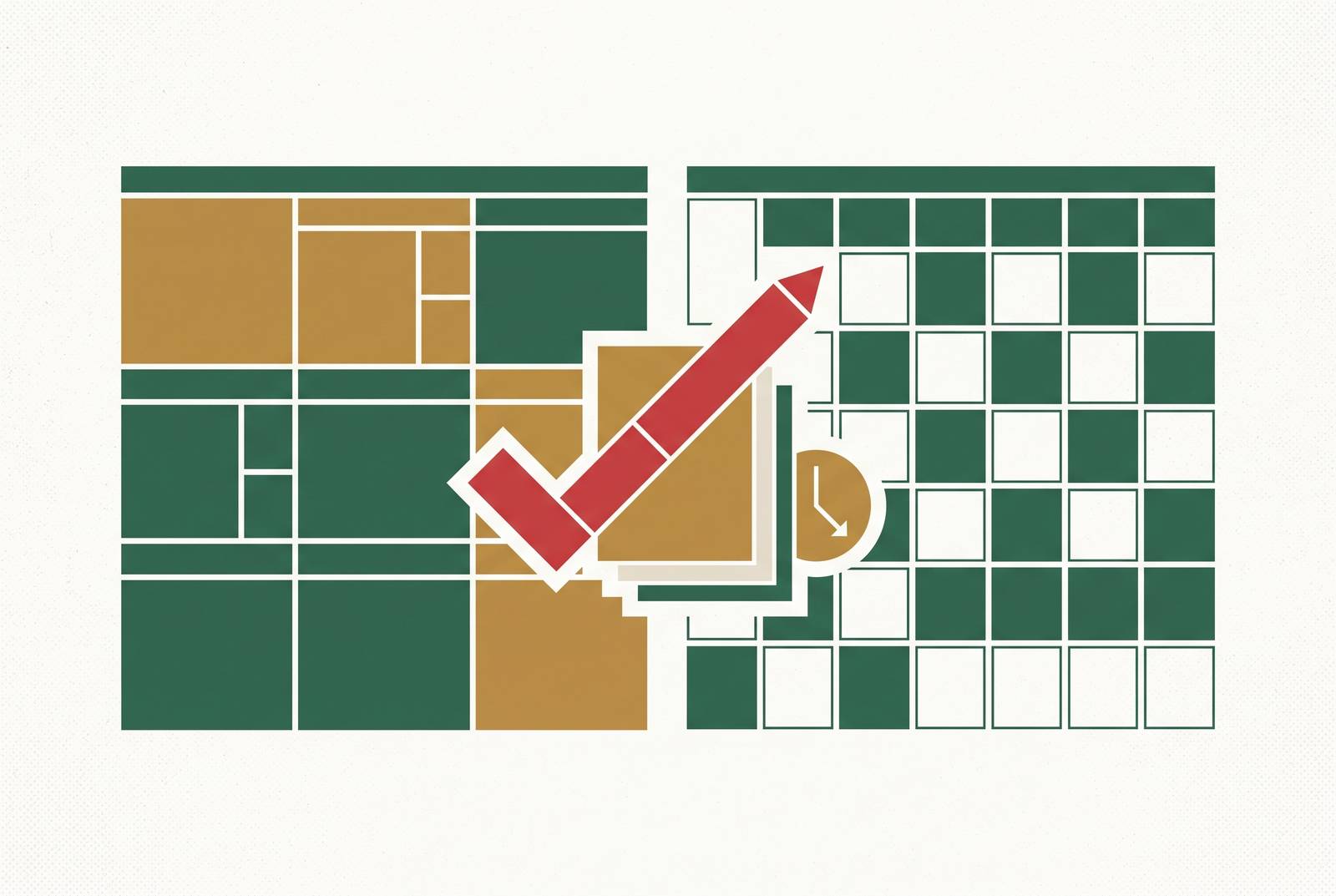
AP exams land on the same fixed calendar every May no matter when a student's course actually ends. That single fact is the whole problem. A traditional-schedule student finishes their AP course the same week they walk into the exam room. A block-schedule student might finish in January and then wait four months, or still be learning new material the week testing starts. Same exam, wildly different runway.
This isn't a small scheduling quirk affecting a handful of overachievers. Over 1.3 million students in the Class of 2025 sat for more than 4.8 million AP exams, and 37% of public high school graduates in the country took at least one. Research has flagged the specific risk for fall-block students: content learned in September can fade badly by the time May rolls around. Research suggests something sharper still, that the score gap often blamed on 4/4 block schedules may have less to do with how well students learned the material and more to do with when they're forced to prove it. The course works. The calendar doesn't.
The fix is two prep calendars. It's two, built backward from the same fixed exam window, but accounting for two very different timelines.
How block and traditional schedules are structured, and what each means for contact time
Traditional schedules run 6 to 9 periods a day, each 35 to 50 minutes, with an AP course stretched across the full school year. New content is introduced in small doses, week after week, from August through April or May.
Block schedules compress that same content into longer class periods, usually 90 to 120 minutes, and often finish the course in a single semester. Straight 4×4 block means four courses per semester, a brand-new set each term. Some schools run modified block or hybrid versions that blend the two models. Each variant changes the gap between "last day of instruction" and "exam day" in its own way.
Block scheduling has a real upside: students can pack in more AP courses over four years, because two math courses can fit into one year instead of being spread across two. That's a genuine advantage for anyone trying to build a heavy AP transcript. But the same compression that makes block efficient for coverage makes it risky for retention, especially in subjects like math, foreign language, and writing-heavy courses, where skills build cumulatively and don't survive a long gap well.
For calendar planning, one question determines how much review time exists and how much of that time is retrieval versus fresh learning: when does the student last receive new instruction? Everything downstream, how much review time exists, how much of it is retrieval versus fresh learning, gets decided by the answer.
And the exam date itself isn't moving. The 2026 exam window runs May 4 through 8, and May 11 through 15, with late testing from May 18 through 22 available through a separate registration process. Every calendar in this piece counts backward from those dates.
The fixed landmarks every prep calendar must be built around, regardless of schedule type
Before phase-by-phase planning makes sense, a few dates need to be locked in, because they apply no matter which schedule a student is on.
The exam window itself:
Deadlines that land before testing even starts:
- AP Seminar, AP Research, and AP Computer Science Principles performance tasks: due April 30, 2026, at 11:59 p.m. ET
- AP Art and Design portfolios: due May 8, 2026, at 8 p.m.
Administrative deadlines that shape what options are even on the table:
- November 14, 2025: last day for AP coordinators to order exams
- January 16, 2026: deadline for SSD accommodations requests
- March 13, 2026: deadline for spring course orders
Scores come back in early July 2026.
One more factor belongs on every calendar now: the shift to digital testing. 2026 is the second full year with the Bluebook digital platform in wide use, covering 28 of 36 AP subjects, 16 fully digital and 12 hybrid. The hybrid format asks students to read questions on a screen and write free-response answers on paper, a split-attention skill that needs its own practice reps, not just a quick look at the interface the week before.
For anyone in a portfolio-based course, the April 30 deadline needs to sit on the calendar months early. That work competes directly with review time later in the spring, so it can't be an afterthought.
The traditional-schedule prep calendar: phase by phase from September to May
Picture a student whose AP course runs September 2025 through May 2026, with new material arriving every week the whole way through.
Phase 1, course-concurrent foundation (September to December 2025). Keeping pace with the class each week is the prep. Confirm exam registration early since coordinators face a November 14 ordering deadline. Students in portfolio-based courses (Art and Design, CSP, Seminar, Research) should start choosing topics and gathering material now. April 30 arrives faster than it looks from September. A short daily review habit, even a few minutes, adds up over the length of a school year far more than it seems like it should.
Phase 2, structured content consolidation (January to February 2026). By late January, enough ground has been covered to start reviewing unit by unit instead of day by day. Anyone needing accommodations has to act by the January 16 deadline. Timed free-response practice should also start now, building the stamina needed for a full-length exam. Students beginning dedicated study in February should plan for around 7 hours a week.
Phase 3, content mastery lock-in (March 2026). All core content should be reviewed by the end of March. The March 13 course order deadline is purely administrative, but it's a useful marker that the season has officially turned. Weekly time commitment rises to around 10 hours if dedicated prep is starting this month, per study planning guidance. This is the moment to identify weak units honestly, while there's still time to actually relearn them rather than just skim them again. Bluebook practice sessions should start here too, including the screen-to-paper-booklet workflow for hybrid exams.
Phase 4, full-length practice exams and gap-filling (April 2026). Content learning should be done. April belongs to full, timed practice exams using past AP materials from AP Classroom, done under real exam conditions, distraction-free. April 30 is the hard deadline for Seminar, Research, and CSP performance tasks, so students in those courses need to have been running prep and portfolio work in parallel all along, not one after the other. Practice exam results should point directly at what's left to fix. Anyone with an afternoon exam slot should build in practice sessions at that same time of day. Peak focus at noon doesn't come naturally to most students.
Phase 5, final sharpening and exam execution (May 1 to 15, 2026). The week before exams is for light review only, no new material, and a real focus on sleep and routine. The night before an exam is for reviewing key formulas, not cramming a new chapter. Between back-to-back exams, a short mental reset beats diving straight into the next subject. The Art and Design portfolio deadline (May 8) lands right in this window. Students with several exams in one week should weight their heaviest study earlier if their toughest exams come first.
For AP students juggling a same-day exam combination, time has to be split deliberately. One workable split weights the lowest-readiness subject most heavily, with progressively smaller shares going to the middle and strongest subjects.
The semester-block prep calendar: two very different situations depending on which semester the course runs
Block students split into two groups with opposite problems. Fall-block students finish too early and have to fight forgetting. Spring-block students start too late and have to fight the clock.
Fall-semester block students (course ends around January 2026, exam in May 2026)
The gap here can stretch several months between the last day of class and the exam, the longest retention risk any AP student faces on any schedule.
Phase 1, in-course intensive (August to December 2025). Every class session functions as exam prep from day one, because the countdown to the gap starts the moment the course ends. Registration should be confirmed early, since AP coordinators face a November 14 exam ordering deadline that affects whether a student's exam slot exists at all. Weekly cumulative review should start in month one, not month three, so earlier units don't fade while newer ones are being taught. Hybrid-exam students should start practicing the Bluebook interface early enough that it's second nature by the time the course wraps.
Phase 2, the bridge period (January to February 2026). This phase doesn't exist for traditional-schedule students; it's unique to fall-block. The goal isn't new learning, it's preventing forgetting, through weekly spaced review of material already covered. This takes deliberate scheduling, since other spring courses will be competing for the same hours. The SSD deadline (January 16) still applies here. Subjects that depend on continuous practice, such as those built on cumulative skills, are especially vulnerable to fading during this stretch. At least two sessions a week, an hour or more each, is the minimum benchmark for staying on track toward a target score.
Phase 3, structured review and practice exams (March to April 2026). By March, fall-block students should be entirely in review and retrieval mode, since all the content was covered months earlier. A full-length timed practice exam in March helps identify which units took the biggest hit during the bridge period. April mirrors the traditional-schedule mock exam phase in intensity. Fall-block students in CSP, Seminar, or Research should have their performance tasks finished or nearly finished by January, given how long they've already been managing the gap. Weekly study time in March runs around 10 hours if starting intensively.
Phase 4, exam execution (May 2026). Same final-week approach as traditional-schedule students: light review, good sleep, no new material.
Spring-semester block students (course begins around February 2026, exam in May 2026)
This creates the opposite risk. No retention gap to worry about, but almost no cushion between finishing content and sitting the exam, and in some cases new content is still being taught when testing starts. Some school districts even test spring-block students before the course is fully finished. As a result, the course and exam calendar may leave some students with less instructional time than others.
Phase 1, in-course acceleration (February to March 2026). There's no runway here. Prep starts alongside instruction from day one. The March 13 course order deadline is a reminder of just how compressed this timeline really is. Each unit should get reviewed right after it's taught rather than saved for a later cumulative pass. AP Classroom's unit progress guides and past free-response questions, tackled unit by unit as each one closes, do more work here than a broad review ever could.
Phase 2, mock exams under time pressure (April 2026). Some content may still be in progress this late. Practice exams should cover completed units first, then loop back to newly finished material. Spring-block students in CSP, Seminar, or Research have the least prep time of any group and need to treat performance task work and exam review as two tracks running side by side from February on. Burnout risk climbs here too, since these students have been at full intensity for only a couple of months by the time exams hit.
Phase 3, final review and exam (May 2026). If instruction stretches into late April or even early May, final review compresses down to the days right before each exam. That means focusing only on the highest-weight topics and the weakest known units, not attempting a full content pass that there simply isn't time for.
Exam-specific scheduling decisions that cut across both calendar types
Whichever calendar a student is following, one decision applies across the board: build the schedule around the hardest exams first, not around whatever order they happen to fall on the calendar.
2025 score data gives a useful starting point for figuring out where extra time should go. AP Latin, for instance, had 59% of test-takers score a 3 or higher, according to figures reported by Top Tier Admissions. Numbers like that don't mean a subject is unteachable. They mean it deserves a bigger slice of whatever study hours are available, whether that's the 7-hour week recommended for students beginning serious prep in February or the 10-hour week recommended for students whose intensive prep begins in March.
The exam date is fixed, but the runway toward it isn't, and building a calendar on purpose, months out, is what prevents a bad calendar; reacting to the gap only after it appears on a practice exam score does not.