Scheduling SAT Prep Inside English and Math Classes Without a Standalone Course
Teachers can weave SAT strategy into daily English and math lessons without adding courses.

Students Already Prepping Inside a Classroom, Whether Their Teachers Know It or Not
The digital SAT runs 2 hours and 14 minutes: a Reading and Writing section (54 questions, two 32-minute modules) and a Math section (44 questions, two adaptive modules), scored on the familiar 400 to 1600 scale. Every domestic test-taker has sat for this version since March 2024, so every student in the class of 2025 and 2026 took, or will take, the exact same computerized, adaptive test.
Most schools miss that most of that test is already happening in class.
Look at where students actually sit for the exam. In the SAT Suite of Assessments Annual Report, 68% of the Class of 2025 took the SAT through a School Day program, during school hours, on a school-administered date. Only 32% tested exclusively on a weekend date they picked themselves.
That flips the usual assumption about prep. If two-thirds of students take the SAT as part of the school day, the school day is the preparation environment, whether a teacher planned for that or not.
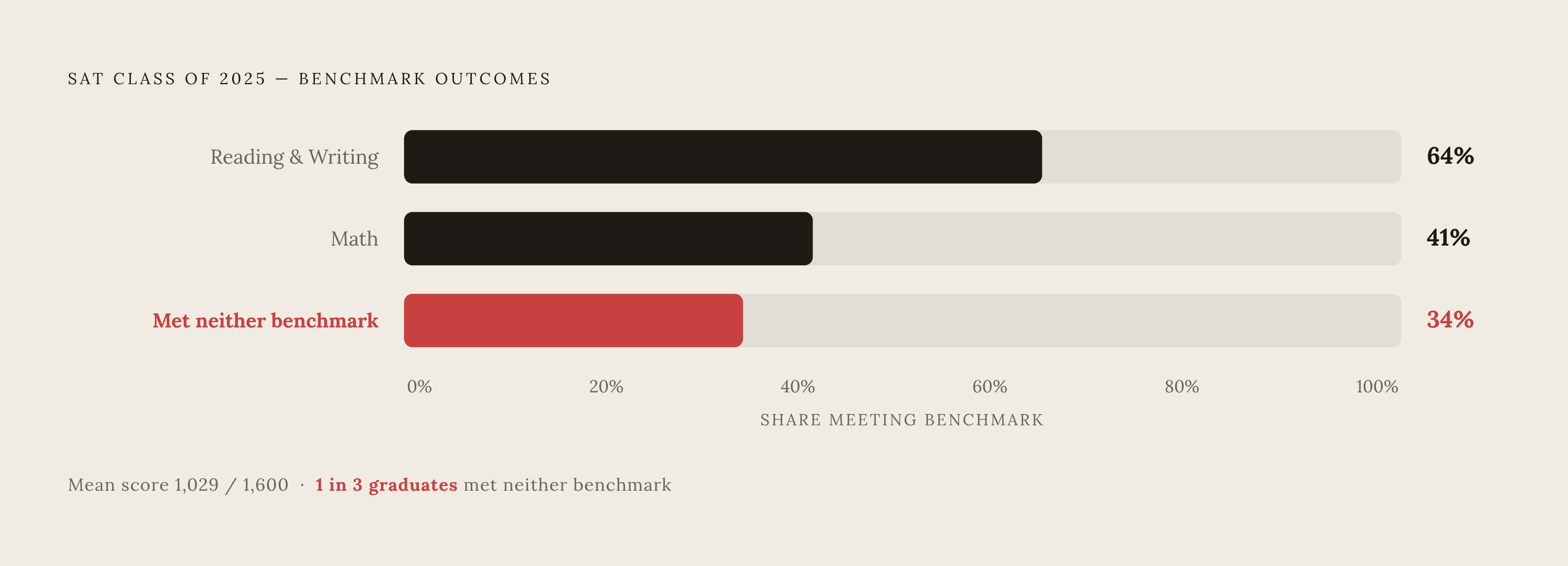
And the results say the current setup isn't enough on its own. Mean score for the Class of 2025 was 1029. On benchmarks: 64% of test-takers met the Reading and Writing benchmark, but only 41% met the Math benchmark, and 34% met neither one.
A third of the graduating class went through years of English and math instruction and still didn't clear either benchmark. These weren't students who skipped class. They sat in front of a teacher five days a week, the whole time. So the assumption that SAT readiness is somebody else's job, the tutor's job, the weekend prep course's job, is the assumption that leaves those students uncovered. Usually the ones who needed the help most.
SAT content domains inside English and math curriculum
Most of what the SAT tests is already sitting inside a standard curriculum. Nobody needs to invent new material. They need to name what's already there.
Reading and Writing breaks into four content domains, each with a fixed weight:
- Craft and Structure (28%), the largest single domain, tests vocabulary in context, connections across texts, and reasoning.
- Information and Ideas (26%) tests comprehension, analysis, and reading informational graphics.
- Standard English Conventions (26%) tests grammar, sentence structure, punctuation, pronoun use, and parallelism.
- Expression of Ideas (20%) tests revision for clarity and rhetorical effectiveness.
Matching that against a typical ELA syllabus makes the overlap almost embarrassing. Standard English Conventions is grammar instruction, no translation needed. Information and Ideas overlaps with close reading and nonfiction units. Expression of Ideas overlaps directly with revision work in a writing unit.
Math lines up the same way. A teacher covering linear systems in Algebra II is, functionally, teaching SAT content. So is a teacher running a unit on scatterplots and margin of error.
Craft and Structure is the one domain that doesn't map cleanly. According to testprepkart.com, the SAT rewards pattern recognition and reasoning, not literary interpretation or memorization. Literary analysis built around theme and symbolism is a different skill from identifying how a single word functions in context under a 32-minute clock. Genre instruction sits next to SAT skill instruction. It isn't the same thing, and pretending it is leaves the largest single domain on the test undertaught. Closing that specific gap, on purpose, is where the real work starts.
The real gap: strategy and timing, not just content coverage
Content coverage is the easy part. It's mostly already solved by the curriculum a teacher is already running. What's harder is performing under a very specific set of conditions: adaptive modules, a hard clock, and multiple-choice formats that reward a particular kind of thinking that has nothing to do with how well a student knows the material.
Most schools respond to a low score by assigning more content review. That's the wrong fix. According to testprepkart.com, students who change their strategy, not just their study hours, often gain 80 to 150 points. Time isn't the scarce resource here. Deliberate, targeted practice is, and no amount of extra content review substitutes for it.
What does strategy actually mean, in practice terms?
On Reading and Writing: eliminate wrong answers systematically, locate the relevant line fast instead of rereading the whole passage, and resist the urge to over-interpret a straightforward question.
On Math: know that a calculator is allowed on all 44 questions, manage time across two adaptive modules where difficulty shifts based on Module 1 performance, and recognize a question type by its structure before hunting for the topic.
None of that requires new curriculum. It requires a layer of test-specific reasoning laid on top of what's already being taught. Which raises the real logistics question: how does a teacher add that layer without blowing up the schedule?
Building micro-practice into existing class routines without restructuring anything
Embed it. Don't isolate it. SAT prep folded into instruction that's already happening beats a bolted-on unit competing for the same 50 minutes, every time.
Three slots do almost all the work:
Warm-ups: A few minutes, one SAT-aligned question or short passage, at the start of class. A tool built for exactly this lets teachers build quizzes of up to 80 questions filtered by content domain, and gives students scored feedback and answer explanations the moment they finish. Fixing a mistake while it's still fresh keeps it from resurfacing later on a graded quiz.
Exit tickets: One SAT-format question tied to the day's lesson, at the end of class. This tells a teacher if a student can apply a skill under test-like conditions. Those are two different questions, and a student acing one doesn't guarantee they'll pass the other.
Station rotations and independent blocks. Slot SAT practice into time that's already built for independent or small-group work, and let an adaptive tool run the individualized part.
None of this needs a scheduling overhaul. A few minutes here and there, aimed at a known gap, adds up to a real but modest rhythm of embedded SAT work each week. That's a rhythm, not a unit.
For English teachers: rotate warm-up passages by domain, one week on Information and Ideas, the next on Craft and Structure, so coverage happens on purpose instead of by accident. For math teachers: label existing problem sets by SAT domain, so students start recognizing "this is a Problem-Solving and Data Analysis question" instead of treating every problem as a one-off.
Before any of this gets scheduled, a diagnostic needs to come first. Which domains actually need the warm-up time? That's not a guess a teacher should be making from memory.
Using diagnostics to decide where to spend the limited time you have
A practice session with no analysis behind it is a score report sitting in a drive folder. It doesn't tell a teacher what to do next. What turns micro-practice into a real plan is knowing, ahead of time, which domains deserve the limited class time available.
Two tools do this work, and they do different jobs. A free practice platform lets students filter quizzes by section or content domain, up to 80 questions per Knowledge and Skill area, and returns answer explanations and skill-level data immediately, fast enough to run inside a single class period. An official adaptive diagnostic tool gives a fuller readiness map, best run at the start of a semester, with results used to build informal, targeted skill groups inside the existing class roster.
The adaptive diagnostic's real advantage is what it skips: the three-hour commitment of a full-length practice exam. A half-day practice test isn't realistic in most classrooms. This is.
What does the data actually tell a teacher to do?
- Domains with gaps across the whole class point to a whole-class warm-up.
- Gaps that appear in only a few students point to station rotation or a differentiated exit ticket.
- A wrong answer caused by a missing concept needs different follow-up than a wrong answer caused by running out of time.
That third distinction gets missed constantly, and it's the one that matters most. A student who runs out of time on Module 2 doesn't need more grammar review. A student who keeps misreading Craft and Structure questions does. Diagnostics separate those two students. Once they're separated, having two different students who need two different lessons at the same time in one room means no single teacher can run both.
AI tools' contributions beyond what a teacher working alone can replicate
Individualized tutoring produces dramatically better outcomes than group instruction, and no teacher can deliver individualized tutoring to 30 students at once. It becomes especially visible in exam prep, where the gaps between students are specific and different from each other. Grammar review helps the student who's shaky on commas. It does nothing for the student who runs out of time on Module 2. A room full of thirty different gaps can't be closed with one lesson plan.
This is exactly where an adaptive practice tool earns its place, running in parallel across every student in the room, doing what one instructor physically cannot:
- Adjusting difficulty in real time based on how a student answers, mirroring how the Digital SAT's own adaptive modules behave.
- Telling apart a timing issue, a careless slip, and an actual gap in understanding. Each needs a different kind of follow-up.
- Returning scored, annotated feedback immediately, in a room where the teacher physically can't review every student's work before the next class meets.
There's a workload case here too, separate from the student-outcome case. Research has found that teachers who use AI tools regularly report meaningful time savings each week. That's not a rounding error against everything else already on a teacher's plate.
Two tools show what this looks like in practice. An AI-powered tutor can walk a student through a Socratic back-and-forth, asking questions and offering hints instead of handing over the answer, which matters most during independent or station-rotation time when the teacher is on the other side of the room. Passionfruit, an AI-powered study platform built for SAT and AP mastery, gives students unlimited practice problems with AI grading, and tries to model what a student actually understands versus what they've simply drilled enough times to get right by accident. That's the differentiated, parallel-running practice no single teacher can hand-build for thirty students at once.
None of this replaces the teacher. It replaces the repetitive, individualized feedback loop that used to require a private tutor or hours a teacher doesn't have, and it frees the teacher up for strategy and higher-level intervention instead.
How motivation and framing affect whether embedded prep works
A well-built warm-up rotation dies the moment students file it under "extra test stuff" that doesn't count toward anything. That's a framing failure, not a content failure, and it kills the whole system quietly if nobody addresses it directly.
The fix takes intent, not more material. Frame SAT skills as college and career readiness, not test tricks. A student sits through a grammar warm-up differently when it's labeled "Standard English Conventions, 26% of your Reading and Writing score" than when it's just another worksheet. Same content. Different frame. Different level of buy-in.
There's also a lever more concrete than any pep talk: money. SAT scores feed directly into merit aid and scholarship eligibility. That's a near-term financial stake, not an abstract "this matters for your future" pitch, and naming it out loud gives students a reason to engage that has nothing to do with their grade in the class.
Visibility closes the loop. Showing students their own growth, movement from a fall diagnostic to a spring one, turns scattered micro-practice into something they can see themselves inside. A single test score is a data point. A growth chart is a story. Students respond to the story.
A semester of this in a real English or math class
A shape for the semester, not a rigid script:
Weeks 1 to 2: Run a diagnostic as a class activity. Break results down by content domain. Separate class-wide gaps from individual ones. Build loose, informal skill groups from what the data actually shows.
Week 3 onward: Start the warm-up rotation, one or two domains a week, cycling through all four Reading and Writing domains and all four Math domains before the semester ends.
Ongoing: Exit tickets tied to that day's domain. Students with a gap that keeps resurfacing get routed to AI-assisted practice during station rotations or independent blocks, where the tool delivers the repetition a teacher can't personally give every student.
Mid-semester: Re-run a shorter diagnostic. Check what's actually moved. Adjust which domains get warm-up time based on where the gaps sit now, not where they sat in September.
Final weeks before test day: Shift warm-ups away from content domains and toward timing and strategy: timed two-question sets, answer-elimination drills, awareness of how Module 1 performance shapes Module 2.
None of this calls for a new course, a dedicated prep period, or a curriculum rewrite. It calls for knowing what each warm-up is actually targeting, and a feedback loop, diagnostic data plus AI-assisted practice, that keeps that targeting accurate as the semester moves.
Go back to that 34% figure: the share of the Class of 2025 that met neither the Reading and Writing nor the Math benchmark, after years of school-based instruction. A standalone SAT course, the kind families pay for outside of school, was never going to reach most of those students. Embedded, intentional prep, built from warm-ups, exit tickets, and diagnostic data a school already has access to, is the version of this that can actually reach them.
The goal was never to turn an English or math class into an SAT class. It's to make the SAT feel like a natural extension of what students are already learning, so test day ends up measuring mastery they built all along, not something separate they had to go chase down on their own.