When to Intervene at the Individual Level Versus Reteaching the Whole Class
Match your intervention size to how many students actually have the gap.
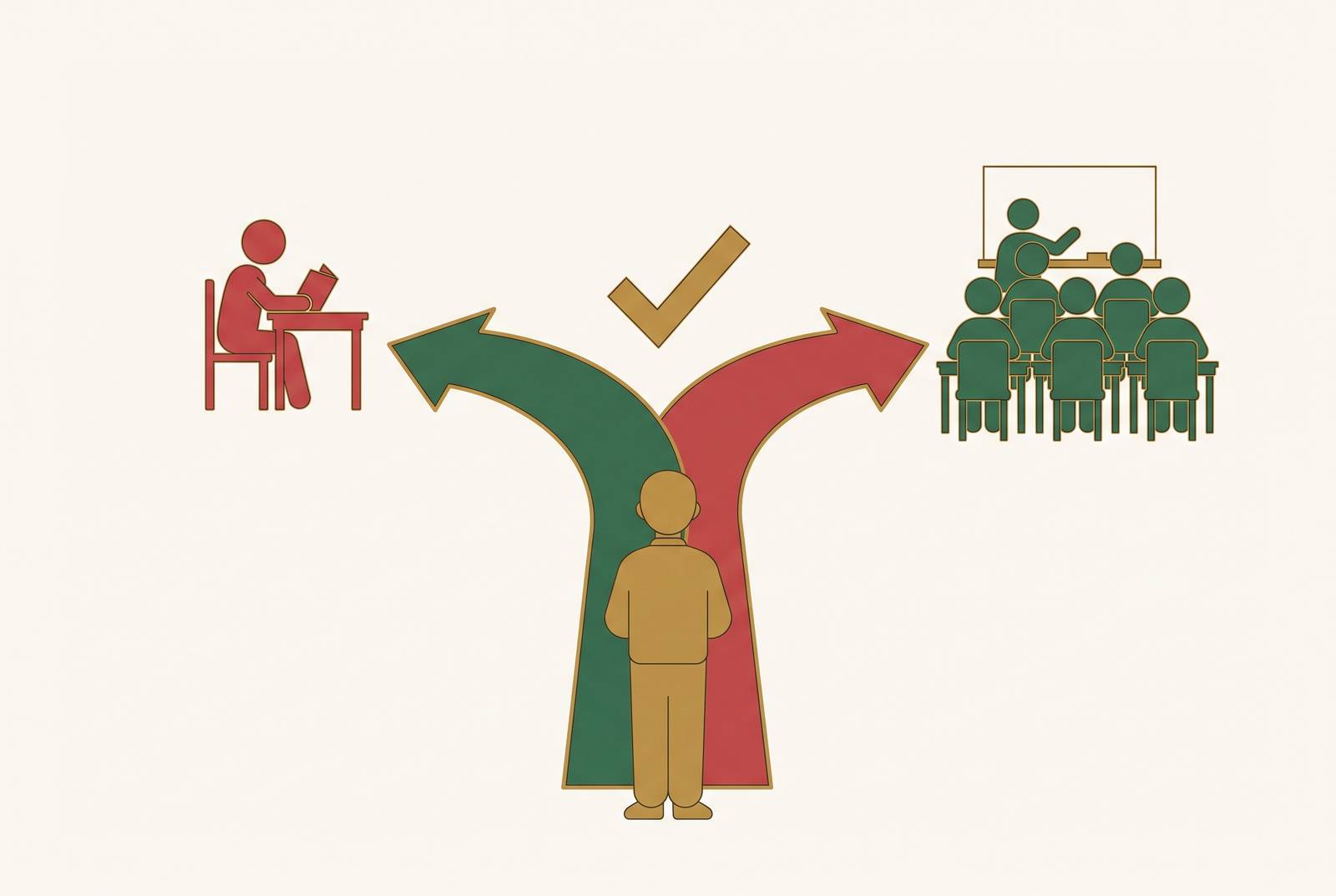
This piece is about one decision every teacher makes after grading a stack of assessments: pull a few students aside, or stop and reteach everyone. The angle is simple. That decision is a math problem about how widely a misunderstanding has spread across the room.
Most teachers default to one of two moves when the data comes back. Either slow the whole class down and reteach, or pull the strugglers into a corner. Neither move starts with the one number that should drive the decision: how many students actually have the gap. When most of the class shows poor understanding of a concept, reteaching the whole group makes sense. When the number struggling is small, something like one in six or fewer, reteaching everybody wastes the time of students who already understood the material the first time. Everything in this piece builds from that single variable: distribution. Once a teacher can read it accurately, the rest of the decision (individual, small group, or whole class) follows almost automatically.
Reteaching by reflex instead of checking distribution
Skip the question of how widespread the gap actually is, and both common responses tend to backfire, in different directions, as Dr. Catlin Tucker's 2026 analysis names directly: when students struggle, the automatic response is to slow down, review, reteach, or pile on more practice, moves that don't address the actual problem because they never stop to ask who needs help and how many.
Reteach the whole class when only a handful of students needed it, and the students who already understood the material disengage, or worse, feel like they're being punished for having paid attention the first time. Tucker is blunt about the other failure mode too: "Repeating that same instruction is unlikely to make it effective". The students who got it the first time are stuck sitting through material they don't need, and the students who didn't get it are hearing the exact same explanation that failed them once already.
Small groups, used when the gap is actually widespread, cause deeper damage. Shanahan's 2025 research found that small-group reading instruction doesn't consistently beat whole-class teaching, and for the students who need the most support, poor and minority students in particular, mostly whole-class instruction built around purposeful reading and discussion had the greatest impact. Placing students into low groups carries an equity cost. Earlier research that Shanahan reviews found that Black students and low-income students placed into low groups ended up making less progress, not more. A teacher who rotates small groups through a remediation station while most of the class quietly stays lost isn't being cautious. The setup guarantees that the majority never gets the coherent reteach they actually needed.
A third failure mode skips the prerequisite gap. Student Centered World's 2026 writeup uses a World War I example to make this concrete. Students were being asked to understand the Treaty of Versailles without ever having closed their gaps on what caused the war in the first place. New content gets piled on top of a foundation that was never finished. Neither reflex, reteach everyone or pull a few students, fixes that kind of problem, because the problem is one of sequence, not grouping. It's about sequence.
How the RTI tiering structure formalizes the distribution decision
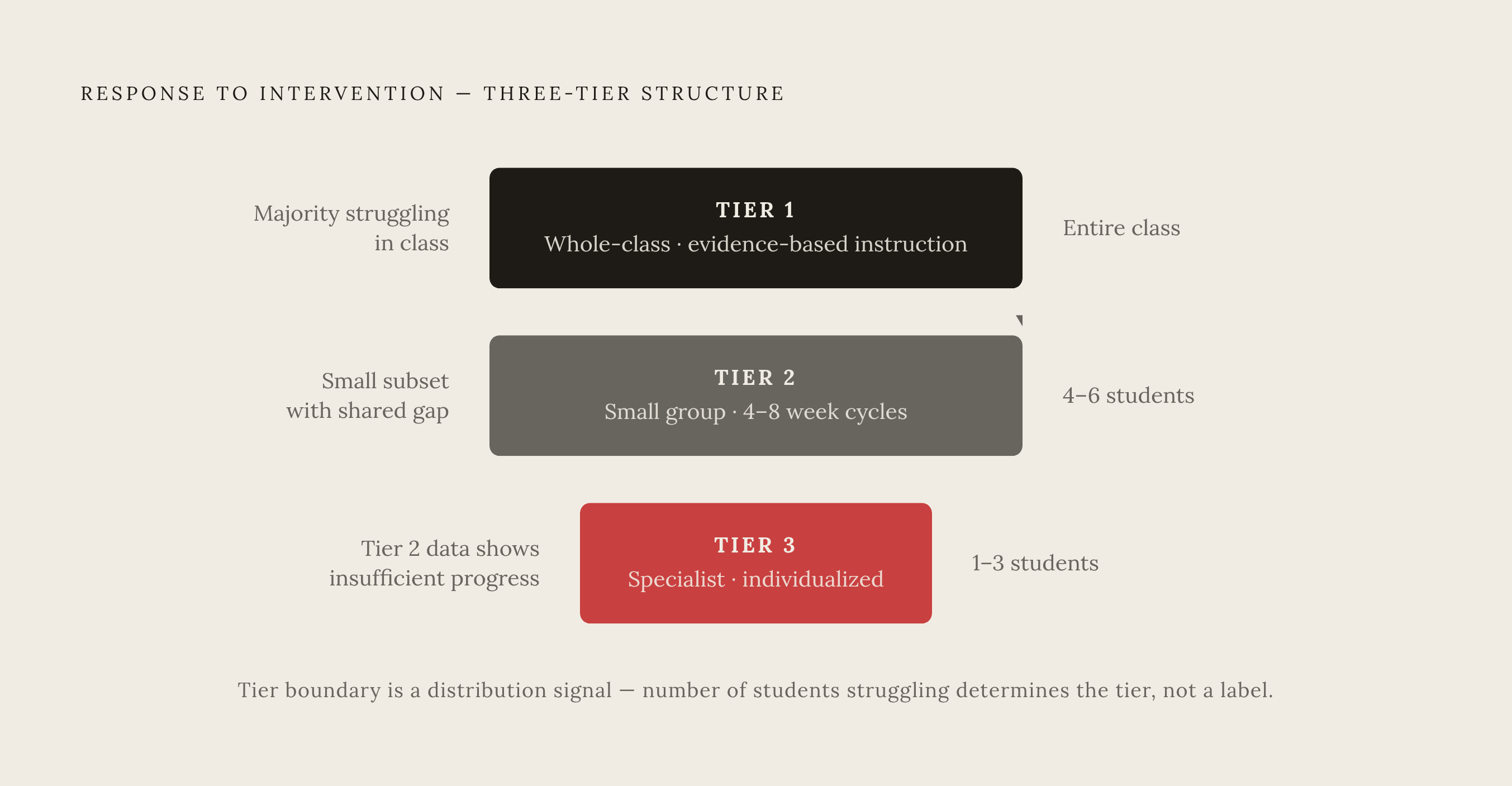
The Response to Intervention model exists to take this decision out of the realm of gut instinct and turn it into something closer to a formula. RTI assigns whole-class instruction, small-group intervention, and individualized support to separate tiers, and what separates one tier from the next is how many students actually need this level of response.
Everway's 2025 overview lays the structure out in three parts. Tier 1, delivered when most students are making progress under it, is high-quality, evidence-based instruction delivered to the whole class, while Tier 2 is supplemental, usually delivered to small groups of four to six students who share a specific gap, and it runs alongside Tier 1 rather than replacing it, typically over cycles of four to eight weeks with regular progress checks. Tier 3 is the narrowest band: highly individualized, delivered one-on-one or in groups of two or three, often by a specialist, and it only kicks in when Tier 2 data shows a student still isn't making enough progress.
What makes this structure useful is that the tier boundaries themselves are a distribution signal, not an arbitrary label. If Tier 1 data shows the majority of the class struggling, the problem sits with the initial instruction, and the fix belongs at the whole-class level, ideally with a different approach than the one that just failed. If only a small subset is struggling, that's evidence Tier 1 worked for most students, and a Tier 2 small-group response is the appropriate scale of response. RTI also isn't built to let a teacher wait and see how things shake out. Everway's 2025 overview notes that those four-to-eight-week intervention cycles require regular team input and ongoing progress monitoring, so the call to move a student up or down a tier is driven by data on a set timeline, not by a hunch that a student "seems to be getting it now".
Mastery Learning backs up the same logic from a different angle. Students shouldn't move on to the next skill without demonstrating adequate mastery on an assessment, and reteaching should target the students who didn't clear that bar rather than assuming the whole class needs the entire lesson repeated. Most students, even the ones who need help, have gaps in specific areas rather than a total breakdown of everything covered. The tiers and the mastery threshold are really the same idea stated two ways: match the scale of the response to the scale of the problem, and let the data set the boundary instead of instinct.
Why error type matters
Knowing how many students are struggling only answers half the question. Skipping the question of what kind of struggle it is leads a teacher to reach the right group of students with the wrong kind of help.
Tucker's 2026 analysis gives a clean example from a math classroom. After a formative assessment, a teacher notices a cluster of students consistently mixing up the numerator and the denominator when reading fractions. Instead of reviewing the entire fractions unit from the top, she pulls a small group and targets that one specific confusion, a Tier 2 response sized to the actual misunderstanding rather than to the test score alone, and that sizing is the distinction in miniature. Error count tells a teacher how big the group should be. Error type tells her what that group's lesson should actually cover.
The Jamie Jasperson tracking system, described in Student Centered World's 2026 piece, builds this distinction into daily practice. After each small-group lesson, the teacher writes down the specific misconception a student showed, not a score, not a percentage, and groups students by shared error pattern rather than by shared grade. One tracked example: three students didn't understand grouping, four didn't understand arrays, and two didn't understand either concept. That's three separate intervention groups pulled out of a single assessment, each one built around a distinct misconception rather than a single blended "struggling" category.
This changes what whole-class versus individual intervention actually looks like in practice. A class where most students made the same procedural slip might genuinely need a short, whole-class correction aimed at that one error. A class where students are making several different conceptual errors needs several small, concurrent groups running at the same time, not one large reteach that tries to cover everyone's problem at once. The practitioner logic that's emerging from this kind of tracking backs that up: rather than one oversized reteach session, a teacher might run two or three short sessions in parallel, each one aimed at a distinct gap, instead of trying to patch fifteen different errors by repeating the original lesson from the beginning.
Research on small-group instruction as the default response
The framework runs into its strongest objection here: isn't small-group instruction just automatically better than teaching the whole class? The research doesn't support that as a blanket rule. Small-group instruction's effectiveness depends on how it's matched and targeted, not on group size alone. Its value depends entirely on whether the group is matched to the right slice of students and whether it actually uses a different instructional approach than what failed the first time.
Shanahan's 2025 work is direct about this. For a lot of students, simply receiving solid, evidence-based instruction in a small-group format isn't enough on its own, because the group size was never the thing doing the work. Swain's 2024 argument pushes in a similar direction from the whole-class side: well-run whole-class explicit teaching, built around a single learning objective, heavy modeling, guided practice, and real feedback, can be what Swain calls the "sweet spot" of differentiation, because individual students can get varying levels of real-time support inside that same lesson rather than only through a separate pullout group. Differentiation, in other words, can happen inside the whole-class period. It doesn't require splitting the room.
None of this is an argument against small groups as a tool. It's an argument against small groups as a reflex. Tier 2 small groups are well-supported when they target a specific shared gap with a different instructional strategy, not simply by virtue of being small groups. The gain doesn't come from the act of splitting students into a smaller room. It comes from how precisely the group's focus is targeted and how different the teaching actually is once they're there. Tucker's 2026 analysis makes the same point from the design side: effective Tier 2 instruction is more personalized, more scaffolded, and more responsive to what specific students actually need. It is not simply the whole-group lesson delivered again to fewer people. A small group that gets the same slides at a slower pace is the same instruction with a smaller audience, not a different tier of instruction. It's the same instruction with a smaller audience, and the research gives little reason to expect that alone to close a gap.
How faster assessment feedback changes the distribution decision
A teacher has always been able to determine how widely a gap has spread, at least in theory. A teacher could always count up who got which problem wrong. What's changed is how fast that count can happen, and how much earlier in the unit it can happen.
A teacher notices a misconception forming during class discussion, waits for the unit's summative assessment to confirm it, and only then intervenes, usually after new content has already been assigned on top of a gap that was never closed. Student Centered World's 2026 piece describes this exact pattern appearing in both high-performing schools and Title I settings, which suggests it's less about school resources and more about the timing of the feedback itself. Formative assessment is the fix for that timing problem. Tucker's 2026 analysis points to pre-assessment and ongoing formative data as the tools that let a teacher make Tier 2 decisions before instruction moves forward, instead of only after it has already failed a group of students.
A handful of tools are compressing that feedback loop further. GradeWithAI's assistant, Kleo, answers context-specific questions about individual students and assignments, flags learning gaps, drafts parent communications, suggests remedial activities, and builds follow-up quizzes directly from performance data. Gemini-powered features built into a widely used teacher practice tool now let teachers generate targeted multiple-choice questions quickly, while still keeping the teacher in control to review and edit anything AI-generated before it reaches students. One redesigned tutoring assistant, rolled out to all district partners in the summer of 2026, now has access to students' skill mastery data, including prerequisite skills, so it can surface a prerequisite review when a student's data suggests they need one, though actual engagement with the tool remains limited, with only a small fraction of eligible students using it.
The common thread across these tools is speed. An AI teaching assistant that can scan a stack of student assignments, flag common mistakes across the whole class, summarize the recurring errors, and draft personalized notes turns what used to take an entire planning period into a matter of minutes. That's the practical shift this section is about. Asking how widespread the gap is was always the right approach. It just used to take too long to answer before the class had already moved on to the next unit.
Applying the distribution framework in AP and SAT prep, where the stakes of misidentification are highest
AP and SAT prep is where getting this decision wrong costs the most, because the clock is fixed and the material doesn't wait for a gap to get closed later. A missed prerequisite on limits doesn't just hurt a quiz grade. It resurfaces on every related question for the rest of the course, and on exam day there's no second formative check coming to catch it.
The same distribution logic from the classroom applies here, just with tighter margins. If a majority of students in a prep group are missing the same skill, the problem lies with the initial instruction, and whole-class reteaching is the right call, the same Tier 1 logic that applies in a regular classroom. If it's a handful of students missing one particular piece, a small, targeted Tier 2 group built around that exact misconception makes more sense than slowing the whole group down. And error type matters just as much here as anywhere else. Distribution tells you how many students need help, while error type tells you what kind of help they need, and conflating the two produces reteaching that reaches the right students with the wrong instruction.
Tools built specifically for this kind of prep are starting to apply the same feedback-speed logic described in the last section. AI-powered grading and progress tracking aimed at AP and SAT students can identify not just which answer was wrong, but where in the student's reasoning the breakdown actually happened, giving both the student and the instructor the individual-level distribution picture before the next study session even starts. That's the whole framework in miniature: distribution first, error type second, timing third. Get those three right, and the choice between pulling a student aside or reteaching the room stops being a guess.
Sources
- Whole Class vs. Small Group Reading: Research Insights
- From Data to Action: Tier 2 Instructional Strategies That Strengthen Small Group Instruction - Dr. Catlin Tucker
- Response To Intervention (RTI): Tiers And Best Practices
- Reteaching Strategies Using Data for Every Student
- Whole class teaching is not one size fits all — Dr Nathaniel Swain