Formative Assessment Frequency and AP Score Outcomes
Frequent formative assessments don't boost AP scores without strategic timing and design.
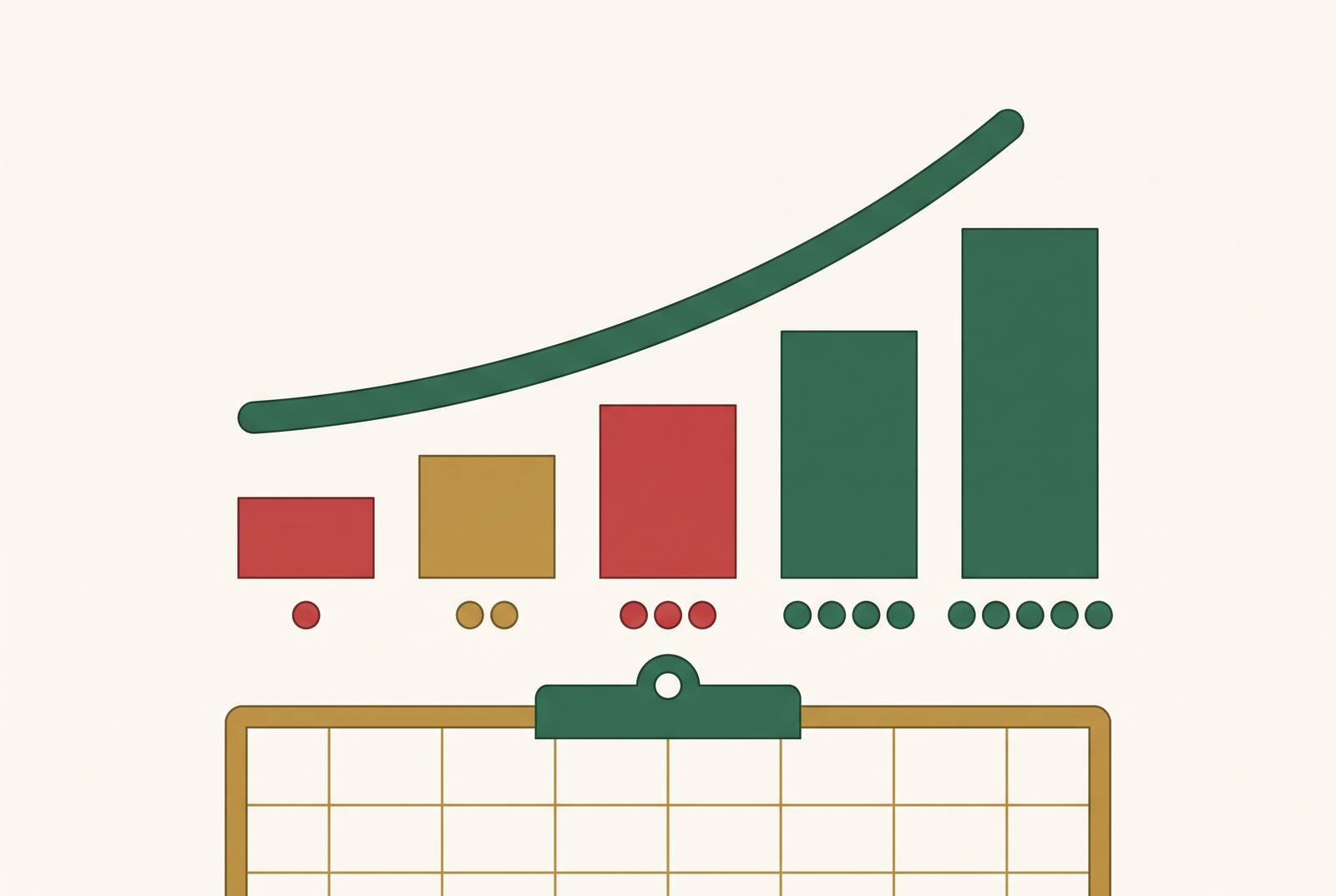
AP courses run on one immovable deadline: the May exam. That fixed endpoint changes how teachers and students think about time. When a school year has a hard stop and a high-stakes test waiting on the other side, the instinct is to build in more checkpoints along the way, more quizzes, more practice sets, more chances to catch a problem before it becomes a transcript. More checks feel like insurance against falling behind.
The logic seems sound on its face. More checkpoints should mean more chances to catch gaps and fix them before the exam arrives. Formative assessment, as a category, has earned its reputation for good reason: decades of classroom practice treat it as a core tool for improving performance. But the term covers an enormous range of practices, from a two-question exit ticket to a full diagnostic exam, and "doing more formative assessment" can mean wildly different things depending on which classroom you're standing in. Wu and Yu, writing in Frontiers in Psychology in 2025, point out that even though formative assessment is broadly endorsed, the precise pathway connecting it to actual performance gains remains unclear. That gap between endorsement and mechanism is where this argument starts.
Research on frequency as an isolated variable
Once researchers isolate frequency as its own variable, separate from design, timing, or stakes, the picture gets a lot less tidy than EdTech marketing tends to suggest. Adding more formative checks does not reliably move the needle on student performance.
Bulut, Gorgun, and Yildirim-Erbasli studied this directly in 2025, publishing in the Journal of Computer Assisted Learning. Using learning analytics on online formative assessments in higher education, they examined both frequency and stakes, meaning whether assessments were mandatory or optional, and found that increasing frequency did not reliably improve course performance. Participation rates shifted dramatically depending on whether a check was required or voluntary. Two classrooms with identical assessment calendars could show completely different real engagement underneath those numbers. Raw frequency counts can mask that difference.
The more interesting finding is that assessments used more strategically, fewer in number but mandatory rather than optional, appeared to carry more predictive and instructional value than simply piling on additional checks. One objection deserves airtime here: this was a higher education study, and AP classrooms differ in stakes, course length, and student motivation. But the mechanism driving the effect, engagement quality and signal clarity, isn't tied to any one setting. If anything, the AP calendar's fixed May deadline makes timing matter more, not less. That sets up the real question this research raises: if frequency isn't what drives outcomes, what is?
Predictive signal strength versus check frequency in AP prep
What formative assessments seem to reliably improve is the predictive signal: the ability to flag which students are struggling and where, early enough for someone to actually do something about it.
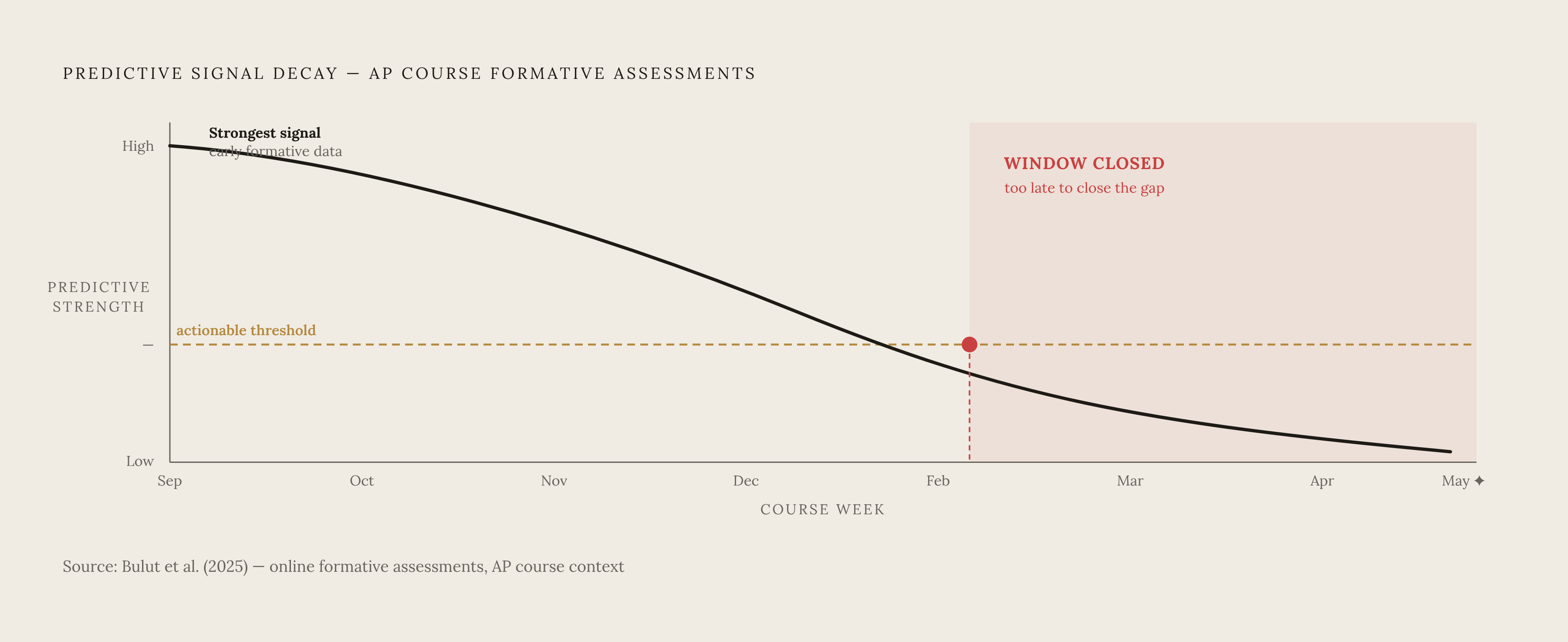
Bulut and colleagues found that online formative assessments predicted student performance most strongly earlier in the semester, with that predictive power gradually fading as the term wore on. Early, well-designed checks carried more weight than later ones, even when the later ones came more frequently. Offering assessments more often did seem to sharpen the predictive utility of the resulting scores, but the real driver wasn't volume. It was signal richness: more data points early in the term gave a clearer picture of who needed help before the window for help closed.
Applying that to an AP course makes the stakes concrete fast. Feedback arriving in April about material covered back in October cannot help the student who generated it. The window for using that information has already shut. That reframes what AP teachers should actually be optimizing for. The goal is maximizing how early and how clearly each event reveals which specific learning objectives a given student hasn't yet locked down, not squeezing in the maximum number of formative events across the year.
How assessment design determines a gap's visibility
Timing alone doesn't solve the problem. An assessment that spits out one overall score, no matter how early it's given, can't tell anyone which specific learning objectives a student is missing. That kind of feedback is too blunt to drive any real course correction.
Physics educators offer a useful illustration, since the structural flaw is visible so clearly in that field. Research-based assessments have long served as formative tools in physics classrooms, but fixed-length, end-of-course designs share a common weakness: an overall score doesn't show which specific objectives tripped a student up, and by the time results come back, it's too late for the student who took the test to benefit. The same structural reason produces that flaw in most end-of-unit AP practice tests across every subject.
Teachers' ability to act on the data in front of them is the deeper issue. Wei and colleagues, writing for CHI '26, found that teachers reading plain scores, without access to the reasoning behind a wrong answer, struggled to turn those outputs into specific instructional decisions. Pre-service teachers in their study couldn't engage in evidence-based reasoning when the assessment tool only handed them opaque numbers. Moving from score-based judgment to evidence-based reasoning requires assessment outputs that show what a student knows, where their thinking broke down, and what that breakdown implies for what comes next. A number alone can't carry that information.
Cognitive diagnostic assessments and explainable AI platforms exist precisely to close that gap, surfacing fine-grained knowledge mastery and specific cognitive barriers rather than a single aggregate figure. Wei and colleagues found that conventional assessment tools, by contrast, tend to produce opaque scores or parameters that actively hinder reflection and transfer. Their proposed fix: explainable platforms with scaffolding built in, designed to help teachers move from reading a score to reasoning through evidence.
The role teachers' capacity to act on assessment data plays in whether feedback produces change
Good timing and good design still run into a third requirement: a teacher has to be able to translate whatever the assessment reveals into a change in instruction. That translation step is itself a variable, and no amount of frequency or clever design fixes it on its own.
This isn't a question of teacher effort. Wu and Yu found that formative assessment shapes academic performance partly through the emotional climate a teacher creates in response to the evidence in front of them, a mediated pathway where how a teacher reacts to assessment data shapes whether students can actually act on the feedback they receive. Teachers aren't the bottleneck here. The tools handed to them often are.
Wei and colleagues' CHI '26 study shows that clearly. Pre-service teachers shifted from score-based to evidence-based reasoning once their assessment tools gave them visualized cognitive diagnostic reasoning, including contrastive and counterfactual explanations, the kind of output that shows not just what a student got wrong but what alternative reasoning would have gotten them to the right answer. Teacher capacity, in other words, isn't fixed. It moves with the quality of the scaffold underneath it.
Timing of feedback within a class period matters just as much as timing across a semester. Real-time AI grading of open-ended responses changes when a teacher can step in. Instead of reviewing results after class and adjusting the lesson plan for next week, a teacher working with immediate diagnostic output can redirect instruction in the same session the misunderstanding occurred. For an AP class, immediate diagnostic output lets a teacher notice that most of the room misunderstood the same conceptual move and catch it before the unit test, instead of after the damage is already baked into a grade.
The measurement problem in AP prep
A score, no matter how frequently it's collected or how early it arrives, can't tell anyone whether a wrong answer came from a missing fact, a broken procedure, or a flawed conceptual model. Each of those requires a completely different fix, and a single number flattens all three into the same outcome.
The foundational framework here traces back to Sadler's 1989 work and Hattie and Timperley's 2007 synthesis, later developed further by Black and Wiliam: effective formative assessment has to help a student answer three questions. Where the student is trying to go, where the student is now, and how the student closes the gap. A score, on its own, answers only the second question, and it does so crudely. It tells a student they're not where they need to be without telling them why or how to move.
Generic feedback compounds the problem. Telling a student "you got this wrong" makes them aware a problem exists without giving them any means to fix it. That gap matters more in an AP context than almost anywhere else, because the May exam tests applied reasoning across a full year of accumulated content. A student can drill hundreds of practice problems, score well on every unit test along the way, and still carry a conceptual gap that never gets examined, one that costs them precisely when the exam asks them to apply that idea in an unfamiliar context. Drilling more problems doesn't fix that kind of gap. It can actually make things worse, giving a student more repetitions applying a flawed model rather than surfacing the flaw itself. The correction has to come from feedback that names the breakdown in thinking, beyond just the wrong answer at the bottom of the page.
A formative feedback loop that predicts AP score improvement in practice
Putting the pieces from the previous sections together brings a different picture of effective formative assessment into focus, one defined not by how often a student gets tested but by whether each test surfaces the specific breakdown standing between that student and a qualifying score, early enough that something can still be done about it.
Early in the course is where this matters most. Mandatory assessments built around specific learning objectives, rather than broad cumulative reviews, produce the clearest, most actionable signal, and Bulut and colleagues' 2025 findings back this up directly: online formative assessments yielded their most predictive features earlier in the semester, which makes identifying at-risk students early the single highest-leverage move available to a teacher. Waiting until spring to find the gaps means finding them after the window to close them has already shut.
The feedback generated by those early assessments has to do more than mark an answer right or wrong. It needs to specify where the reasoning actually broke down, and Wei and colleagues' CHI '26 research shows that this requires explainable diagnostic output, not a raw score, to change what either a teacher or a student does next. A number tells you something went wrong. A diagnostic trace tells you what to fix.
AI-powered grading capable of evaluating open-ended responses, not just multiple-choice selections, can produce exactly this kind of diagnostic feedback at scale, across a full class, without waiting for a teacher to hand-grade every free-response answer. The quality bar for any such system is whether it can tell a student who's missing a fact apart from a student whose entire conceptual model is pointed in the wrong direction. Those two students need entirely different interventions, and a system that can't tell them apart is just producing a faster version of the same blunt score. For schools and teachers weighing how to build this into an AP course, the practical shift reallocates attention toward fewer, better-designed, mandatory checks that produce real diagnostic feedback, rather than piling more assessments onto an already packed calendar.
Sources
- The impact of frequency and stakes of formative assessment on student achievement in higher education: A learning analytics study - Bulut - 2025 - Journal of Computer Assisted Learning - Wiley Online Library
- The influence of formative assessment on academic performance: exploring the role of teachers’ emotional support - PMC
- Beyond Scores: Explainable Intelligent Assessment Strengthens Pre-service Teachers' Assessment Literacy