Student Self-Report Confidence Ratings as a Formative Signal
When students feel confident, they're often wrong about it.
This piece is about student confidence ratings as a formative assessment tool, and the argument is simple: they only work when a student's sense of certainty actually matches their performance, and the students who need that match most are the ones least likely to have it. Confidence ratings are cheap. A teacher can ask a room full of students to rate how sure they feel about a concept on a scale of one to five, collect the answers in seconds, and never grade a single paper to do it. That efficiency is the whole appeal. If a student genuinely knows what they know, their stated certainty should predict how ready they are, flag gaps before a test locks those gaps in place, and tell a teacher where to spend tomorrow's class time.
The logic holds up fine on paper. Formative assessment exists to catch problems while there's still time to fix them, and a tool that does that without extra grading hours looks like a gift in a busy classroom. But the entire system depends on one condition that nobody checks by default: does the student's internal sense of certainty actually track whether they're right? That condition has a name. It's called calibration, and it is not guaranteed, not consistent across students, and not stable from one topic to the next. When calibration breaks down, a confidence rating stops reflecting reality and starts reflecting something else entirely, maybe mood, maybe bravado, maybe just unfamiliarity with how little they understand. A room full of students reporting high confidence can look like a lesson that landed. It can also look exactly the same when half those students are about to fail the unit test. Confidence ratings don't tell a teacher which scenario they're in. Calibration is the variable that decides.
What calibration means and why it is the variable that decides whether confidence is signal or noise
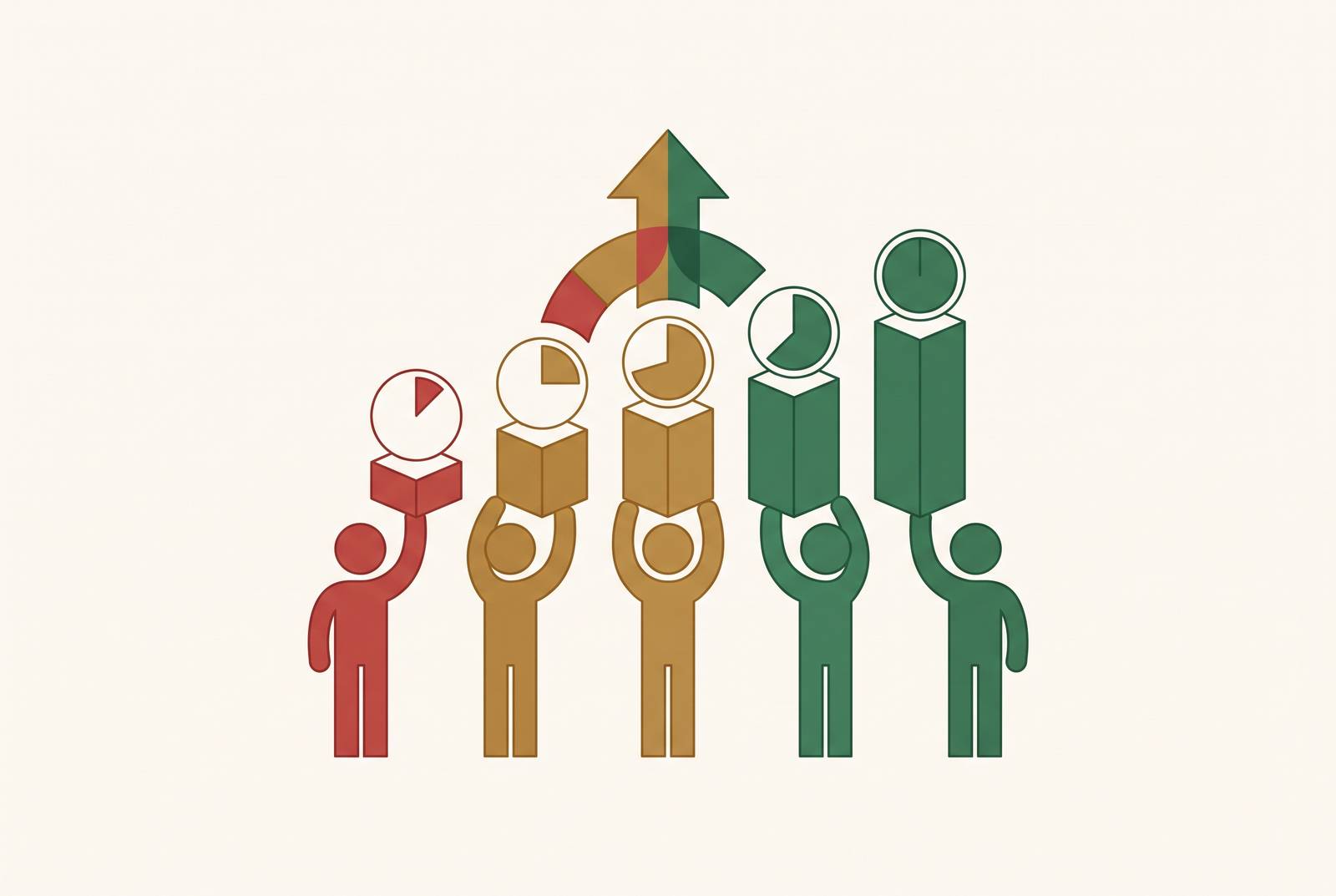
Calibration measures how closely a student's stated certainty lines up with whether they're actually correct. That's the entire definition, and it matters because it determines whether a confidence rating carries information or just noise dressed up as information.
A well-calibrated student is predictable in a useful way. When they say "I'm confident," they're usually right. When they say "I'm not sure," that uncertainty points to a real gap. Both answers are actionable, which is what a teacher wants from a formative signal. A poorly calibrated student breaks that predictability in either direction. Overconfidence hides gaps a teacher needs to see. Underconfidence can bury a student who actually has the material down, leading a teacher to spend time reteaching something that was never the problem. Of the two failure modes, overconfidence does more damage in a classroom setting, because it cancels out the intervention a teacher would otherwise make<sup>1</sup>. A student who says they're unsure at least gets noticed. A student who says they're sure, and is wrong, disappears into the data as a success story.
Research on trainee surgeons makes this concrete. A study using a suture self-assessment grid found that less experienced trainees tended to overestimate their own ability when researchers ran a multivariate analysis on the results. The same study found that anxiety affected how trainees rated themselves, while it did not affect the expert evaluators' scores of the same work. Emotional state was distorting self-assessment independently of actual skill, so two trainees with identical ability could rate themselves very differently depending on how anxious they felt that day<sup>1</sup>. The clinical setting doesn't matter here. What matters is the pattern: miscalibration wasn't random noise scattered across the group. It tracked experience level in a predictable direction. A teacher could, in principle, detect and correct for it. Tight calibration doesn't happen on its own. It has to be built, through repeated contact between what a student predicts and what actually happens.
Why the students who most need accurate self-assessment are the ones whose confidence is least trustworthy
The students who most need an accurate read on their own understanding are the ones whose self-assessment is least likely to be accurate. That means the tool fails hardest exactly where the stakes are highest.
Accurate self-assessment requires something a struggling student doesn't have yet, which is enough subject-matter knowledge to judge their own understanding against. A student who hasn't grasped a concept doesn't have the internal reference points to know whether their grasp is solid. The gap they'd need to see sits inside the very apparatus they'd use to see it. This is a structural feature of incomplete knowledge: the less a student knows about a topic, the less equipped they are to know what they're missing. The surgical trainee study backs this up directly. Overestimation wasn't scattered randomly across skill levels. It appeared in a systematic pattern that tracked inexperience rather than as noise.
Students prepping for a timed exam have probably lived this without a name for it. A student re-reads their notes the night before a test, recognizes the material as familiar, and rates their confidence high. That feeling of recognition is not the same thing as being able to retrieve the answer cold, under test conditions, without the notes in front of them. Same-day re-reading produces a convincing illusion of mastery. It does not produce the actual performance gains that come from retrieval practice, which is the act of trying to pull information out of memory without cues. So the students who complete a confidence check most enthusiastically, reporting high certainty across the board, may be exactly the students most likely to skip the practice that would have closed their gaps, arriving at test day with holes nobody flagged.
There's a real objection worth taking seriously here. Some research finds that overconfidence peaks not at the bottom of the knowledge scale but somewhere in the middle, among students who know enough to feel capable but not enough to see their own blind spots. That complicates any simple story where only the weakest students are the overconfident ones. But it doesn't undercut the core claim. Whether overconfidence clusters at the bottom or in the middle, the students who need intervention aren't self-identifying through their confidence ratings, because those ratings aren't tracking their actual gaps. If anything, a mid-knowledge peak widens the problem. It means students with real partial command of the material, not just the ones furthest behind, can also be giving teachers false readings.
How miscalibration plays out in classroom practice when teachers read confidence as a performance proxy
When a teacher treats confidence ratings as a stand-in for actual performance data, without cross-checking either, any miscalibration sitting inside a student's head flows straight into the teacher's decisions. The whole point of a classroom intervention loop is spotting who's struggling. If confidence ratings are doing that job alone, an overconfident student's high rating quietly cancels the help they needed.
Classroom tools built to surface live understanding, platforms that track student progress during a lesson and flag who's falling behind, only deliver on that promise if the signal reflects what students actually know rather than what they believe they know. A live dashboard full of high confidence ratings can create a false sense that the lesson worked, when the truer picture is that the struggling students don't yet realize they're struggling.
A study of medical students during COVID-19 put numbers to this gap. Students rated their own performance before seeing their actual scores, and researchers found a measurable gap between the two<sup>1</sup>. That gap wasn't uniform. Students with lower actual scores were less accurate in rating themselves: the students doing worst were also the worst judges of how they were doing. The practical failure isn't that confidence ratings exist or that teachers collect them. The failure is treating them as equivalent to performance data, when at best they're a correlated indicator that often lags behind reality.
As AI tools increasingly handle routine grading and feedback, the less teachers manually review graded work, the more a student's own self-report becomes the primary signal left for a teacher to read in real time. That shift raises the stakes on getting confidence ratings right, because the other cross-checks that used to catch a miscalibrated student (a teacher's eyes on returned homework, a stack of quizzes marked by hand) are doing less of that work than they used to.
What happens when self-reported confidence is replaced by or cross-checked against verified performance data
The fix isn't complicated in concept, even if it takes discipline to run consistently: swap self-report for direct measurement, or at minimum check one against the other. When that happens, gaps become visible in a student's performance whether or not the student ever felt uncertain about them.
Strong AP and SAT prep already runs on this logic without necessarily naming it. The cadence looks like this: assess with a real task, find the specific weak points, drill those weak points, then retest to confirm they're closed. None of those four steps asks the student how they feel about their own understanding<sup>1</sup><sup>4</sup><sup>8</sup>. Retrieval practice sits at the center of why this works. When a student tries to recall something without their notes in front of them, a real gap, not a perceived one, becomes visible to both the student and whoever's teaching them.
A 2024 study of nursing students in clinical simulation adds a useful data point here. Students who had prepared beforehand reported better self-confidence outcomes, with a mean self-confidence score of 4.44 out of 5 across the group, and the quality of the simulation itself positively affected both satisfaction and confidence. The takeaway is that structured, performance-based experience is what generated reliable confidence in the first place, not self-rating done in isolation. Confidence that follows demonstrated performance carries more weight than confidence that precedes it, because it's been tested against an external standard rather than generated from the inside by a student who may not have the knowledge to judge accurately.
This is also where AI-powered grading tools earn their keep, not as a replacement for teacher judgment but as a way to close the loop faster. When a tool returns item-level feedback immediately after a student submits work, it gives the student a fast, repeated comparison between what they predicted and what they actually produced. Over many attempts, that comparison is what calibrates confidence. Among tools built for AP and SAT prep, a platform like Passionfruit fits naturally into this picture: by tracking what a student actually understands against what they believe they understand, it turns the comparison between perception and performance into something that happens automatically, attempt after attempt, rather than something a teacher has to engineer by hand every time.
How educators can actively develop calibration rather than just work around its failures
Calibration is learnable. It isn't a fixed trait some students have and others don't. Educators who treat it as a skill to actively build, rather than something to assume or quietly work around, can turn confidence ratings from a liability into a genuinely useful signal.
The central move is closing the feedback loop between what a student predicts and what they actually score, and doing it consistently, soon after the prediction is made. A student who sees, over and over, exactly where their certainty diverged from their result starts adjusting their internal gauge. The medical student study referenced earlier built this loop directly into its design: students predicted their performance after each attempt, then immediately received their actual score. That structure made the gap between perception and reality visible to students in real time, and seeing that gap is the precondition for closing it. No one improves a measurement they never get to check against anything.
The surgical trainee study offers a parallel lesson from a different field. The self-assessment grid used alongside expert evaluation didn't fix anyone's calibration by existing. What it did was create a condition where a trainee could directly compare their own judgment against an outside standard, which is the only way a mismatch ever becomes visible enough to correct. One honest caution belongs here too: broader reviews of self-assessment tools have raised questions about the psychometric quality of many instruments in use, so not every confidence-rating tool on the market is built carefully enough to produce a trustworthy signal. Pair any confidence tool with real performance checks instead of throwing the tool out.
For a classroom teacher without access to a research-grade instrument, the fix is simpler than it sounds. Treat a confidence rating as a prompt rather than a conclusion. Ask "how confident are you?" and follow it immediately with "now show me," turning a passive self-report into an active retrieval check that generates real data on the spot. Track the gap between what students predict and what they score over time, not just once. Treat a large, persistent gap as a signal that calibration itself needs direct attention rather than assuming the content needs reteaching. For AP and SAT students working inside a platform like Passionfruit, that ongoing tracking of actual understanding against self-perceived understanding happens as a byproduct of normal practice, which is the version of this that scales without asking any single teacher to run the comparison by hand for every student, every day. Calibration, not confidence itself, decides whether confidence ratings help or mislead, and calibration only improves where self-report gets checked against real performance, consistently, over time.
Sources
- Full article: Student self-assessment: a meta-review of five decades of research
- Evaluating Satisfaction and Self-Confidence among Nursing Students in Clinical Simulation Learning
- Formative assessments during COVID-19 pandemic: an observational study on performance and experiences of medical students
- Student self-assessment: feasibility, advantages and limitations Example of a workshop for trainee surgeons using a suture score
- Prevalence of Dunning-Kruger effect in first semester medical students: a correlational study of self-assessment and actual academic performance
- The Accuracy of Health Professions Students’ Self-Assessments Compared to Objective Measures of Competence - PMC