What AI-Graded FRQ Feedback Can and Cannot Replace in Teacher Review
AI catches structural rubric gaps but misses the reasoning behind answers that look correct.
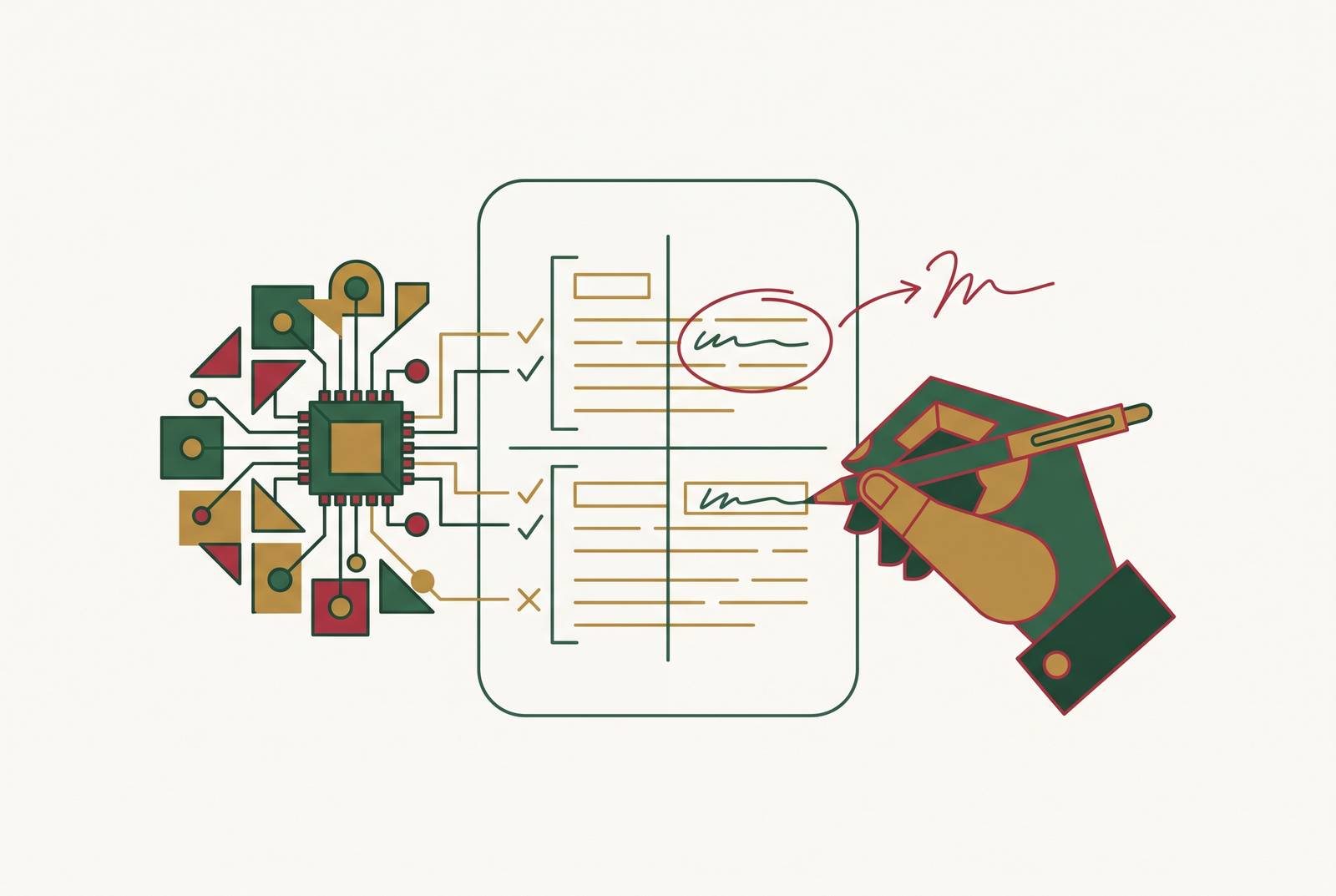
AI grading for AP free-response questions works best as a quick first pass that checks the answer against the rubric, shows students what is missing, and gives them a chance to revise. A teacher still needs to review the reasoning behind an answer, especially when smooth writing hides a misconception. AI feedback and teacher review are useful in that order.
Why AP students write FRQs and get feedback days later — or not at all
Write an essay, hand it in, wait. By the time feedback arrives, the class may have moved on, while the student has kept practicing the same approach. A teacher with many class sections cannot return a scored document-based question, or DBQ, the same night. That delay reflects limited capacity. Practice without feedback can reinforce the very errors the assignment was meant to expose.
In AP courses, those errors have time to settle in. A thesis-writing habit formed in September is six months harder to break in April, because each new response gives the student another chance to rehearse it. More practice is not automatically better practice. If the student keeps restating the prompt instead of making an argument, a growing stack of essays records repetition.
The supply of official practice material has also narrowed. AP Central has only the three most recent years of past questions publicly available, following a significant reduction in access to older FRQs. That makes the write-score-revise loop more valuable, because feedback helps students get more from each attempt. Yet most teacher AI adoption is in lesson preparation.
What rubric-aligned AI grading genuinely does well on FRQs
A thesis that merely restates the prompt has a recognizable structural problem. So does a DBQ that cites documents without explaining what they show, or a long essay question, or LEQ, that promises to compare two periods and never makes the comparison. These questions concern whether the answer does the work required to earn a point. Rubric-aligned AI grading is well suited to catching those omissions.
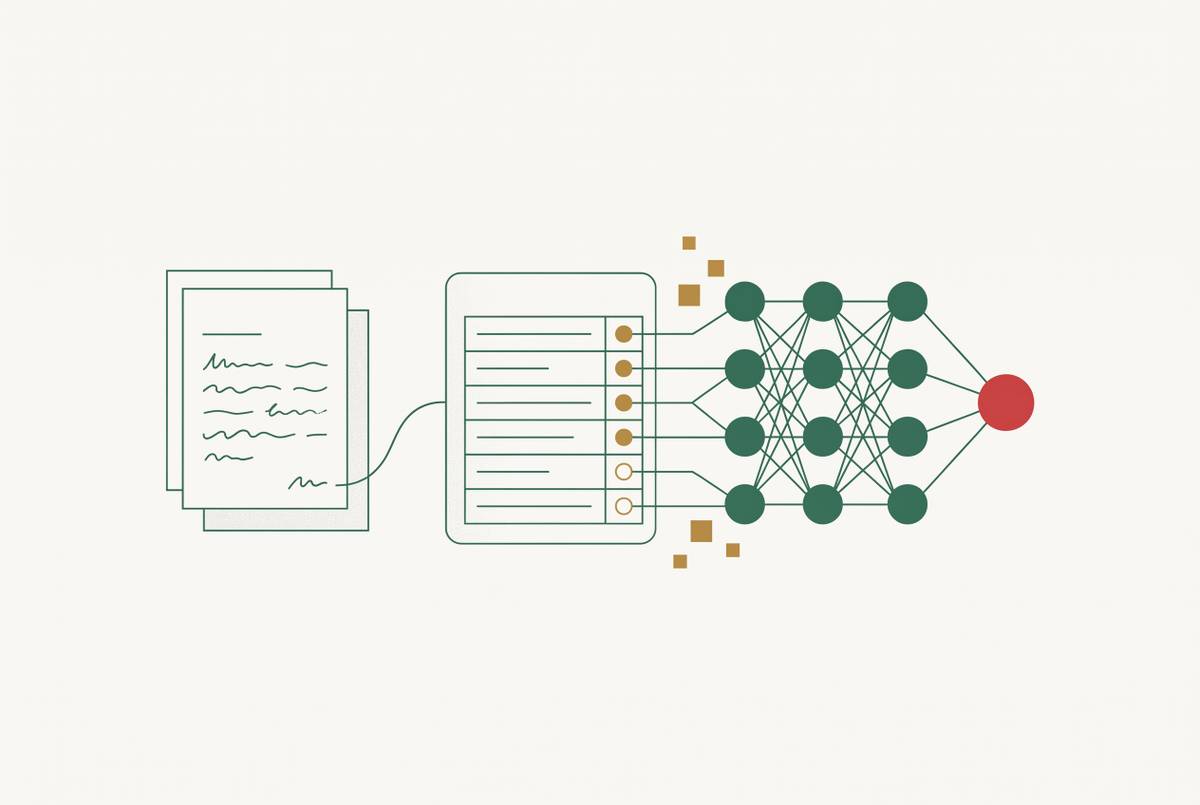
The mechanism is rubric decomposition. A system checks the response against the scoring criteria for that question, gives points for each rubric row, and explains which requirements the answer met or missed. That is structured evaluation. Mentioning a document is different from analyzing it, just as writing the word “compared” does not summon a comparison into existence. Useful feedback tells students what they still need to do, beyond giving them a disappointing total.
Research supports this capability within defined tasks. The 2025 benchmarking data puts AI agreement with human graders on rubric-based essay grading at 85–92%. “Automated Grading of Open-Ended Questions in Higher Education Using GenAI Models,” published in December 2025 in the International Journal of Artificial Intelligence in Education, found that its highest-performing model achieved close to perfect agreement with human expert graders on open-ended software engineering questions, with low false positive and false negative rates. Those results establish a real capability. They do not show that every AI grader does equally well on every AP response.
For students, the practical gain is speed. A student can write a DBQ, see which rubric row failed, revise, and attempt another that evening. No teacher with five sections can provide that loop at scale. At the class level, AI-generated scoring data can also reveal which topics or rubric rows are causing widespread trouble. That gives the teacher a diagnostic signal that would otherwise have to be assembled by hand from a stack of essays, leaving more attention for interpreting the pattern.
Where AI agreement with human graders breaks down, and why it matters for AP specifically
Agreement depends on what the grader must judge. The same 2025 benchmarking puts agreement with human graders at 75–85% on open-ended writing, below the range for rubric-based essay grading. The distinction is between tasks with tightly specified requirements and tasks where the quality of an argument demands more interpretation. Doing well in software engineering does not show how well a system will judge literary analysis.
A May 2026 study of AI grading of undergraduate essays found that every system tested gave higher scores for longer essays, a wider range of words, and more complex sentences, whatever the quality of the work. Agreement with human-awarded degree classifications varied considerably by institution, and the largest errors appeared at the extremes. The systems undervalued the strongest work and overvalued the weakest. The danger is a familiar one in a new form. An argument wearing a waistcoat can look more respectable than it is.
For AP, that bias has specific consequences. The sophistication point and AP Literature essays depend on whether an argument is genuinely defensible. A system that gives too much weight to how writing looks can mistake fancy wording for sound thought. Valid reasoning expressed in an unexpected way can look wrong to a grader that leans too heavily on a reference answer.
The December study found that sentence embedding models struggled with the semantic nuances of diverse student expressions. Some responses contradicted reference answers despite being semantically correct, exposing the risk of treating a reference as the only acceptable route. Content adds another source of error. AI feedback can hallucinate, with the risk becoming sharper around specific details such as an enzyme regulation mechanism in AP Biology, a court precedent in AP Government, or an event in AP US History. Fast feedback is useful, but speed does not certify either the score or the explanation attached to it.
What rubric scores cannot capture: the reasoning behind a correct-looking answer
Did the student understand why the answer worked? A rubric evaluates what appears in the response, while a student's reasoning may include a faulty assumption that happens not to spoil this particular result. The next question may expose it. This is a different limitation from scoring error, because the score can be right while the student's understanding remains wrong.
Consider a thesis that earns its point. The claim may be technically arguable, yet the student may be confused about causation, periodization, or how evidence supports an argument. A checked row establishes that the written claim qualified.
A practicing AP Calculus reader made a related observation after the 2026 AP Reading. The reader noted that nuances, exceptions, special cases, and other considerations would make the non-calculator FRQs difficult for AI to grade. Even structured STEM answers require interpretive judgment. Breaking a rubric into rows does not remove the need to recognize when an exception changes how a response should be understood. The example also shows why “structured” should not be mistaken for “simple.”
Revisions based on AI feedback can train rubric compliance, but a stronger-looking answer is not proof that the underlying misconception has gone away. If faulty reasoning becomes visible on the next response, an official reader can judge the work that the earlier score did not expose. Whether the student has an understanding that will survive a slightly different question remains unresolved.
What teachers can see that no rubric-checking system can
A teacher reads an essay with knowledge that the essay itself does not contain. Months of writing can show a recurring error, including one the student has already received feedback about repeatedly. Class discussion may reveal understanding that disappears on the page, or confusion hidden by fluent prose. That history changes the interpretation of the answer. A single-response rubric check has no way to recover context that is absent from the response.
For example, an unconventional structure can reflect strategic thinking or confusion. A teacher who knows both the rubric and the student can interpret the choice against earlier work and classroom discussion. Borderline claims and sophisticated arguments call for the same kind of judgment. A student needs to use a defensible thesis as part of a coherent argument.
That interpretive work has a different purpose from finding omissions. A missing comparison can be identified as a gap, but adding a comparison does not by itself show that the student understands the relationship between the periods. Several concepts may need to work together. A 2026 study published in Applied Sciences found that AI-generated personalized learning pathways significantly reduced lower-order learning gaps, but higher-order skills were still hard to learn, especially when learners had to bring several concepts together as the work placed more demands on their thinking.
This gives teachers an interpretive role. They can use a pattern of missed rubric rows as evidence while interpreting it through what they know about the student's thinking. The same visible omission need not have the same cause in every student. What the student needs from teacher review is an explanation of how their thinking is working, where it breaks down, and why a correction makes sense.
How to use AI FRQ feedback and teacher review together without confusing their roles
For students seeking instant feedback before the exam, AI feedback works best before teacher review as a first-pass structural check, including a missing thesis, uncited evidence, or an undeveloped comparison. It helps to work on those problems while the response is still fresh. Teacher review can then focus on whether the argument holds up and whether a correct-looking answer rests on sound reasoning. The sequence gives the two forms of feedback distinct jobs.
Choosing an AI grader therefore calls for attention to its scoring approach. The relevant criteria are question-specific rubric alignment, points assigned by row, and explanations of requirements met or missed. An encouraging paragraph is not a scoring method. Nor does matching human graders on one task show that a system will do as well on AP essays, especially when judging sophistication or literary argument.
For teachers, the corresponding use is diagnostic. Class-level analytics can show which topics and rubric rows students miss most often, helping teachers decide which concepts to review and reteach when many students struggle with them. The teacher still interprets what those patterns mean. A cluster of missing comparisons identifies where to look, but it does not explain every student's reason for leaving them out.
That division needs to be stated openly. Most students have not had a clear conversation with a teacher about what AI feedback can and cannot tell them, and most schools do not yet have explicit guidance on its place in the feedback workflow. Without that clarity, a fast score can be treated as equivalent to teacher review simply because both arrive labeled as feedback. The write-score-revise loop helps because students can go through it again with little wait. For students to learn from it, they need to treat rubric compliance as a first step toward strong work and keep working on their thinking after they meet the rubric.
Sources
- Pensieve Grader: An AI-Powered, Ready-to-Use Platform for Effortless Handwritten STEM Grading
- AI-assisted grading and personalized feedback in large political science classes: Results from randomized controlled trials
- Automated Grading of Open-Ended Questions in Higher Education Using GenAI Models - ScienceDirect