Using Rubric Transparency to Improve Student FRQ Self-Assessment
Students need practice applying rubric criteria, not just access to them.
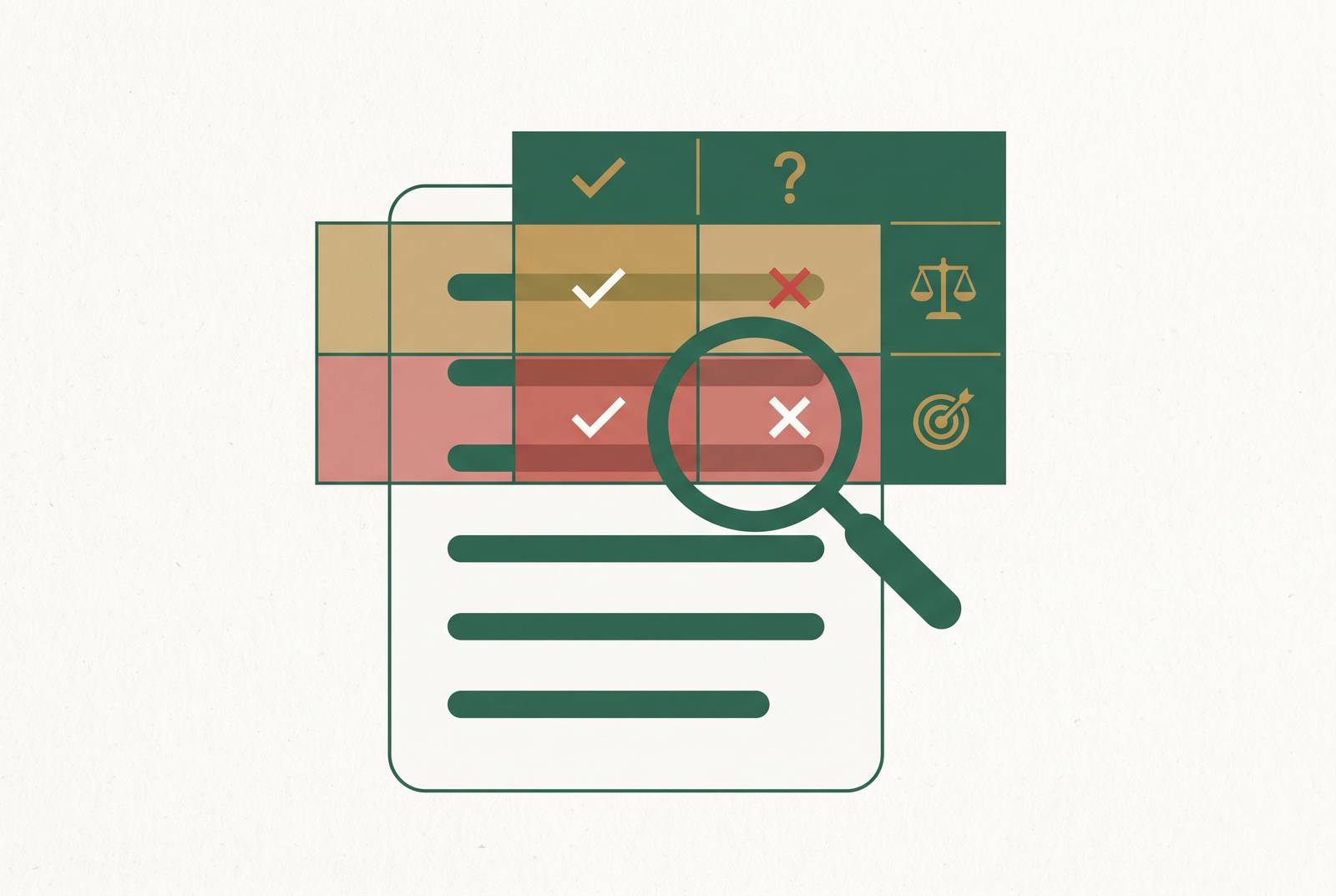
Rubric transparency can improve student FRQ self-assessment, but only when students learn to use the criteria. The useful shift is from handing out a scoring guide to teaching a produce-assess-revise cycle. That cycle turns the rubric into a tool for finding specific gaps between what a student thinks they know and what their response actually demonstrates.
Why rubric transparency alone does not improve FRQ performance
Posting a rubric on the board can feel like the intervention is complete. The expectations are visible, the points are explained, and nobody has to guess what counts. A rubric makes criteria and performance levels explicit, but that clarity supports learning only when students do something with it. A map is useful equipment, but owning one is not the same as navigating.
Students consistently report that rubrics help them focus and feel less anxious. Those gains matter, but feeling clearer about an assignment does not show that a student can score a response correctly. Studies in which students received a rubric without training in its use typically showed no, small, or only partial effects on learning. Students still need to use the rubric to decide whether the words on the page meet a criterion. In AP FRQs, that distinction has a direct cost because each question carries a specific rubric tied to discrete scoring points. A student can know that there are expectations and still get wrong what earns credit.
How students misread their own FRQ responses even when they have the rubric
The obvious worry is that students will award themselves points they have not earned. That happens when they credit the understanding in their heads rather than the understanding demonstrated in their responses. Students can discount work that actually meets the criteria, underrating a response that earns full rubric credit. These are different errors, but both send practice in the wrong direction.
Underestimation is not simply healthy modesty. If a student decides a successful response is inadequate, they may spend time repairing something that is not broken and lose confidence unnecessarily. Overestimation, meanwhile, leaves a real gap hidden behind a reassuring score. Having the rubric alone cannot solve either problem because the student must still make sense of the criteria. The scoring guide is not a mind reader, and it cannot award points for what the writer meant to say.
In the AP context, task verbs are a major source of this mismatch. “Describe,” “explain,” and “justify” demand different kinds of responses. A student who treats them as interchangeable can read a rubric carefully and still apply it incorrectly. Feelings also shape self-assessment, as students decide whether to excuse a gap or get caught up in a small writing error. Accurate scoring therefore requires more than careful reading. It requires guided practice in deciding what counts as evidence that a criterion has been met.
What the research says actually works: the produce-assess-revise sequence
Jonsson et al. (2025) identified two key characteristics common to successful rubric interventions in their review of studies. Teachers explained both the rubric’s content and how students should use it formatively. The instruction also followed a sequence in which students produced work, assessed it or received feedback, and revised. These findings put teacher explanation and the opportunity to act on feedback at the center of the process. Neither is decorative scaffolding that can disappear when the schedule gets crowded.
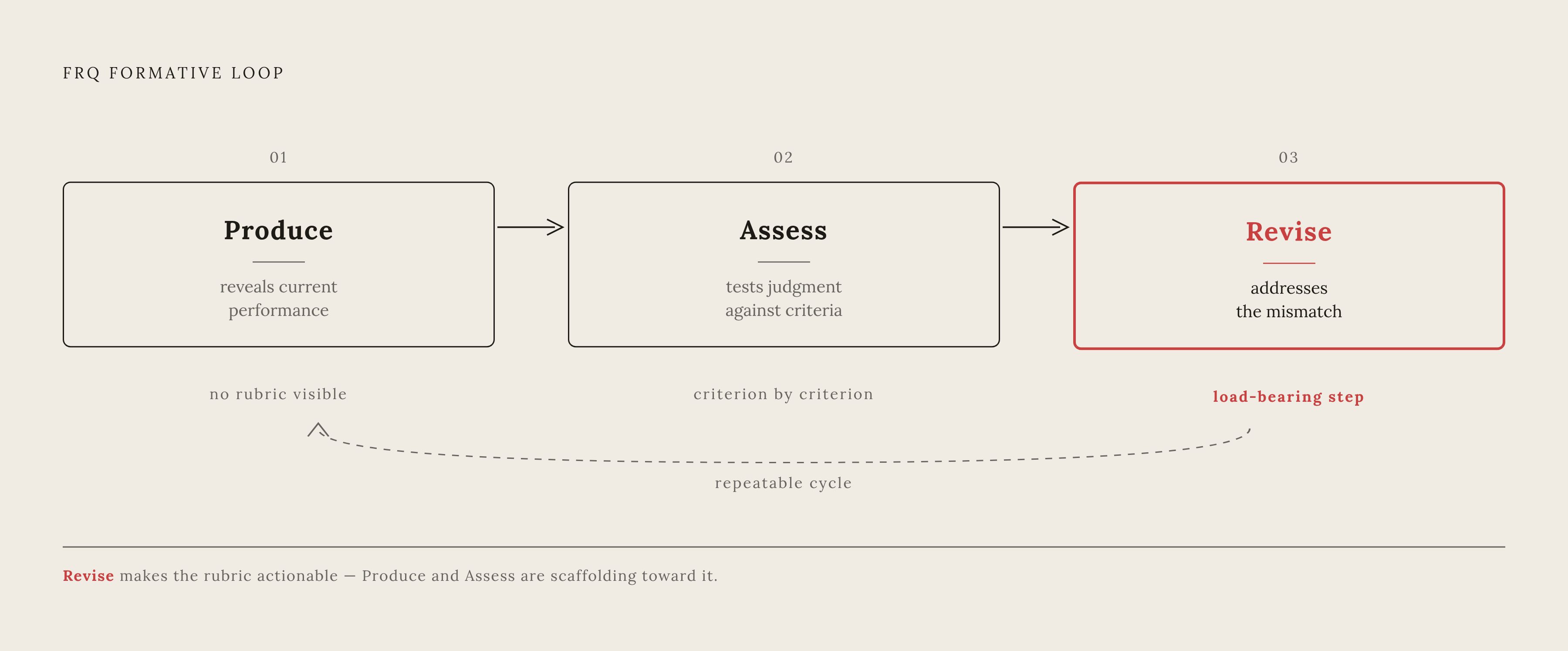
Revision is the load-bearing step because it gives the assessment somewhere to go. Without it, students may identify a weakness but never practice correcting it. The rubric becomes actionable when a student changes the response because of what the assessment revealed. Diagnosis is an intermediate step in learning.
For FRQ practice, this changes the unit of instruction. A practice question is no longer a single writing task followed by a wait for a grade. It contains three distinct student actions, each with its own purpose. Producing reveals current performance, assessing tests judgment against criteria, and revising addresses the mismatch. Students are therefore practicing how to evaluate their work as well as how to answer the question.
Teaching students to apply task verbs before they touch a practice FRQ
Before students can make those judgments, they need to understand the language that controls the scoring. AP rubrics are criterion-referenced and task-verb-driven, so a point depends on a specific kind of thinking shown in the response. “Describe” requires students to identify a feature without explaining it. “Explain” requires information about how or why a relationship, process, or outcome occurs, using evidence and/or reasoning to support a claim. “Justify” requires students to defend a claim with evidence and reasoning.
These distinctions are easy to flatten into a vague instruction to write more. But more sentences may still leave out the reasoning that is needed. A longer description can remain a description, just with more luggage. An exam redesign makes attention to the exam’s demands especially important. Generic writing quality is not a substitute for showing the operation a task requires.
Give students two or three responses at different rubric levels for the same prompt and ask them to score each. Comparing their judgments with the official scoring surfaces where their reading of a criterion diverges. The goal is calibration, meaning that students can roughly predict a response’s score before seeing the official result. That preparation helps them base self-assessment on more than whether an answer reads well or feels convincing.
How self-assessment during revision surfaces knowledge gaps that practice alone misses
Once students can interpret the criteria, self-assessment can reveal more than whether an answer is wrong. Consider a student who cannot award a point because they cannot tell whether their response meets the requirement. That uncertainty is itself useful information about their understanding. The student’s difficulty now has an address in the rubric.
This specificity changes what the student can study next. A student who recognizes that a response describes a relationship but does not explain it has identified a missing reasoning step. A student who sees only a low score has a much vaguer direction. Rubric-guided self-assessment can also show that a response uses the wrong framework altogether, even when the writer at first thinks the answer is right. Multiple-choice practice and feedback on final submissions do not reliably bring that kind of gap into view in time for revision.
Fraga-Viñas & Bobadilla-Pérez (2025) found minor disparities between student self-assessment and teacher assessment when students used a rubric in an EFL writing context. Students also said they knew more about how they learn. That finding supports the formative value of evaluating work against criteria, without establishing that every AP self-score will be accurate. Students make a metacognitive gain as they get better at telling what they have shown they know from what they assume they know. To keep that distinction useful, frame self-assessment as diagnosis. That framing matters when students are tempted to forgive a gap they have noticed or retreat into fixing surface errors instead.
Peer assessment as a check on self-assessment accuracy and a second round of rubric engagement
Peer assessment using the same rubric adds a check on the writer’s judgment. When the two scores diverge, the disagreement becomes material for learning. One student may have misread a criterion, or both may be interpreting it in different defensible ways. Either possibility deserves attention before the writer revises.
A useful discussion of an FRQ response requires the assessor to articulate the evidence for why the answer does or does not satisfy a specific requirement. That explanation is a different act from simply reading the rubric or writing an answer. It gives the assessor another round of engagement with the criteria while giving the writer a second view of the response. The disagreement can therefore be more instructive than the score itself.
This benefit depends on preparation. Peer feedback is only as reliable as the peer’s understanding of the rubric, which makes calibration an equity concern as well as an instructional one. Students should not get less useful feedback just because their partner misunderstands a task verb. The earlier work with criteria and exemplars is therefore a prerequisite. The argument here is for formative peer assessment that informs revision.
Where AI-assisted grading fits into the produce-assess-revise cycle for FRQ practice
The practical obstacle to repeating this cycle is often feedback latency. A student who writes an FRQ on Tuesday and receives teacher feedback on Friday cannot act on it while the attempt is still fresh. AI-assisted grading aligned to official rubric criteria can shorten that delay. It works best when it makes the cycle easier to repeat by giving students a rubric-aligned score to check their self-scores against before they revise.
That distinction protects the learning task. If an AI score substitutes for self-assessment, the student loses the practice of judging their own response. If it follows self-assessment, the comparison can reveal where the student’s interpretation needs attention. Speed is useful here because it gives the student a chance to act.
Human review remains necessary. AI-generated scores should be editable and reviewed before publication to students, and teachers need to verify alignment with the current year’s exam specifications, particularly when exams are redesigned. Prompt choice also affects how much a practice attempt can reveal. Students may already know older rubrics and sample responses that have been widely shared, so these may reveal less about what students can do. Prioritizing current-year, unseen prompts helps keep the practice focused on what students can produce.
What teachers need to change about how they structure FRQ practice sessions
When planning a unit, reserve time for the whole cycle rather than treating revision as whatever fits after grading. Start with explicit instruction in the rubric’s content and formative use, including the task verbs students will need to distinguish. Then make the produce stage a baseline attempt. Have students write the FRQ without the rubric visible, simulating exam conditions. This separates their current understanding from performance guided by a scoring sheet.
At the assess stage, provide the rubric and ask students to score their responses criterion by criterion. Have them note which points they cannot award and why, including places where they are unsure how to judge the evidence. Check those judgments with peer assessment from students who have practiced calibration or with AI feedback that has been reviewed. Then require revision through a rewrite or annotations that address the unmet criteria. Keep the revision visible beside the original so that both the gap and its repair are explicit.
This structure costs instructional time, so the support around it matters. AI-assisted grading can reduce the feedback burden and help teachers run practice more often without proportional increases in grading time. Riahi et al. (2026) noted that teachers rarely create rubrics from scratch because doing so is time-consuming. Teacher-refined AI rubric drafts can lower that barrier and leave more attention for explanation and discussion. The goal is a student who finishes an FRQ session able to name a specific gap, explain where it appears in the response, and show how to address it.
Sources
- Self-assessment with Rubrics as a Key Tool in the EFL ...
- Full article: Using rubrics for formative purposes: identifying factors that may affect the success of rubric implementations
- Rubrics as a way of providing transparency in assessment Anders Jonsson*
- Rubrics enhance accuracy and reduce cognitive load in self-assessment