How AP Free-Response Grading Rubrics Are Encoded Into AI Scoring Models
AI models score AP rubrics best when trained on human-scored examples for each criterion separately.
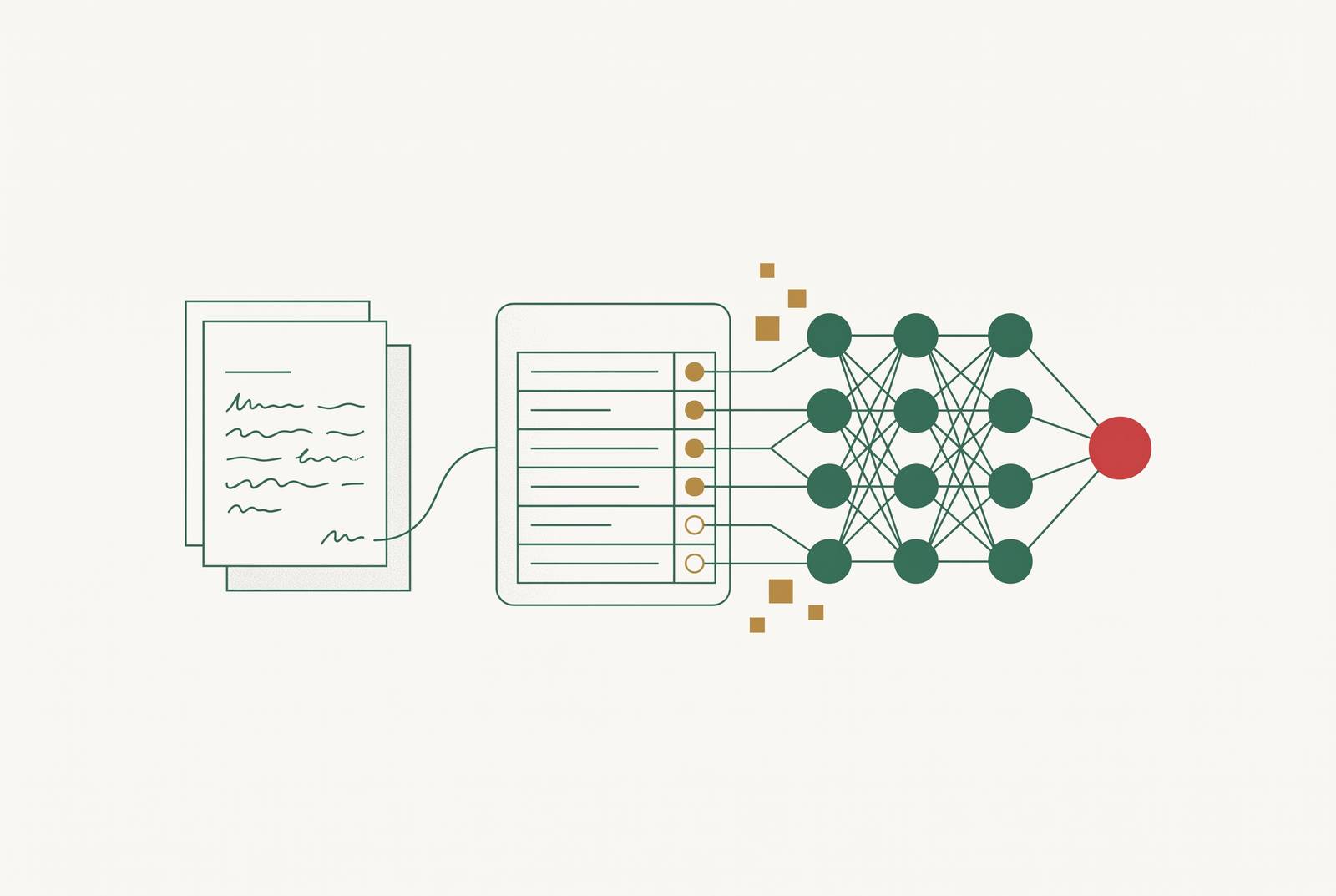
AI grading for AP free-response questions works best when models score each rubric criterion separately and calibrate those judgments against human-scored examples. Good feedback on a missed explanation does not show that scoring instructions built from rubrics work as well for literary Sophistication.
The two rubric structures AP scoring uses and why they cannot be treated the same way
One AP exam uses two scoring systems in the same test. Its first three free-response questions mostly award discrete points for meeting a specific task, such as identifying, describing, or explaining something accurately. Concept Application has 3 points spread across three parts scored on their own, while Quantitative Analysis has 4 points across four parts. SCOTUS Comparison has 4 points across three parts, and Part B can earn 1 or 2 points.
The argument essay changes the scoring structure. Its 6 points sit in four rows, namely Claim/Thesis, Evidence, Reasoning, and Response to Alternate Perspectives. Claim/Thesis, Reasoning, and Response to Alternate Perspectives each use a binary 0–1 judgment, while Evidence ranges from 0–3. The top Evidence band requires use of a foundational document listed in the prompt.
AP Chemistry and AP Physics award points for correct substitutions, labeled calculations, and sound reasoning even when the final answer is wrong. AP Literature uses a 6-point analytic rubric across all three essay types, with Thesis at 0–1, Evidence and Commentary at 0–4, and Sophistication at 0–1. AP Seminar’s Individual Written Argument stretches to 7 independent rows and 48 points across Context, Perspective, Argument, Evidence, Citations, and Style. Checking that a concept is named correctly differs from judging whether commentary adds meaning or just retells the text.
Why point-independence is the first engineering constraint AI must satisfy
For point-based questions, the first engineering requirement is independence. Earning one point must not make the next point easier to earn, and missing one must not contaminate judgments elsewhere. A general-purpose AI summary works in the opposite direction, blending details into a synthesized evaluation. That can lead to comments that read well but use the wrong scoring logic.
A scoring system can return a separate JSON entry for each rubric row, then validate the output and retry if it cannot be parsed. This makes the scoring units explicit and keeps missing or malformed entries from passing unnoticed. The model must still assess the evidence for each criterion rather than distribute points according to its impression of the whole answer.
Quantitative work adds another constraint to that separation. When one sign error cascades through later arithmetic, the model must locate the original mistake rather than deduct repeatedly for every inherited wrong value. Correct moves elsewhere can still deserve partial credit. Handwritten submissions add an earlier dependency because optical character recognition, or OCR, must preserve fractions, arrows, and unit labels before scoring begins. If a fraction is misread, the grader is judging a different calculation, however carefully it follows the rubric afterward.
How few-shot calibration with anchor responses encodes rubric intent into the model
The main way to teach the model how to use the rubric is few-shot calibration with human-scored anchor responses. The model receives the task, the official rubric, and representative answers spanning score levels, so that written rules arrive with examples of their application. Anchors supply what rubric text leaves implicit. They show how an explanation earns credit and how one that sounds relevant can stop short of the required reasoning.
The Autorubric paper’s RiceChem finding supports the value of adding examples, reporting better accuracy with few-shot prompting than with zero-shot prompting. A 2026 study published in the National High School Journal of Science complicates any claim that more scoring instructions automatically produce better judgments. The study found that rubric-guided prompting alone did not consistently improve agreement with human labels, and reduced DeepSeek-R1’s accuracy while introducing inflation bias. Those findings pull against a simple “paste in the rubric” approach. Together, they support a narrower interpretation in which calibration does the work that rubric wording cannot do alone.
FRQuick exposes this pipeline in a concrete implementation. The DC student project, named DC’s top Track II project in the 2026 Presidential AI Challenge, sources its rubric from the published file containing the questions and grades point by point using full-, partial-, and no-credit examples. It returns structured JSON, validates that output, and retries on parse failure, while caching the instructions, examples, and rubric. Failure handling is part of the design. If its primary Claude grader fails, it tries a Workers AI backup, with a final fallback to rubric self-scoring and an explanatory note if both fail.
These details describe more than a carefully worded prompt. They combine scoring examples, output checks, and fallback behavior around the model’s judgment. The wider automated-scoring field uses hand-engineered feature-based methods and deep learning methods, and hybrid implementations that combine them have worked well in practice. Calibration is one part of that larger system, which is still needed. A valid output can still contain a bad judgment, just as an excellent rubric cannot rescue unreadable input.
Why holistic analytic rows — especially Sophistication — resist the same encoding approach
On short, well-structured tasks with clear criteria, automated scoring can be as accurate as human raters, but it does less well when the writing is open-ended or the criteria are unclear. Essay rows demand a different kind of judgment. An Evidence and Commentary score depends not just on whether evidence appears, but on how effectively the writing uses it to develop an interpretation.
Multi-band rows also expose central tendency bias. LLM judges can cluster scores toward the middle, avoiding the extremes and reducing exact agreement on a 0–4 scale. Adjacent accuracy, which counts judgments within ±1 point, provides another view of that performance, while coarser scales can ease the problem. Neither makes exact and near agreement interchangeable. Being one point away can look reassuring in a benchmark and still leave a student with the wrong account of what the essay earned.
Sophistication presents the sharpest version of this challenge. AP Literature defines it through “complexity, nuance, or a purposeful writing style that strengthens the interpretation,” so particular content must contribute to that effect to satisfy the criterion. Judging how well a student explores tension, explains ambiguity, goes beyond a surface reading, or keeps a controlled analytical style means judging the quality of the interpretation. There is no magic-word detector for nuance. FRQuick user feedback highlights its refusal to award the point for “a sentence or two added as an afterthought,” showing how actively this boundary needs calibration.
A 2026 AIME-Con study found that anchor-based comparative judgment had much higher adjacent precision across prompts than direct scoring, and even its lowest comparative result was above the highest direct-scoring result. That supports comparison with scored examples as an architectural alternative. Directly assigning a rubric score and judging a response against anchors are different tasks for the model. The practical implication is that Sophistication benefits most from teacher review, even when other rows are scored reliably.
How rubric recalibration and the digital transition create a moving target for AI models
Calibration has a date attached to it. When scoring standards are recalibrated, older anchors may preserve a superseded interpretation even if the rubric’s words remain identical. A model trained on pre-2025 examples for affected subjects can therefore apply yesterday’s benchmark to today’s response. The mismatch can be hard to see. Quoting the current rubric correctly does not establish that the model applies its criteria according to current expectations.
The 2025–26 digital transition also changes how work gets to the model. Fully digital exams, including AP English Language, AP Psychology, and AP US History, submit responses through Bluebook, while hybrid math and science exams retain handwritten free-response work. Other assessments remain outside Bluebook, including Art and Design portfolios, AP Music Theory, AP Research, and world language exams. Outside Bluebook does not mean one common format. AP Chinese and AP Japanese use a separate application that runs on a device, while the paper-based world language exams listed here use booklets.
For scoring models, the relevant distinction is the route from student work to readable evidence. The risks when reading typed responses differ from those for handwritten calculations, especially when the steps in a calculation themselves earn partial credit. A change in how work is submitted can therefore affect whether a score is valid before the model reaches a rubric row. This makes encoding an ongoing maintenance task. Current anchor responses are needed when standards change, while changes in submission format require renewed attention to whether the scoring pipeline preserves the work those anchors are meant to judge.
What the teacher workload problem reveals about the practical value of getting rubric encoding right
An AP Biology teacher with a large roster across three sections can face well over a thousand rubric-scored responses by April, with four to six FRQs per unit. Each response contains several judgments. Hand-grading at that depth is what pushes teachers to cut practice frequency by spring, and reduced practice cadence correlates with lower scores. Questions are available, but feedback capacity is the bottleneck. Faster scoring is useful only if it preserves the distinctions that make the practice instructive.
What teachers need is evidence at the criterion level. A holistic total does not show which element a student attempted, which one was missed, or where the reasoning stopped. A well-encoded model can provide that breakdown without asking the teacher to reconstruct every score from the response. Consistency is another potential gain in team-taught courses, where human calibration can drift and takes work to maintain. But applying a poorly calibrated standard the same way each time just makes the same mistake faster.
A teacher can distinguish a Thesis problem from an Evidence and Commentary problem and use that detail to choose what to reteach. EssayGrader says its AP Seminar IWA grader evaluates all 7 rubric rows in under 2 minutes, illustrating the time compression possible with row-level scoring. Speed and accuracy remain separate claims. The classroom value comes from reducing grading time while retaining enough detail to support more practice and more focused instruction.
How rubric-encoded AI feedback changes what students understand about their own knowledge gaps
“Incomplete” describes an answer’s shortfall without locating it, while rubric-point feedback can identify that an explanation named the concept and the phenomenon but omitted the causal link between them. That names a move the student can revise. It also separates knowing the relevant concept from using that knowledge to explain an outcome. Those gaps call for different work, even if they produce the same lost point.
A student can redraft the missed rubric move, resubmit, and compare the affected row rather than hope that a generally better-sounding answer will earn more credit. FRQuick implements this through inline highlights tied to criteria and a fix-and-regrade loop that compares changes between drafts. The comparison gives revision a clear target. Instead of tracking only wrong answers, the system can distinguish trouble with claim formation, evidence selection, or commentary quality.
This is the educational payoff of careful encoding. The scoring architecture can produce feedback that reveals a break in reasoning or merely reports the size of the loss. More practice alone does not make that distinction visible, whereas criterion-level feedback gives students a specific gap to work on. Yet the same precision should govern how its limits are described. On Sophistication, AI feedback is most useful as a flag for teacher review, and students should treat the score as a provisional signal to discuss with their teacher.