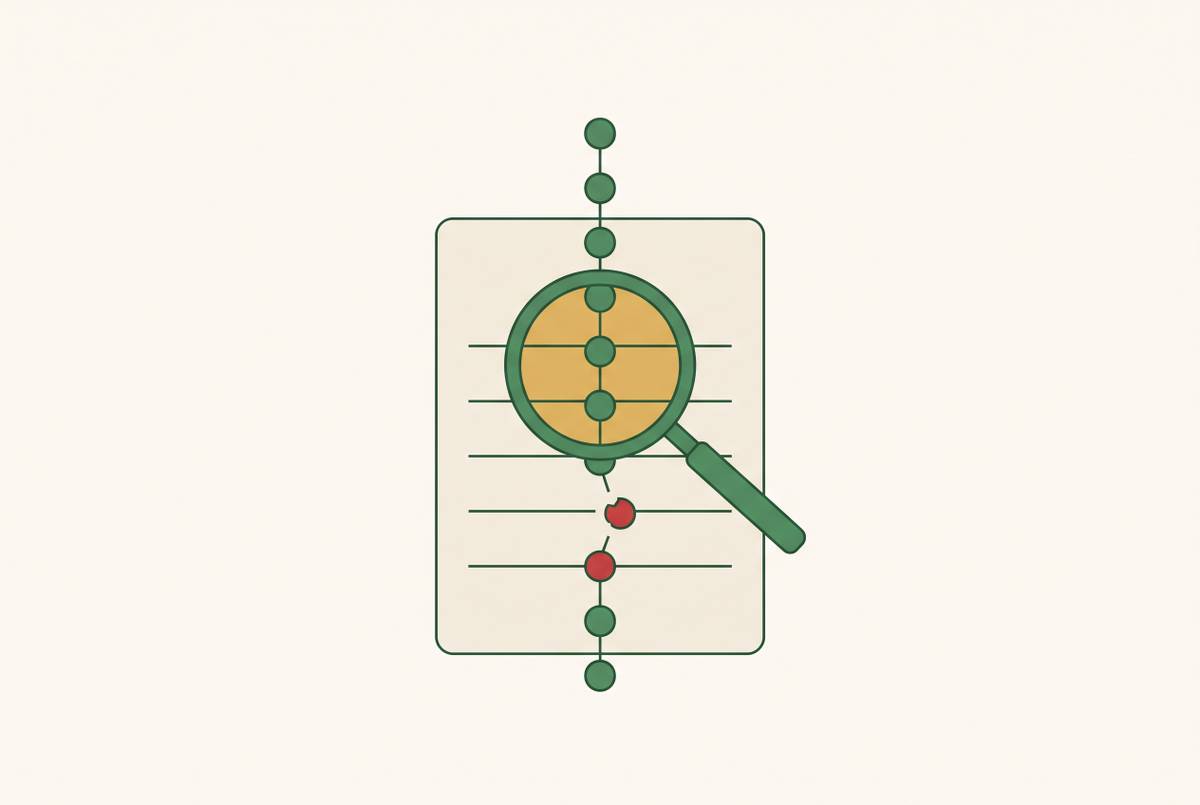
Mapping the Exact Reasoning Step Where FRQ Points Vanish
Identify the exact step where students lose points on free-response questions.

Free-response question points disappear at identifiable steps. Diagnosing those losses involves separating task-verb errors, missing mechanisms, unused evidence, absent commentary, and communication failures. For AP students who know the content but keep missing points, useful knowledge gap diagnosis identifies the first broken step and makes that step the target of the next practice session.
Why FRQ scores fall below what students actually know
A student’s knowledge and a student’s scored response are not the same thing. The rubric can assess only what reaches the page. Each row is scored on its own, so a correct final answer earns no credit for required reasoning it skips, while a wrong final answer can still earn many points for correct steps.
Does the student lack the concept, or did the response leave out the reasoning? Those are different problems with different remedies. When the student knows the content, reviewing it again does not help them put that knowledge into words. The useful unit of diagnosis is therefore the point-earning step.
How task verbs create the first and most common point-loss gate
The earliest break can happen before the student writes anything. Task verbs tell students what kind of work the response must do, and even a correct fact earns no credit if it answers the wrong kind of question. This verb mismatch recurs across Biology, Government, World History, Physics, and Psychology. It is the most common avoidable gate because students can recognize the topic while overlooking the instruction. Familiarity with the noun distracts them from the verb.
AP World History provides a compact map of the distinctions. “Identify” asks for a name, so a paragraph may earn the same point as a phrase while consuming more time. “Describe” asks for specific features at the observational level. “Explain” goes further by requiring a causal chain. “Justify” requires a claim supported by evidence or reasoning, rather than a claim standing alone and looking confident.
“Compare” adds a different obligation to the response. It requires both sides to be connected, with a linking word making the comparison explicit. Two separate descriptions leave that work unfinished. The reader may see the connection, but the student has not performed the requested comparison. In this sense, the verb sets the minimum sentence type needed for the point.
The diagnostic move is to highlight that verb before writing and then test the answer against it. Does an “explain” response actually say why, or does it merely describe what happened? Does a “justify” response provide support? A “because” can help expose the needed connection, but it is not a magic password. What follows it must supply the reasoning the prompt demands.
The mechanism gap: naming a phenomenon without explaining why it happens
Even a student who reads “explain” correctly can stop one step too soon. The response names an outcome, then treats that name as its explanation. This is the mechanism gap. The rubric rewards the move beneath the label.
In AP Biology, “the enzyme becomes denatured” names the phenomenon but does not finish the mechanism. The missing chain explains that high temperatures disrupt hydrogen bonds and hydrophobic interactions, which makes the active site lose its specific 3D shape. The mechanism point depends on that deeper account of how the enzyme becomes “denatured. The label is not the explanation in miniature. Ask “at the molecular level, why does this happen? An answer that says nothing about bonds, shapes, proteins, or molecules may still stop at what happens.
In AP Physics 1, the equivalent stopping point is a computed answer without the principle that justifies it. The number may be right. Yet the response has not named whether the calculation rests on conservation of energy, Newton’s second law, or kinematics. The justification point rewards that stated basis rather than asking the grader to reconstruct it from the arithmetic. Students can check whether they have named the principle before the calculation line it supports.
In AP Psychology, naming a concept likewise differs from applying it to explain evidence. The redesigned Evidence-Based Question works with research studies, so the explanatory task is not completed by supplying a definition. The concept has a job to do. The rubric rewards its application to cited evidence, and the diagnostic question is whether the response explains that evidence through the concept rather than merely placing the two next to each other.
The student has supplied an endpoint without making the explanatory route visible. That is different from failing to find evidence. A response can also contain a sound explanation in general terms while failing to use the particular document, graph, or data supplied by the question. The next gate tests that relationship.
Citing evidence versus using it: the distinction rubrics enforce but students miss
A document title shows that the student knows the document, while a specific idea from it can help support an argument. Naming evidence leaves its relevance for the grader to infer. Using evidence makes the connection available for scoring.
In AP US Government, the Argument Essay requires evidence from at least one foundational document. The required list expands from nine to thirteen effective fall 2026, but the diagnostic distinction is between recognizing a document and deploying its content. A correct title is not enough. After the title, does the response quote or paraphrase a specific idea and explicitly tie it to the argument? If not, the document has received a name tag but no assignment.
In AP Biology, the same problem comes up with graphs and data tables. When a question expects specific values, an answer that could have been written without seeing the data fails to provide the required reference. General knowledge cannot fill that particular slot. The revealing test is whether the response depends on those data at all.
In AP World History, “there were new crops” has a similar weakness. It names a broad category without identifying specific items, regions, or the economic mechanism connecting them. Specificity is doing evidentiary work here. A stronger response names the items and regions and explains the connection. What does the evidence prove about the larger claim?
Listing examples without explaining what they prove: the commentary collapse in argument essays
An essay can give clear, accurate examples and still stop at listing them. This is the commentary collapse. The student has selected evidence but has not explained how it advances the argument’s line of reasoning. The essay becomes a display cabinet when the task calls for an argument.
In an argument essay, this distinction is especially consequential because evidence and commentary account for the largest share of the essay rubric. A thesis establishes a position, but the evidence-and-commentary work develops the reasoning that supports it. More examples cannot automatically repair missing commentary. If the response never explains what an example proves, adding another may simply repeat the same failure with a different fact. The expensive omission is the connection.
AP Government also requires students to respond to a counterargument. “Some people think federalism is good” acknowledges another position without responding to it. Acknowledgment is not engagement. The required work is a developed paragraph that takes the counterclaim seriously and refutes it with evidence. “Some disagree” opens a door, but it does not walk through it.
AP World document-based essays place a similar demand on sourcing. Naming a document’s perspective or origin does not finish the task unless the response explains why that feature is relevant to the argument. The diagnostic question after each piece of evidence is “what does this prove about my claim?” If the answer exists only in the student’s head, the commentary step is absent from the response.
Format and communication failures that cost points independent of reasoning quality
Students can lose some points even when they understand the content well. They reflect omitted or incorrect response components that the rubric assesses independently. Diagrams, units, named principles, and required paragraph forms are not interchangeable with a correct final number. Their presence has to be checked separately.
In AP Physics 1, a free-body diagram can fail through distinct errors, including unlabeled vectors, missing forces, or drawing on the object without representing it as a point particle. Those omissions still cost points even if the math that follows is correct. A paragraph-argument prompt creates another independent requirement. Bullet points or a single sentence do not satisfy the demanded paragraph form, even if they contain pieces of the intended explanation.
The grader can also check on its own whether the answer names a physics principle. If it is missing, that can show a justification gap, while wrong signs on force components or misread graph slopes and areas show different errors. These should not receive one vague label. “Careless physics mistake” blurs a missing diagram, a sign error, and an unstated principle into the same diagnosis. Each calls attention to a different place in the response.
In AP Government, the SCOTUS Comparison FRQ has a required sequence. The response identifies the shared constitutional clause, amendment, or provision, explains how the facts of both cases led to different holdings, and connects the required case’s holding to a named course concept. A case name cannot substitute for those steps. “Both cases are about equality” states a superficial similarity between the cases without the specific legal distinction needed for the reasoning row.
In AP Biology experimental design, the required nodes include the independent variable, dependent variable, control group, measurement method, and replication. Each omission is a separate loss. Students can check their work by labeling each node before turning it in. A blank slot exposes a missing component without requiring a judgment about whether the answer sounds convincing. These distinctions become useful only when the student has a repeatable way to find them in a completed response.
How to run a step-level diagnostic on a completed FRQ response before moving on
Instead of asking only “what score did this earn?”, ask “which required step failed first?” A score records the result. It does not by itself distinguish a misunderstood concept from an unexplained mechanism or unused evidence. Reviewing steps is what turns repeated misses into a diagnosis that can guide practice.
First, highlight the task verb and compare it with the response actually written. Then locate the mechanism sentence. If the answer names a phenomenon, check whether it also states the molecular, causal, or procedural layer beneath it. When no such sentence exists, the diagnosis is more precise than “needs more detail.”
Next, check each piece of evidence at two checkpoints. Has it been used through a specific value, idea, or detail tied to the claim? Has commentary explained what it proves? A response may pass the first checkpoint and fail the second. A single note saying “weak evidence” can hide that distinction.
Then check communication requirements independently, including diagrams, units, paragraph form, justification sentences, and correct concept names wherever required. These are not bonus polish. After checking all five failure types, identify the earliest break and make that step the next practice target. A student whose explanations repeatedly stop before the mechanism needs mechanism-focused practice.
Self-diagnosis has a limit because students know what they meant. Students may think they have written reasoning they left out, so feedback from someone else that follows the rubric helps them find the missed step more reliably. For AI-powered grading, the useful criteria are separate judgments for each rubric criterion, feedback tied to the sentence that earned or lost credit, and identification of the failed step. The next response should test whether the student can now perform the specific move that was missing.