Using Flexible Grouping During Exam Review Units
Regrouping students by topic gaps beats static labels before exams.
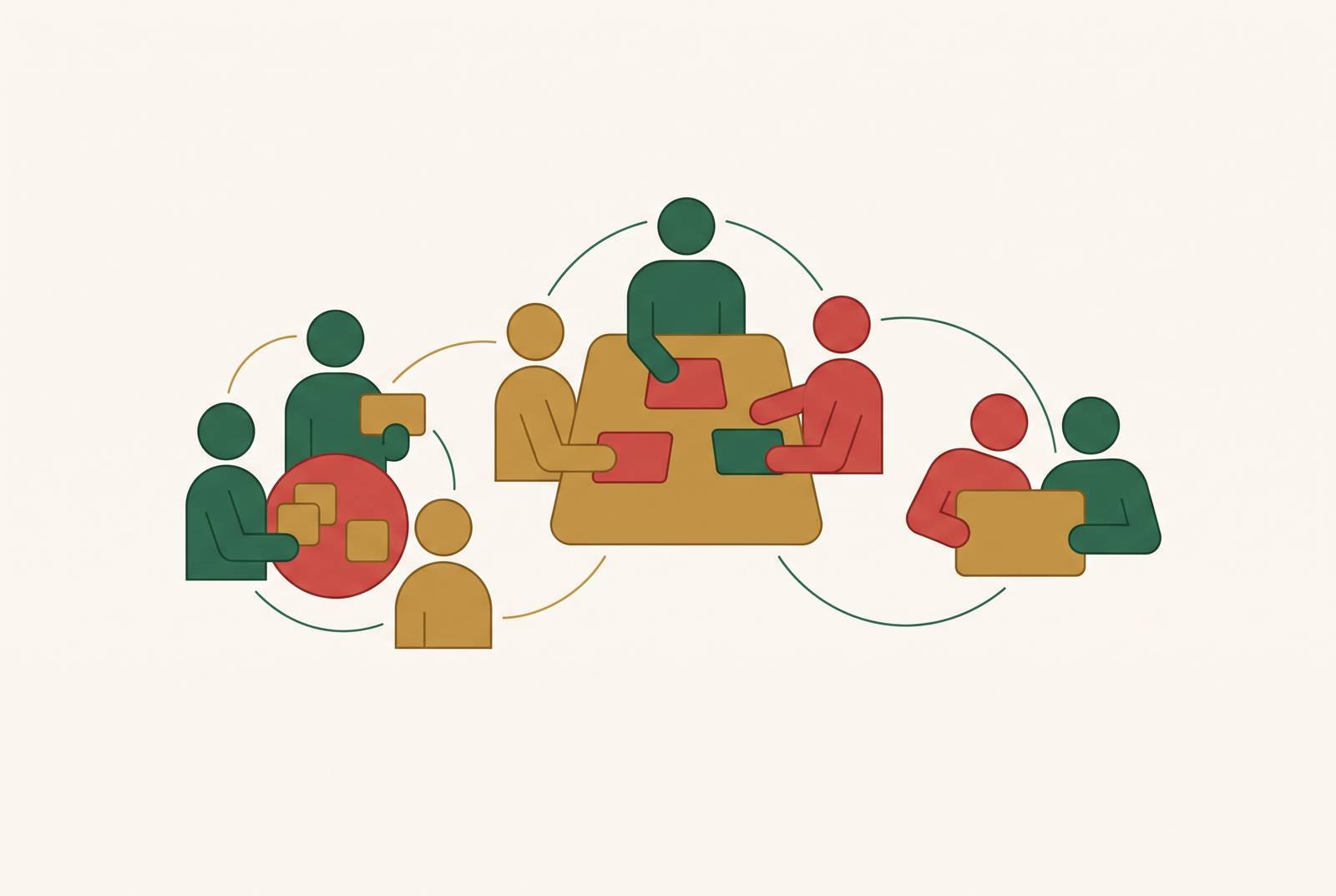
This piece is about flexible grouping during exam review, and why it beats static ability grouping for one simple reason: it replaces a label with live data. Instead of sorting kids by how "strong" they are overall, it sorts them by what they actually still need to learn, topic by topic, right up until test day.
Why static ability grouping breaks down during exam review
Picture a student placed in the "honors" track back in September. That label tells a teacher almost nothing useful by the time exam review starts. The student might be rock solid on Unit 3 and shaky on Unit 7, and the honors tag doesn't say which. It just says "good student," which is true and also useless when the job is finding specific holes before a fixed test date.
That's the first crack in ability grouping: it freezes a judgment made months earlier and treats it as current. Students grow at different speeds. A single track assignment was never built to move, so it can't track that movement.
The second crack runs deeper than scheduling. Static grouping tends to reinforce the gaps it claims to manage, and it can wear down the confidence of kids placed in the lower track, cutting them off from harder material and from classmates who could model stronger academic habits. Those are costs that build over a semester. They become sharp once review starts: review is about closing specific, nameable gaps before the test, not pacing through new content, and a system organized around a label can't point to a gap. It can only point to a kid.
Flexible Grouping
Flexible grouping sorts students by what they currently know and don't know, tied to one specific learning target, and it changes as soon as that target is met or the data says otherwise. When the reason goes away, so does the group.
Two mix-ups are worth clearing up before going further. First, flexible seating is not flexible grouping. The grouping criterion has to be skill and knowledge, not who happens to sit near whom.
Second, rotating through stations isn't flexible grouping either. Flexible grouping doesn't aim for everyone to touch the same material. It aims for each group to work on what that specific group needs.
The strategy also doesn't stand on its own. It has to pair with something else: homogeneous groups paired with direct, explicit teaching, and heterogeneous groups paired with structured cooperative tasks. Same students, different arrangement, different job for each.
Replacing the Achievement Label with Rolling Diagnostic Data
The mechanism that makes flexible grouping actually work during review starts with a diagnostic, not a transcript. At the start of the review period, a topic-level diagnostic shows exactly which content areas need heavy time and which can get a light touch. That result, not a broader achievement summary or track placement, becomes the input for every grouping decision that follows.
The word "topic-level" carries real weight here. A score of 3 on an AP Biology exam tells a teacher almost nothing about what to teach next. Knowing a student has consolidated cellular respiration but hasn't consolidated genetics tells the teacher what to teach next. The composite score hides the information a teacher needs; the topic breakdown hands it over directly.
Reading that breakdown correctly takes one more layer: prerequisite structure. A student who bombs a downstream topic might not actually have a gap in that topic. A prerequisite map, laying out which topics feed into which, makes that upstream gap visible in a way a single test score never could.
Once the diagnostic data is in hand, regrouping follows the data, not the calendar. A student who crushes Unit 3 practice problems but struggles on Unit 7 items joins the Unit 7 gap group, no matter what their overall record says, and leaves that group the moment the gap closes. Multiplying this across a student juggling several AP exams, the same logic scales up: diagnostic data can guide how review time gets split across subjects, by topic, not by course label. The achievement label never enters the decision. The gap does.
What Homogeneous and Heterogeneous Groups Each Do
Once the data points to specific gaps, the next question is how to organize the room around them. Homogeneous and heterogeneous groups aren't interchangeable tools, and picking the right one for the moment shapes whether instruction reaches the gap a teacher is trying to close.
Homogeneous groups earn their keep during explicit re-teaching. When every student in a group shares the same missing piece, a teacher can aim instruction directly at that piece instead of spreading attention thin. Teachers sometimes unconsciously lower the bar for groups labeled "low," slowing the pace and softening the rigor. Watch for that habit directly; it doesn't fix itself.
Heterogeneous groups shine in a different setting: collaborative, applied work. Drafting free-response answers, explaining reasoning out loud, giving each other feedback. The teacher ends up grading fewer total responses but gets a richer read on where misconceptions are hiding, since the discussion reveals thinking that a single written answer wouldn't show. The risk here runs the other direction: a confident student can dominate the group, and without clear role assignments and turn-taking norms, a weaker student can still feel singled out even inside a mixed group.
Both formats beat straight whole-class instruction on one count: students get far more chances to respond and get feedback in a small group than they do raising a hand in a room of thirty. And the teacher's job shifts depending on which format is running. In homogeneous re-teaching, the teacher leads from the front of that small group. In heterogeneous cooperative work, the teacher steps back and circulates, watching and stepping in only when needed.
Closing the Gap Between Assessment and Regrouping Decisions
None of this works at any real speed if the cycle from test to grouping decision takes too long. Without some kind of tool, a teacher has to grade a diagnostic, interpret the results, and reorganize groups, and doing that by hand after class can stretch into days. Meanwhile, students sit in the wrong group for multiple sessions before the data finally catches up and prompts a change.
Real-time AI grading of open-ended responses shrinks that cycle down to the length of the class period itself. Class-level analytics pull the same information up a level, flagging which topics tripped up the most students. That flips the question a teacher asks from "who did poorly overall?" to "which topic sent which students off track?" The second question produces a useful group.
A 2026 research pipeline out of Georgia Tech, presented at the CSEDM workshop co-located with the EDM conference, gives a concrete look at how far this can go. Researchers Youssef Medhat, Junsoo Park, Ploy Thajchayapong, and Ashok K. The graph itself wasn't hand-built from scratch: GPT-4 extracted it directly from lesson PDFs, with a human checking the topic boundaries it drew. That detail matters because it shows this kind of infrastructure doesn't require a research lab to build. A teacher's own lesson materials can feed the same kind of system.
AI-generated differentiated materials solve a second time problem that appears right after grouping: once groups exist, each one needs its own practice set, its own task, its own version of the lesson. Generating those quickly removes a real bottleneck. Grading and gap-detection tools built on this same principle, tools that flag not just what a student got wrong but where their reasoning broke down, give teachers a topic-level map instead of a single aggregate score, and a map is what actually drives a regrouping decision. None of this replaces a teacher's judgment about how to use a group. It just gets the data in front of them fast enough for that judgment to act on it.
Managing the Planning Overhead of Flexible Grouping
Flexible grouping takes real planning time, and pretending otherwise does teachers a disservice. Teachers already stretched thin will feel this cost directly, especially in the first few weeks of a review unit before routines settle in.
Routines are what bring that cost down over time. Teaching those routines explicitly, until they run on autopilot, pays off across a multi-week review unit even though it costs time up front.
A teacher should decide monitoring strategy in advance, too. A teacher running several groups at once either circulates across all of them or parks with one group for direct instruction while the rest work independently. Deciding which model a given session will use before the bell rings cuts down on in-the-moment scrambling.
The two-stage exam model pairs an individual exam with a collaborative follow-up, and the collaborative stage can happen asynchronously, outside class hours, within 48 hours of the individual exam. But the asynchronous design exists specifically to answer that concern, and students have rated their engagement and feedback quality in that format as equal to or better than a standard in-class exam.
None of this requires running every group configuration every day. A teacher might run homogeneous gap-targeted groups on Monday, right after a diagnostic, and heterogeneous collaborative FRQ groups on Wednesday. Trying to do both every single day is a recipe for burnout, not better data.
Differentiated Instruction and Flexible Grouping
Flexible grouping turns out to be less a scheduling trick and more the delivery mechanism for differentiated instruction itself. Differentiated instruction usually gets described across four areas: content, process, product, and learning environment. Flexible grouping touches all four, which is part of why it does more than a simple seating change could.
Content shifts first. Process shifts next: the pace and the teaching approach match the group's readiness, so a low-readiness group gets explicit, step-by-step re-teaching while a high-readiness group works through independent application tasks.
Product is where heterogeneous groups earn their value again. Working together, students can show what they understand through discussion, through a jointly written FRQ response, or by teaching a concept back to each other, not only through an individual worksheet. And the learning environment, the physical setup of the room, follows the purpose of each group: a teacher-led table for re-teaching, an independent cluster for students extending past the basics, a shared space for groups drafting FRQs together.
None of this happens automatically. It requires a teacher to keep checking in on where students actually stand and to make grouping decisions based on that ongoing read, during both planning and the lesson itself. Flexible grouping is what turns that constant monitoring into something teachers can act on, instead of a nice idea that never quite gets built into the lesson plan.
This matters more during AP and SAT review than it might at other points in the year. A student who explains their reasoning out loud in a group, takes pushback from a peer, and revises an answer is rehearsing the exact moves that free-response questions and open-ended SAT items demand, which is practice for the actual test.
Putting it into practice: a sequenced approach to a review unit built on rolling data
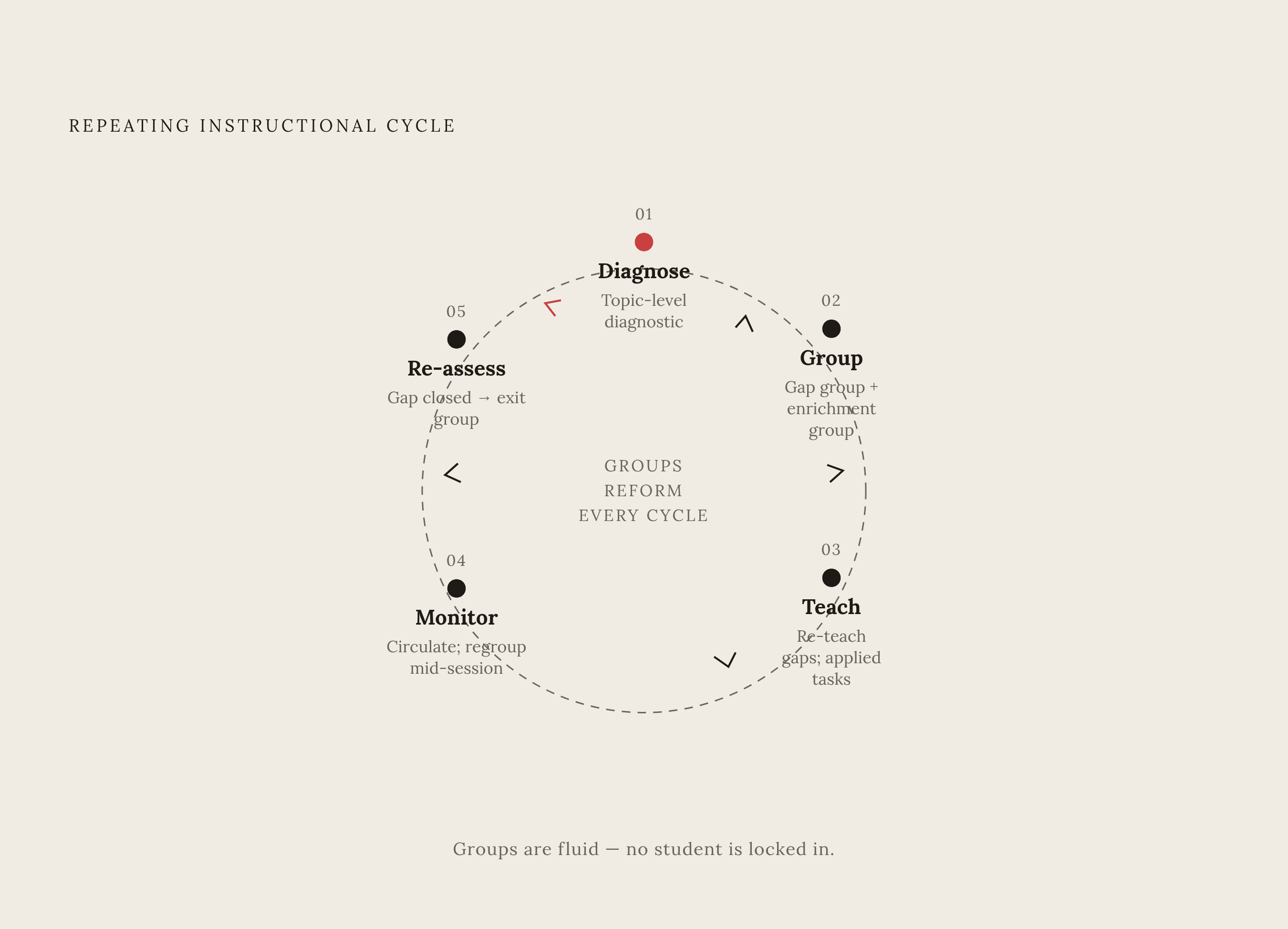
Everything above comes together in a repeating five-step cycle: diagnose, group, teach, monitor, regroup. It's the engine that keeps review locked onto the gaps actually holding scores back, instead of drifting toward whatever topic happens to come next on the syllabus.
Step one is the opening diagnostic, given at the start of the review period.
Step two is initial group formation. Homogeneous groups form around the two or three topics the diagnostic flags as weakest across the whole class. Students who've already got those topics down move into heterogeneous collaborative work or enrichment tasks, so they're not stuck re-sitting a lesson they don't need. This is where the prerequisite logic from earlier pays off directly: a student struggling with a downstream topic might land in a group built around the upstream skill they're actually missing instead of the topic where the gap happened to appear.
Step three is targeted instruction. The teacher leads explicit re-teaching for the gap group, while the cooperative group works through an applied task, FRQ drafting, a problem set, peer explanation, using the roles and norms already established.
Step four is monitoring within the session itself. Circulating by hand or using real-time grading tools, a teacher watches for new misconceptions as they surface and adjusts instruction, or regroups, mid-session if the data calls for it. The goal stays the same one named earlier: shrinking the lag between a student showing a gap and a teacher responding to it.
Step five is re-assessment and regrouping. After a topic gets re-taught and practiced, a topic-level re-check shows who's closed the gap and who hasn't. Students who've closed it move out of the gap group; students who haven't stay, and the instruction adjusts again. Because groups reform every cycle instead of locking in for the whole review period, no student gets stuck wearing a "remedial" label for weeks at a time. Tools that track topic-level understanding, rather than a simple right-or-wrong tally, fit naturally into steps four and five, revealing in the regrouping data which gaps are closing and which are holding on, so a teacher can regroup based on evidence instead of a guess.
The same five-step cycle scales down to a single student working alone on AP or SAT prep. A diagnostic shows the specific topic gaps holding the score back, focused practice targets exactly those gaps, and a second diagnostic confirms whether the gap actually closed. That's the same structure a classroom runs at scale, just run by one student instead of thirty.