Score-Goal Conferencing to Build Student-Owned Study Plans
Students often study their hardest subjects instead of their weakest ones.
A student spends six hours a week on the subject she finds hardest. It's the one that keeps her up at night, the one she quizzes herself on during lunch. Then the diagnostic comes back, and it turns out she's already scoring a 4 on that exam. Meanwhile, the subject she barely touches, the one that feels comfortable and familiar, is a 2.
That's the default pattern for a lot of students, because study time usually follows how hard a subject feels, not how far a student actually is from the score she needs. Felt difficulty and score gap are two different measurements, and most students only have access to one of them without help.
Why does this happen? Because without an outside anchor, a diagnostic score, a real target, a structured conversation that forces the comparison, there's no mechanism that catches the mismatch. A student can only go on instinct, and instinct tracks discomfort, not distance from target.
The Digital SAT makes this error more expensive than it used to be. The exam adapts module by module: how a student performs on Module 1 sets the ceiling for how high the final score can go, no matter how well that student knows the harder material waiting in a tougher second module. A hidden gap in foundational skills doesn't just cost a few points the way it might have on the old paper test. It can cap the whole score before the harder content even gets a chance to show up. Students who assume their weakest-feeling subject is automatically their biggest opportunity are often wrong, and the cost of being wrong is no longer just inefficiency. It's a study plan that feels productive, fills up a planner, and still doesn't move the number that matters.
What score-goal conferencing is
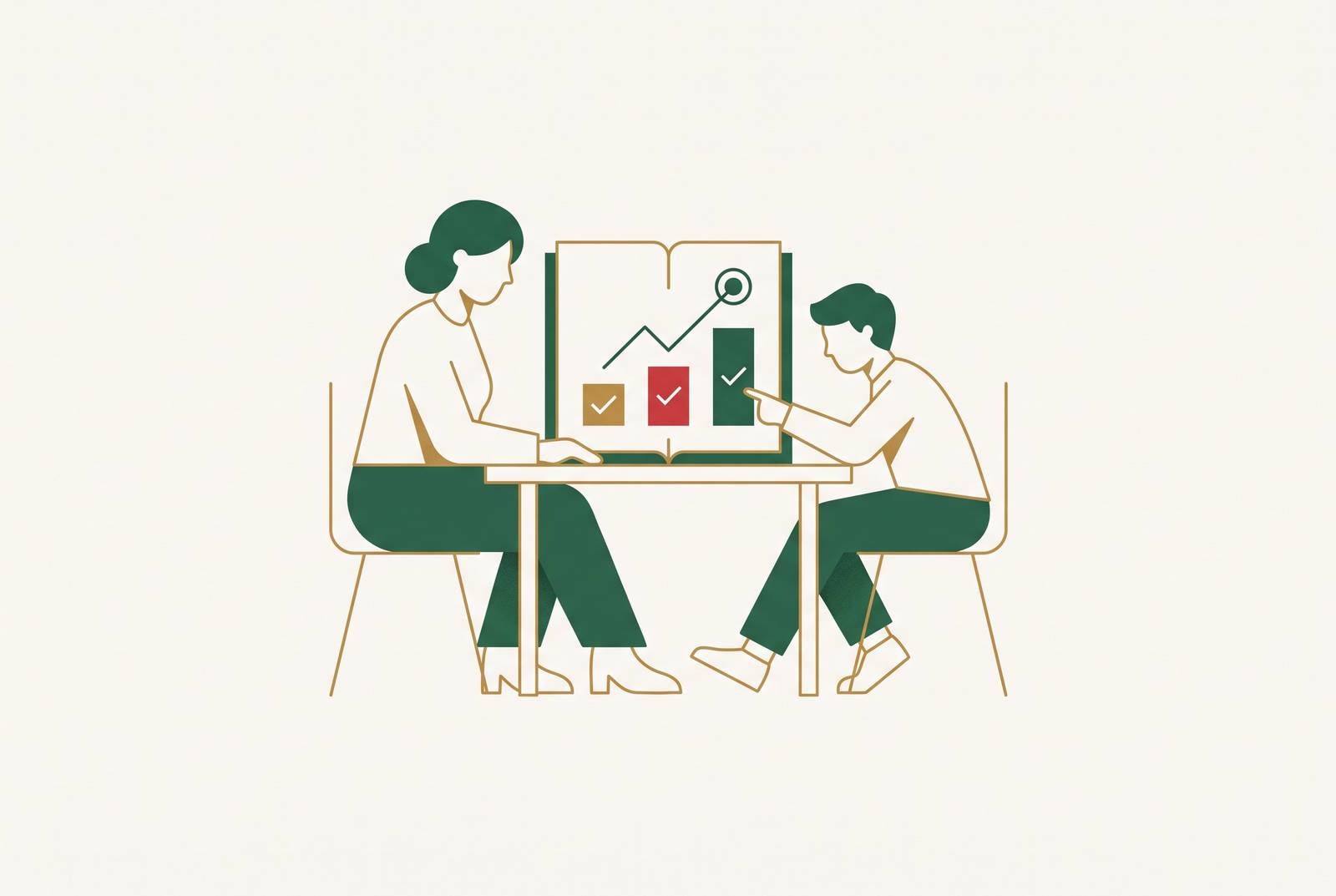
A score-goal conference is a structured conversation, anchored to real diagnostic data, where the student explains the gap between where she is now and where she needs to be, and names what's standing in the way. The teacher isn't delivering the diagnosis. The student is.
The structure flips the usual roles. The student prepares the material and leads the conversation. The teacher holds the frame, asks the questions, and listens for the blind spots the student hasn't named yet. That's the whole mechanical difference between this and a grade review, a tutoring session, or a check-in: a grade review looks backward and the teacher drives it, a tutoring session delivers content, a check-in shares information without asking the student to set a goal. A score-goal conference does something none of those do. It makes the student responsible for stating the gap out loud and committing to closing it.
Student-driven goal setting isn't a new idea invented for test prep. When students can name where they currently stand and what they're working toward, they tend to show up more motivated and more prepared to improve, because the act of articulating a goal is itself part of how a student recognizes the tasks in front of her and her own role in finishing them. A score-goal conference just gives that principle a specific, recurring shape in a classroom built around AP and SAT prep.
For AP courses, the conference anchors to the Course and Exam Description, so the student can see the weighting of each exam section and plan around it. For the SAT, the core strategic principle, heavy focus on the weaker section with maintenance practice on the stronger one, isn't new either. What the conference does is take that abstract rule and turn it into the student's own concrete decision, made with her own numbers in front of her.
The Digital SAT's adaptive format adds one more layer the conference has to surface. A low score in a section can come from two very different places: not knowing the content, or knowing it but losing points to pacing and careless errors under time pressure. Both drag the final score down, but they call for completely different fixes, and a conference that doesn't separate the two will produce a plan aimed at the wrong problem.
How teachers run a score-goal conference
A score-goal conference works when three things are sitting in the room: a diagnostic baseline the student has already looked at on her own, a target anchored to real admissions data rather than a vague sense of "doing well," and a teacher whose job is to keep pushing past vague answers until the student commits to specifics.
Before the conference even starts, the student has work to do. She takes a full-length diagnostic under conditions that actually resemble the real exam: timed, uninterrupted, in the real format (Bluebook, for the Digital SAT). Good SAT prep starts with this kind of honest self-assessment, because practice items and diagnostics are what let a student see her strengths and weak points clearly enough to set a target that's actually realistic for the colleges on her list. She also scores each section and sub-domain and ranks them by gap size, not by which one felt hardest while she was taking it. That ranked list becomes the document she brings into the room. For AP students juggling several exams, the same logic applies subject by subject: rank the exams by score gap, not by which class keeps her up at night.
Once the conversation starts, the teacher's questions do most of the work. It opens on the gap, not the raw score: where is she now, where does she need to be, and what's the single biggest distance between those two points? From there, the teacher pushes for specifics. "Which sub-domain is costing you the most points?" gets a useful answer. "Which section is hard?" doesn't.
Part of the teacher's job is surfacing blind spots the student hasn't considered. Does she understand that Module 1 performance sets her score ceiling on the Digital SAT? Has she actually mapped her study time against how each AP question type is weighted in scoring, or is she just guessing? Then comes the moment that tests whether any of this has sunk in: "If you had ten hours this week, how would you split them across your subjects, and why?" The answer to that question tells the teacher immediately whether the student is reasoning from her own data or just defaulting to habit.
The conference should end with one written commitment: a ranked priority list the student wrote herself, not a schedule the teacher built for her.
Timing changes what's possible here. When a diagnostic returns scores and feedback fast enough for a student to still remember taking it, the conference can happen while the material is still fresh. AI grading tools that return rubric-aligned feedback within minutes let a student revise her own thinking and sit with her errors before she ever walks into the conference, so she arrives with a diagnosis already half-formed. For AP subjects built around writing, rubric-aligned feedback that scores thesis, evidence and reasoning, and sophistication separately gives the conversation an actual vocabulary. Instead of "your writing needs work," the conversation can be "your evidence and reasoning score is what's dragging the rest down."
Building a prioritized study plan from the conference
Walking out of the conference, you've got a ranked list of gaps and a commitment you made out loud. The job now is turning that into a real week-by-week plan, one where your hours follow the size of the gap instead of habit or whatever subject is making you anxious that day.
Start by anchoring to your actual target, not some general idea of a "good score." Your target score comes from the specific colleges on your list, their admitted-student ranges, not from a number that sounds impressive in the abstract. Where you're starting from determines how the plan gets built: it works backward from the distance between your diagnostic and your target, not forward from a generic twelve-week calendar someone else designed. For the SAT specifically, that means starting with a diagnostic practice test to set your baseline, then building the plan around how much time you actually have and how many points you need to close the gap.
From there, let the ranked gap list from the conference become your actual time budget. Whatever subject or section carries the biggest gap gets the biggest share of your weekly hours, and it keeps that share until the gap closes. On the Digital SAT, Module 1 performance decides whether you land in the easier or harder version of Module 2, so foundational accuracy can't be treated as optional even if your real goal is mastering advanced questions. For AP exams, the weighting laid out in the Course and Exam Description isn't a detail to skim. A student who doesn't know that free-response components carry the majority of the score in a class like AP US History is working from the wrong map. And the section you're already strong in doesn't disappear from your schedule. It gets just enough maintenance practice to hold steady while your real hours go toward the weak spot.
Structure the plan itself as a loop, not a countdown to exam day. Diagnose one specific pattern in your mistakes. Repair it with focused practice. Test whether that repair actually holds up under real timed conditions. Then carry what you learned into a full section or full practice test. A plan shaped like a loop catches backsliding before it costs you on the real exam. A plan that's just a calendar of topics to cover won't. Part of what makes the loop work is logging errors by the specific decision that broke, not just marking a question wrong and moving on, because naming the actual mistake is what turns it into something you can practice fixing.
Build checkpoints into the calendar that feed back into another conversation with your teacher. Plan at least two full-length practice tests spaced out so there's still time to adjust after the first one and still enough runway to measure real progress by the second. If you're taking the SAT, plan on sitting for it at least twice. Most colleges superscore, so a second attempt can only help your composite at those schools; check each school's policy directly, since some, like Georgetown, score based on a single sitting instead. Every checkpoint should lead to a short follow-up conversation: did the gap actually close? Did a new one open somewhere you weren't watching? Does the time budget need to shift?
Why the conference breaks down without the right diagnostic
A score-goal conference is only as good as the diagnostic data feeding it. When that data is scattered across different tools, slow to arrive, or too broad to pin down an actual sub-domain, the conference still happens, but it produces commitments that sound specific and aren't.
Most personalized learning tools on the market specialize in one piece of this puzzle: tracking what a student knows, modeling where the gaps are, or recommending the next resource to use. Few combine all three into one adaptive cycle, so a student stitching together data from three separate platforms ends up with a picture that doesn't quite fit together. That's a real limitation on what the conference can accomplish, because the conversation can only be as sharp as the data feeding it.
Timing compounds the problem. In a lot of traditional classrooms, gaps appear only on end-of-term exams, after there's any time left to act on them before the test that actually counts. Tools built around real-time feedback change that by surfacing gaps while the student can still do something about them, which lets a conference happen early enough to matter.
A score report also has a resolution problem. A score report that just says "Math: 620" doesn't tell a student anything about whether the issue is algebra foundations, advanced math content, pacing under pressure, or accuracy specifically in the first module. A conference built on a number that coarse tends to land on a plan that says "do more math," and that's not a plan anyone can actually follow.
There's also a risk on the other side: a tool that does too much. Scaffolding is supposed to build a student's own capacity to reason through a problem, not replace that reasoning with an automated answer. A tool that generates the entire study plan for a student, rather than handing her the data and letting her draw her own conclusions, quietly undoes the ownership the whole conference was built to create.
A diagnostic that actually supports this process does three things. It returns fast. It returns at the sub-domain level, not just a single headline number. And it presents the data in a form the student can read and make sense of on her own, before she ever sits down for the conference.
Tools and platforms that make score-goal conferencing reliable at scale
None of this scales on good intentions alone. Running cohort-level diagnostics, returning granular feedback fast, and knowing which students need a follow-up conversation most urgently all take infrastructure a single teacher can't build from scratch for every class period.
The tools that make this reliable share a few features. They return sub-domain-level diagnostic data quickly enough for a student to actually review it before walking into the conference. They surface which students have the widest gaps, so a teacher can tell at a glance whose conversation needs to happen first. They offer rubric-aligned feedback on written responses, which matters especially for AP subjects built around essays and free-response questions, giving the conference precise language for what the student actually did. They track progress across sessions, so the follow-up conference can actually measure whether a gap closed or just moved. And they keep the student doing the reasoning, rather than generating the plan on her behalf and quietly taking the ownership back out of her hands.
Options built specifically for AP and SAT preparation now offer unlimited multiple-choice practice alongside instantly-graded free-response questions, with AI-powered feedback that goes past a simple right-or-wrong mark. The goal of that kind of tool is to find out what a student actually understands, where her thinking breaks down step by step, and what specific gaps sit between her current performance and mastery, which is exactly the sub-domain picture a score-goal conference depends on. Tools like this serve both the individual student working through prep on her own time and the teacher trying to manage diagnostics and feedback across an entire classroom.
The conference itself still does the work no platform can automate: a student naming her own gap, out loud, and deciding what she's going to do about it. The tools just make sure she walks in with something real to say.
Sources
- Study Habits of Grade 10 Students: A Closer Look at Time ...
- EL Education - Leaders of Their Own Learning: Chapter 5: Student-Led Conferences
- A Practical Guide to Student-Led Conferences
- Everything you need to know about goal setting for students - Teach. Learn. Grow.
- Tutor-Student Goal Setting Conferences
- Goal setting 101: Start by asking students what they think - Teach. Learn. Grow.
- Building student ownership through portfolios and student-led conferences - Teach. Learn. Grow.
- Goal Setting to Increase Student Academic Performance