Helping Score-Plateau Students Break Through the 1350 SAT Ceiling
The Digital SAT's adaptive routing system creates a scoring ceiling most students don't know exists.
This article is about why students stuck near a 1350 SAT score keep stalling there, and why the fix has less to do with studying harder and more to do with winning a routing decision most students don't even know they're playing. But the same score falls below the 25th percentile of admitted students at highly selective schools, where middle-50% ranges run from 1400 to 1550. A student with a 1350 has beaten nearly nine out of ten peers nationally and still sits 50 to 200 points under the middle of admitted classes at places like Georgetown, Vanderbilt, and Carnegie Mellon.
Test Geek's 2026 percentile table puts 1350 at the 90th percentile and 1400 at the 93rd. That three-point gap is the distance between "strong applicant" and "applicant who needs the rest of the file to do a lot of work." The number itself isn't magic. 1350 marks the point where the Digital SAT's internal mechanics start mattering more than how much a student knows. Past this point, the test stops rewarding raw preparation and starts rewarding something narrower: a clean run through a specific set of early questions. Understanding that mechanism is the starting point for everything that follows.
The Digital SAT's module routing ceiling
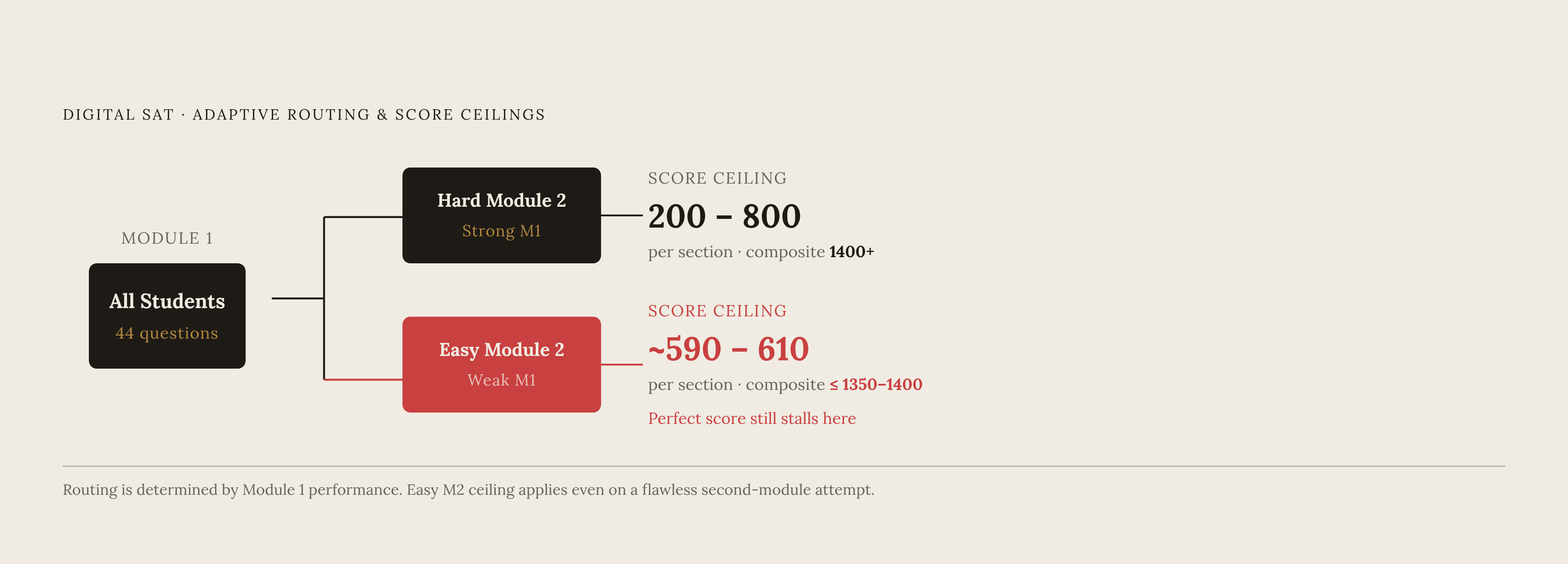
The Digital SAT doesn't work like a shorter version of the old paper test, just delivered on a laptop. It's section-adaptive: the questions a student sees in the second half of each section depend entirely on how they performed in the first half. Module 1 serves every student the same mix of questions. Module 2 does not. Performance on Module 1 decides which version of Module 2 a student receives, and the two versions don't lead to the same places.
IvyStrides lays out the mechanism directly: doing well on Module 1 routes a student into a harder Module 2, the only track that unlocks the full 200-800 score range for that section. A student could run the table on the easy Module 2, answering every single question right, and still watch the section score stall in the high 500s to low 600s.
Stacking that across both Reading and Writing and Math compounds the ceiling effect: a student routed to the easier track in both sections faces a composite ceiling somewhere around 1350 to 1400, regardless of how clean their Module 2 performance looks on paper. The routing decision is.
That's a strange thing to sit with, because it means two students can answer the same number of questions correctly and walk away with very different section scores, depending entirely on which questions they missed and when. The scoring model itself isn't published in a way that lets a student reverse-engineer it question by question. The pattern appears consistently enough across practitioners working with real students that the mechanism is treated as settled. Because the ceiling is mechanical rather than mysterious, it can be attacked directly, by fixing the specific Module 1 misses that trigger the low track in the first place.
Why plateau students keep stagnating despite continued practice
Picture the score report of a student stuck at 1350 to 1390: 1390, then 1410, then 1400, then 1380. Neither reading is right. That oscillation is stable evidence of a fixed error signature. The same mistakes are happening on the same types of questions, test after test, and the natural variation in which specific questions appear on any given form is just shuffling the final number around a ceiling that hasn't moved.
These students are rarely weak across the board. The instinct to fix this by taking another full-length practice test is understandable and almost entirely unproductive. A full-length test measures where the plateau sits. It does nothing to break it, because it doesn't isolate which three or four question types are responsible for the leak.
They're short on an accurate diagnosis of where, specifically, their reasoning breaks down. That's the argument for treating error-pattern identification as the actual first step, rather than content review disguised as more practice.
The three repeatable error patterns that trigger the lower Module 2 track
Most plateaus in the 1350 to 1390 range trace back to one of three repeatable error patterns, and each one is fixable once it's correctly named. The first is what MySATCoach calls the Sounds-Right Trap, and it appears almost exclusively in Reading and Writing. Students pick answers that feel directionally correct or intellectually reasonable rather than answers that are most defensible using the text alone. This pattern concentrates in four specific question types at the 1350 to 1400 level. And on Rhetorical Synthesis questions under time pressure, students pick an answer built from correct facts but aimed at the wrong goal, usually because they haven't locked onto what the question is asking quickly enough.
The second pattern is the Careless Cascade, and it lives in Module 1 Math. None of this reflects a content gap. It appears in the score report identically to a content gap. That is why it gets misdiagnosed so often as "needs more math practice" when what's actually needed is pacing discipline.
The third pattern is Desmos over-reliance, specific to the Math section's built-in graphing calculator. North American Tutors flags this as a distinct strategic failure tied specifically to the digital format, not a generic math weakness. The tool helps enormously in the right moments and costs real time in the wrong ones, and plateau students tend not to have sorted out which moments are which.
Building a personal error log before touching any new content
The most useful first move for a plateau student is an error log: a structured record of exactly which question types get missed repeatedly, built before any new content gets introduced. North American Tutors describes this as the opening move of every effective tutoring session, quoting a tutor who puts it directly: "I build a personal error log before we touch any new content. I don't care how many practice tests they've done. I care which three question types they miss every single time, and we fix those before anything else."
The reason this works is specificity. "I'm bad at Reading" doesn't point anywhere useful. "I consistently miss Inference questions by choosing plausible-sounding answers that go beyond the passage" points directly at a fix. Without that level of precision, more practice just reinforces the same habits that are causing the plateau in the first place.
A useful error log needs to capture a few things for each missed question. And it needs a note on difficulty level, because a miss on an easier or medium question is the kind of miss that drives Module 1 routing losses directly, which makes it a higher priority to fix than an error on a genuinely hard question near the end of a module.
A sample entry might read: question type, Cross-Text Connections; pattern, answer choice too broad relative to both passages; frequency, four out of the last five practice sets; difficulty, medium. The output of a complete error log should be a short, ranked list, two or three fixable patterns at most. Not a syllabus. Not a content review plan. Just the specific leaks that need sealing before full-length practice resumes.
Turning the error log into a 6–12 week targeted drill plan
Once those two or three patterns are named, the right response is a focused plan, typically 6 to 12 weeks, built around drilling those specific patterns until they stop showing up, rather than a return to broad review or another round of full-length tests. North American Tutors identifies 6 to 12 weeks of consistent, structured prep as the window where most students see real score movement, driven by targeting genuine weak areas with that time. Students who start within two weeks of test day aren't really preparing at that point so much as hoping, since behavioral correction of an ingrained error pattern takes real time to stick.
The plan itself should follow the priority order the error log already laid out, treated as illustrative pacing rather than a fixed script, since every student's starting point looks different. From weeks seven through twelve, full-length practice tests come back into the plan, but their job changes: they're there to confirm the identified patterns have actually disappeared, not to go hunting for new ones.
What the plan should not do is add harder content before the existing patterns are corrected. Introducing tougher question types on top of an unsealed leaky floor won't raise the score, since the Module 1 routing losses driving the ceiling keep happening underneath the new material.
AI-powered feedback and the speed advantage over self-review
The error log and drill plan work as a framework, but building that log through self-review alone runs into a real limitation: students are slow and inconsistent at naming the true cause of their own mistakes. Without that distinction, the drill built to fix the problem might target the wrong mechanism entirely, which wastes exactly the kind of focused practice time the 6-to-12-week plan depends on.
This is where AI-powered feedback earns its place in the framework, not as a replacement for the error log but as the tool that makes it accurate. Feedback that diagnoses why a student's reasoning broke down, not just which box they checked, closes a gap that self-review consistently leaves open. What matters is whether the system can name the pattern behind the wrong answer, the same way the error log tries to.
Rather than scoring questions as correct or incorrect and leaving it there, this kind of modeling builds a picture of what a student actually understands and where, specifically, their reasoning gives out, which is the distinction between a genuine content gap and a Sounds-Right error that has nothing to do with content at all. For teachers working with a full classroom, this scales into something useful at the group level too: visibility into which students are stuck on which specific Module 1 question types, so instruction can target the exact patterns keeping a class below the routing thresholds that matter. For students without access to a private tutor, this kind of diagnostic specificity is the same prerequisite that practitioners like those at North American Tutors describe building by hand in a first tutoring session, just made available without the one-on-one relationship.
The objection worth taking seriously: what AI feedback cannot diagnose on its own
The strongest objection to leaning on AI diagnosis is a fair one: a meaningful share of SAT plateaus are execution and pacing failures that show up in behavior while a student is working, surfacing only there and never in the answer they finally submit. A student who runs out of time at question 25 every single time, who hesitates too long on medium-difficulty questions, or who loses focus somewhere in the middle of a module, produces a wrong answer that looks, in the score report, identical to a wrong answer caused by a genuine content gap. The two problems need completely different fixes, and an AI system analyzing the submitted answer alone has no direct way to tell them apart.
The right response to this is to layer the two approaches by what each one does well. The error log itself is built to surface which situation a student is actually in: misses that cluster around specific reasoning patterns point toward AI-addressable fixes, while misses that scatter randomly across a section with no clear pattern point toward a pacing or attention problem instead, one better solved with timed drill structure and, where it's available, direct human observation.
What breaking the 1350 ceiling requires, in order
Breaking through 1350 is a sequencing problem, and the students who get past it consistently are the ones who fix their Module 1 routing losses before they touch anything else. The order matters: build the error log first, identify the one or two patterns actually causing routing losses, drill those patterns in isolation, move to timed module simulations once the pattern shows real improvement, and finish with full-length tests used as validation.
Skipping straight to harder content without that sequence doesn't raise the ceiling. It seals it, because the student ends up optimizing for Module 2 performance while the Module 1 routing decision still controls whether that Module 2 performance ever gets a chance to count.
The actual first action for a student reading this is to pull the last two or three practice tests already taken and build the error log before doing anything else. If that log shows misses clustering around Reading and Writing question types like Inference, Cross-Text Connections, or Command of Evidence, the Sounds-Right Trap is the diagnosis, and precision drilling on text-based reasoning is the intervention. If it shows careless misses in Math on questions the student clearly knew how to solve, the fix is pacing and setup discipline, not more content. And if the misses don't cluster around any identifiable pattern at all, scattering evenly across the section, timing and attention are the real root cause, which points toward timed module simulations.
Scoring above 1400 isn't just a matter of knowing more. It comes down to knowing exactly which of a student's own patterns breaks down under pressure, and closing those patterns specifically enough that Module 1 stops routing them to the track with a ceiling built into it.