Communicating AP Prep Timelines and Expectations to Parents
Parents often miss the three-arc timeline that shapes the entire AP year.

This guide is about how the AP year actually unfolds, and why most parents are working from the wrong map of it. Picture AP prep and the image that usually comes to mind is a cramming sprint: a student hunched over flashcards in late April, trying to absorb a year of material in a few frantic weeks. The real AP year runs on three distinct arcs: Course Start in the fall, Intensive Preparation and Exam Registration from winter into spring, and Exam Administration through Score Release from May into July, each arc asking something different of a student and a family, and studying harder in the final stretch rarely fixes what the earlier weeks left undone. Families who wait until three or four weeks before the exam to ask for help usually land in triage: drilling the two weakest units and settling for a 4 instead of chasing a 5. There's also a quieter shift that changes the stakes of getting this timeline right. With SAT Subject Tests discontinued in 2021, AP scores now carry more weight as proof of subject-level achievement, raising the stakes on understanding the AP timeline accurately from the start of the school year. The rest of this guide walks through those three arcs one at a time, translating each into what a parent can actually watch for and act on.
The fall arc: what happens when the course begins
Fall often gets treated as a quiet runway before the real work starts in January. The structural decisions that shape the rest of the year, course registration, skill-gap triage, early engagement with practice tools, get made in the fall, not in the quiet runway parents often assume it to be, and a family that treats this stretch as dead time can arrive at winter already behind.
One small, concrete action anchors the whole semester: when AP classes begin, teachers hand out an AP Classroom join code, and that code is a student's gateway to official practice questions, personal progress checks, and AP Daily videos. Confirming a student has actually joined their class section in My AP takes a few minutes, and it is the kind of low-lift step that pays off months later when progress data becomes the main tool for judging how prep is going.
Fall is also when accommodations planning needs to start, even though the deadline sits further out than most families expect. January 16, 2026 is the deadline for Students with Disabilities (SSD) accommodations requests, and because that process takes time to move through, families who need testing supports are better off starting the conversation in the fall rather than waiting for the new year.
Fall is the cheapest moment to close prerequisite skill gaps, before course content picks up speed. A student heading into AP Calculus benefits from refreshing algebra and trigonometry back in August, and a student in AP U.S. History gains real ground by building thematic familiarity before the first unit test sets the tone for the rest of the year. None of this requires an intensive study plan. It requires noticing, early, where the cracks are likely to show up later.
Three Key Administrative Deadlines
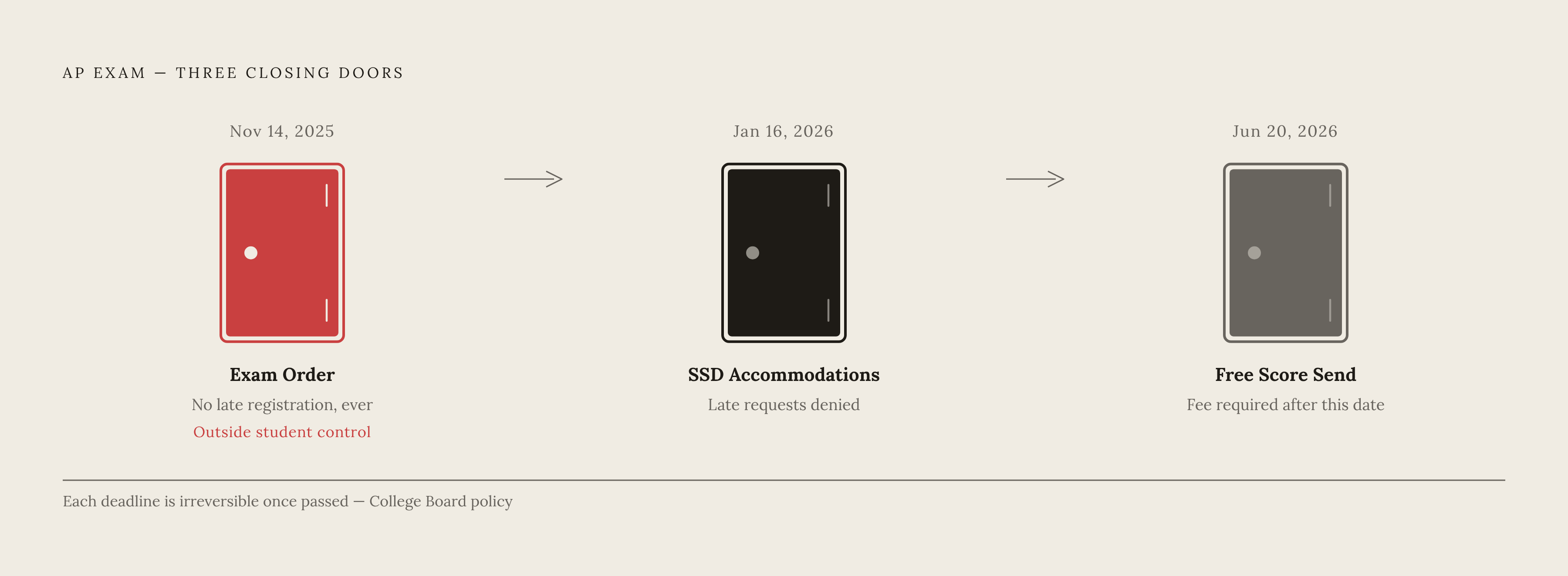
Three dates do more to shape an AP year than almost anything a student studies: November 14, 2025; January 16, 2026; and June 20, 2026. None of them are paperwork for paperwork's sake. Each one closes a door that does not reopen once it shuts.
November 14, 2025 is the final deadline for AP coordinators to order exams, covering both full-year and fall-semester or AP exam only courses. If a school misses that submission, the student cannot sit for the exam in May, no matter how strong their preparation looks on paper. This is the one deadline that has nothing to do with the student's own effort and everything to do with institutional follow-through. It is worth a parent's attention in the fall rather than an assumption that someone else has it handled.
January 16, 2026 is the deadline for SSD accommodations requests. Processing takes real time on the back end, and a family that waits until spring to ask for extended time or other supports will likely find that window already closed.
June 20, 2026 is the free score send deadline. Students can send an AP score to one college at no cost, but the decision has to be made before that date. After it passes, the option is gone and official score sends come with a fee.
There is a safety valve built into the system for emergencies. Students who hit a scheduling conflict or an illness can use late testing, available May 18 through 22, 2026, but that requires coordinating with the AP coordinator ahead of time, not showing up the morning of the original exam and hoping for flexibility. Treat these three dates as fixed points on the calendar, worth writing down long before the intensive prep phase makes everything else feel urgent.
Reading AP Classroom progress data before winter ends
AP Classroom progress checks give parents the earliest reliable signal of how a student is actually doing, long before a report card or a parent-teacher conference would surface the same information. Most parents, though, don't know how to read the numbers once they see them.
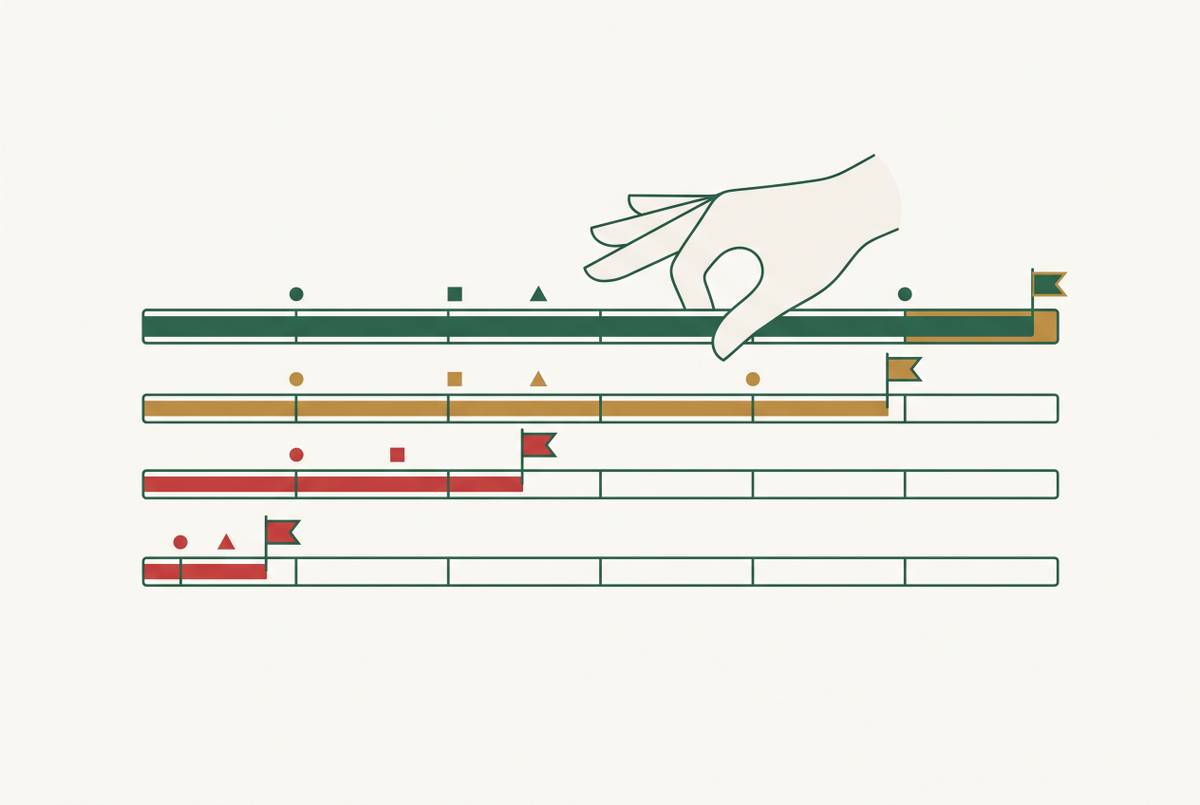
A simple three-tier read helps make sense of where a student stands. A student scoring consistently above roughly 75% across all units is tracking toward a 4 or a 5. A student sitting in the middle range, clear of the danger zone but below the on-track threshold, is likely tracking toward a 3, with real risk of slipping to a 2 if a particularly weak unit happens to show up on exam day. A student scoring consistently below that middle range is dealing with something structural, a prerequisite gap, a pacing problem, or a comprehension breakdown that will not resolve itself without a deliberate intervention.
What makes this data tricky to act on is that the weak spot on the surface is rarely the actual problem. A student who keeps missing questions in a specific AP Physics unit may not have a physics problem at all. The real issue might be a missing algebra skill from years earlier, and treating the physics unit as the thing to re-teach produces the wrong fix entirely.
This is where the question for parents shifts from "how is my student doing" to "what kind of help actually diagnoses the real gap." Static practice books can tell a student what they got wrong. The more useful tools identify why an answer was wrong and trace it back to its root cause, which turns a vague instruction like "review Chapter 7" into something far more precise: rebuild the underlying concept that chapter depends on. When evaluating any prep resource, the right question to ask is whether it explains the reasoning behind an error or just tallies a score.
The winter-to-spring intensive phase: what a realistic 12-to-16-week prep arc looks like
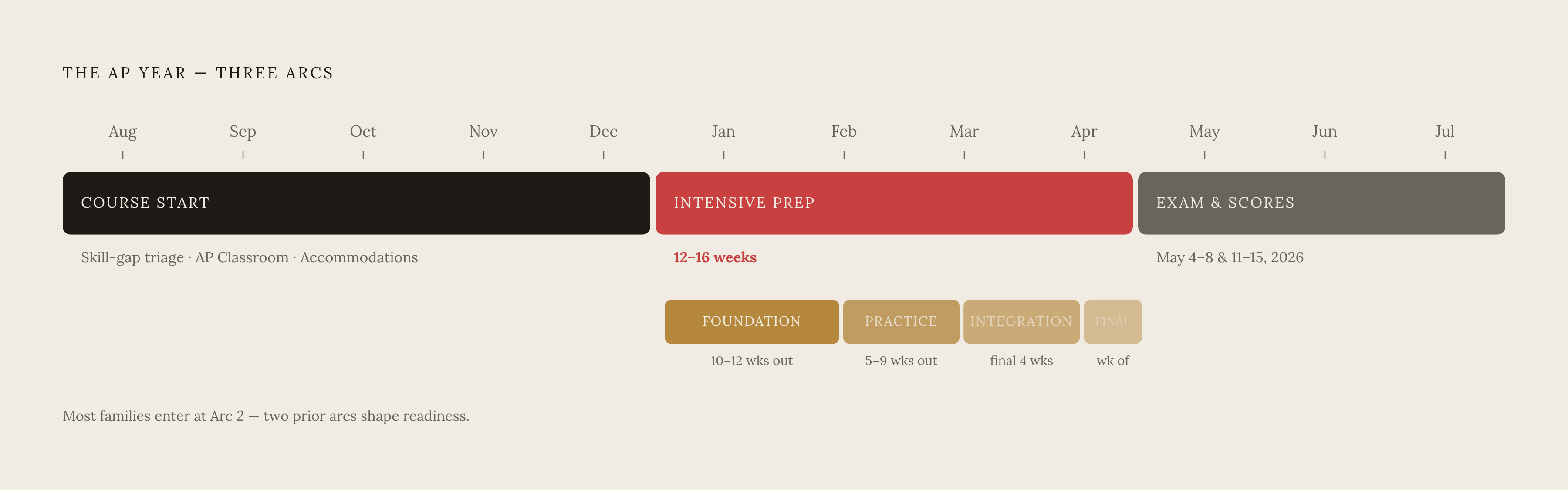
Serious, exam-style preparation usually kicks off sometime between January and April, once the course has covered most of its content. The most effective version of this phase is cumulative, building week over week. A four-phase structure maps cleanly onto the 12 to 16 weeks most families have before the May exams.
Foundation phase, 10 to 12 weeks out, is about diagnostic testing and gap identification, not content review. The goal is a clear map of what needs attention before deciding how to spend the weeks that follow.
Practice phase, 5 to 9 weeks out, shifts the work to timed section practice and free-response question writing, moving a student from simply recognizing material to performing under real time pressure.
Integration phase, the final 4 weeks, is full timed practice exams and targeted reinforcement of whatever weak areas remain. A useful rule of thumb: aim to finish core content by March, so April is free for practice exams rather than new material.
Final week brings a brief review, a check of any devices needed for a digital exam, and logistics confirmation. This is not the week to introduce anything new.
The 2026 AP Exams run across two weeks, May 4 through 8 and May 11 through 15, and the smart move is to work backward from a student's specific exam dates so each of these four phases lands on real calendar weeks rather than vague estimates.
Format matters here too. Students taking exams in 2025 reported that practice through the Bluebook digital testing app didn't fully prepare them for the nuance, length, and complexity of the actual test. For anyone taking a digital or hybrid exam, downloading Bluebook and running through full practice previews inside the app is part of the baseline prep.
For families anchoring their calendar to specific subjects, here's the week-by-week breakdown. Week 1 morning sessions, starting at 8 a.m., run Biology and Latin on May 4; Chemistry and Human Geography on May 6; English Literature and Composition also on May 6; Physics 2 Algebra-Based and World History: Modern on May 7; and Italian Language and Culture along with United States History on May 8. Week 1 afternoon sessions, starting at noon, cover European History and Microeconomics on May 4; United States Government and Politics on May 5; African American Studies and Chemistry on May 6; African American Studies and Statistics on May 7; and Chinese Language and Culture with Macroeconomics on May 8.
Week 2 morning sessions open with Calculus AB and Calculus BC on May 11; French Language and Culture and Precalculus on May 12; English Language and Composition and German Language on May 13; Art History and Spanish Language and Culture on May 14; and Environmental Science on May 15. Week 2 afternoon sessions run Music Theory and Seminar on May 11; Japanese Language and Culture and Psychology on May 12; Physics C: Mechanics and Spanish Literature on May 13; Computer Science Principles and Physics C: Electricity and Magnetism on May 14; and Computer Science A on May 15.
A few deadlines sit outside the standard exam window and deserve their own spot on the calendar. AP Seminar and AP Research performance tasks, along with AP Computer Science Principles Create tasks, are due April 30, 2026, by 11:59 p.m. Eastern. AP Art and Design portfolios are due May 8, 2026, by 8 p.m. Eastern. And the late testing window, for anyone who needs it, runs May 18 through 22, 2026.
Free-response questions are where most students lose points in practice, more often than on multiple choice. Feedback that scores a response against the actual AP rubric and points to exactly where credit was lost gives a student something a teacher's grading turnaround usually can't: fast, specific correction while there's still time to fix the pattern before exam day.
Three warning signs that a student needs more support than the classroom alone is providing
Most families who end up in triage mode in late April could have stepped in back in February, if they'd known what signs to watch for. The warning signs appear in progress check data and free-response scores weeks before the crisis does, not only in hindsight.
The first sign is a progress check pattern that sits consistently below 60%, as a sustained pattern across multiple units rather than a one-time dip after a rough week. That kind of consistency points to a structural gap rather than a bad stretch, and it's unlikely to close on its own.
The second sign appears in free-response work, where a student earns little to no credit on these questions repeatedly, even while feeling like they understand the material. That gap between felt understanding and scored performance rarely closes without direct feedback on what the rubric is actually rewarding.
The third sign is behavioral rather than numerical: avoidance around a specific subject. Skipping practice tests, pushing study sessions off with "I'll do it this weekend," or insisting that one particular AP "doesn't matter" is frequently a stress response to confusion the student hasn't named yet, even to themselves.
The role parents play at this stage is to notice the pattern, name it calmly, and help the student find the right resource, whether that's a teacher's office hours, a study group, or a prep tool built to catch exactly this kind of gap, rather than to re-teach calculus or rewrite a history essay. Catching it in February is a far easier conversation than catching it in April.
Sources
- Annual AP Timeline: From Course Kickoff to Exam Day to Score Release — A Parent’s Roadmap - Sparkl
- 2026 AP Exams: Everything You Need to Know - Top Tier Admissions
- How to Support your AP Student in 2026: A Step-by-Step Guide That Actually Works
- AP Exam Dates 2026: Complete Schedule and Key Deadlines
- test-ninjas.com
- plusplustutors.com
- mindzq.com
- usnews.com